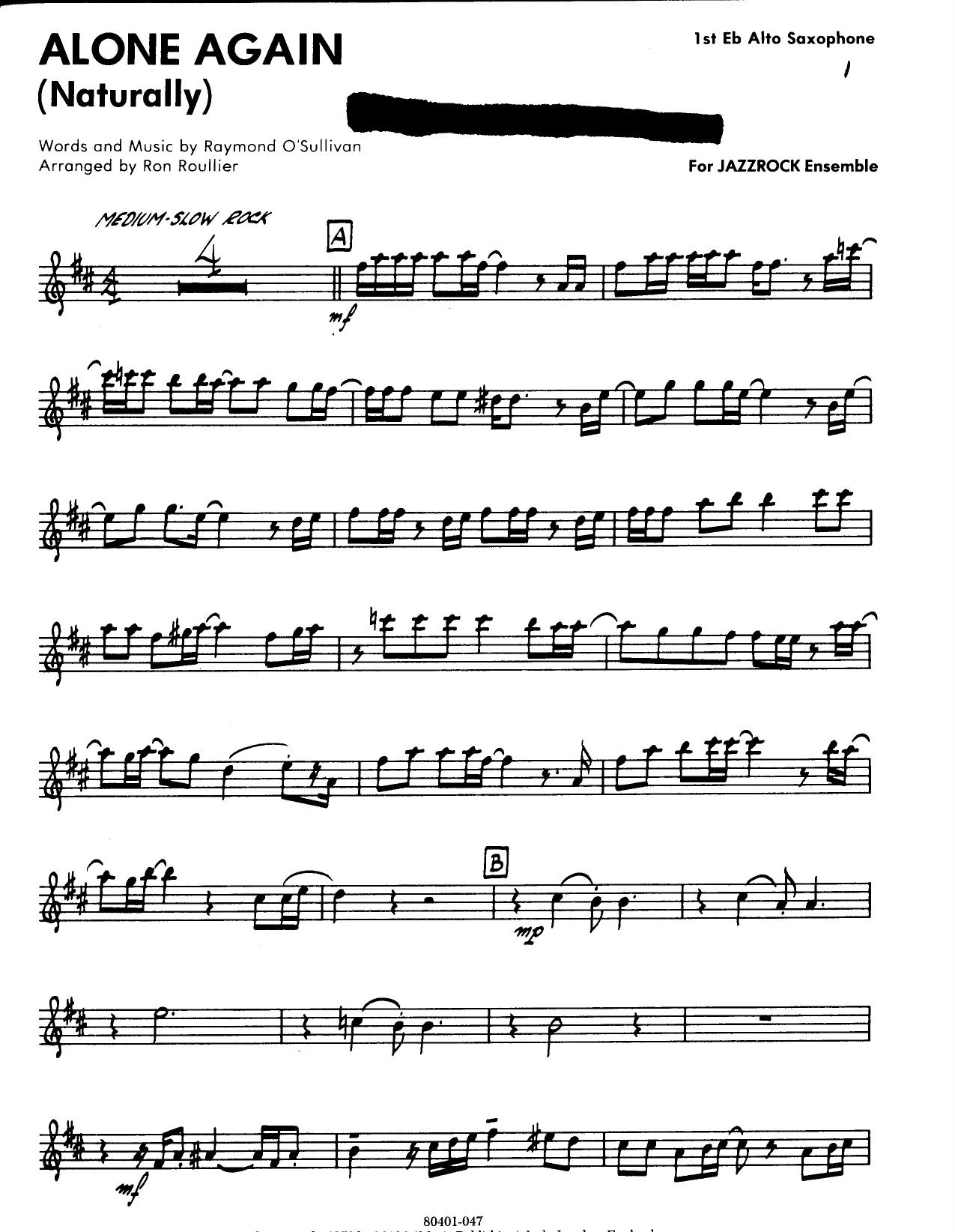
Alone Again (R.Rouillier)
Composed by R. Rouillier
Arranged by R.Rouillier
- Ensemble: Big Band
- Pages: 34
- Instruments (16): 1st Eb Alto Saxophone, 2nd Eb Alto Saxophone, 1st Bb Tenor Saxophone, 2nd Bb Tenor Saxophone, Eb Baritone Saxophone, 1st Bb Trumpet, 2nd Bb Trumpet, 3rd Bb Trumpet, 4th Bb Trumpet, 1st Trombone, 2nd Trombone, 3rd Trombone, Bass Trombone, Piano, Bass Guitar, Drums
- Difficulty: medium
- Content: Individual Parts
- Format: PDF Download (Instant)
- Price: $24.99
Capturing the sophisticated essence of modern contemporary jazz composition, "Alone Again," conceived and meticulously arranged by R. Rouillier, stands as a compelling showcase for full big band instrumentation. Rooted in the rich lineage of mid-century modal jazz and contemporary European large-ensemble writing, the work bridges lyrical introspection with driving, harmonically dense grooves. Rouillier’s compositional voice draws upon the textural expansiveness of arrangers like Bob Mintzer and Bill Holman, while maintaining an intimate melodic narrative that immediately engages both the listener and the performing ensemble. Stylistically anchored in a smoldering, expansive medium-slow groove with intricate rubato interludes, the piece establishes a moody, reflective atmosphere from its opening harmonic statement. The composition opens with a lush, harmonically suspended chordal intro featuring flugelhorns and muted trombones, before settling into a hypnotic, shifting metric foundation. Rouillier utilizes modal interchange and extended upper-structure triads to create a bittersweet emotional landscape—balancing melancholic, serpentine melody lines with sudden bursts of fierce, brass-heavy optimism. The dynamic contour shifts seamlessly from delicate, whisper-quiet subtones in the reed section to roaring, block-chord tuttis that demand absolute precision and blend. The structural architecture of the arrangement places heavy emphasis on coloristic contrast and sectional interplay. The primary melody is initially introduced by a solo alto saxophone, underscored by shimmering voicings in the low reeds and a pulsing bass line, before expanding into a rich, full-ensemble sax soli that highlights Rouillier’s penchant for fluid, linear counterpoint. A striking modal vamp opens the floor for a soaring, emotionally charged tenor saxophone or guitar solo, built over an evolving harmonic matrix that challenges the soloist to navigate sophisticated alterations. The climax arrives in the form of a sweeping shout chorus, where high-register brass stabs lock against a cascading woodwind figure, driving the ensemble toward a breathtaking, suspenseful resolution that fades back into the tranquil nocturnal mood of the opening bars. Advanced high school ensembles with strong section leaders, as well as collegiate and professional jazz orchestras, will find this chart an immensely rewarding addition to their repertoire. While the individual technical demands for brass and woodwinds require solid control of range and intonation—particularly concerning the dense, contemporary chord voicings—the true pedagogical and artistic value lies in cultivating deep sectional listening, cohesive blend, and sophisticated phrasing. "Alone Again" offers a masterclass in modern big band balance, making it an ideal centerpiece for festival programs or sophisticated concert sets. Conductors approaching R. Rouillier’s "Alone Again" should prioritize textural clarity and dynamic restraint, particularly during the dense harmonic shifts of the introduction and transitions. The rhythm section serves as the heartbeat of the chart; the drummer must maintain an elastic, highly interactive feel that supports the rubato-like phrasing of the melody without locking into a rigid, mechanical swing pattern. Bassists should anchor the complex upper-structure chords with clear, resonant acoustic or amplified tones, treating their lines as a secondary melodic voice. Technically, the brass section must exercise extreme discipline with intonation on altered dominants and extended chords. Trumpets should utilize cup mutes or harmon mutes where indicated to achieve the desired breathy, intimate timbre, reserving open bell work for the powerful punctuation of the shout chorus. Saxophones need to focus on seamless blend during the intricate soli passages, ensuring that vibrato is matched across the section. Rehearsals should begin by isolating the rhythm section and lead horn lines to lock in the shifting time feels before merging the full ensemble. Q: What instruments and parts are included in this publication? A: The complete 34-page set includes a full conductor score and parts for a standard 16-instrument big band: Alto Saxophone 1, Alto Saxophone 2, Tenor Saxophone 1, Tenor Saxophone 2, Baritone Saxophone, 4 Trumpets, 4 Trombones, Piano, Guitar, Bass, and Drums. Q: What is the difficulty level of this arrangement? A: This arrangement is graded as advanced, suited for top-tier high school bands, collegiate jazz orchestras, and professional big bands due to its sophisticated extended harmonies, subtle tempo nuances, and technical demands on soloists. Q: What is the musical style and historical background of the piece? A: Written by R. Rouillier, the piece reflects a contemporary jazz idiom influenced by modal harmony and modern large-ensemble writing, balancing introspective ballad-like moments with driving, harmonically rich grooves. Q: What makes R. Rouillier's arrangement unique? A: The arrangement stands out for its distinctive use of modal interchange, lush chord voicings reminiscent of modern European jazz, and a striking structural contrast between intimate sectional solos and explosive brass-heavy shout choruses. Q: What is the approximate performance duration and tempo feel? A: The piece runs approximately 5 to 6 minutes in length and is anchored by an expansive, flexible medium-slow groove that requires careful attention to rubato pacing and elastic time feel.
Questions and answers
- What is included in the Alone Again (R.Rouillier) PDF?
- The verified current file contains a conductor score and individual parts across 34 pages.
- How many instruments or parts are listed for Alone Again (R.Rouillier)?
- The verified instrumentation list contains 16 entries for this Big Band arrangement.
- Who is credited for Alone Again (R.Rouillier)?
- Composer: R. Rouillier. Arranger: R.Rouillier.
- What difficulty is listed for Alone Again (R.Rouillier)?
- The verified difficulty level is medium.
- Can I preview Alone Again (R.Rouillier) before buying?
- Yes. The product page provides a preview generated from the current PDF file.
- How is Alone Again (R.Rouillier) delivered?
- After successful payment, the digital PDF is made available for download. The displayed price is $24.99.
Musicians Also Search For
Alone Again R.Rouillier PDF • Alone Again R.Rouillier sheet music • Alone Again arranged by R.Rouillier • R.Rouillier big band charts • R.Rouillier jazz arrangements PDF • Alone Again R. Rouillier sheet music • Alone Again R. Rouillier big band arrangements • R. Rouillier big band charts • Alone Again big band arrangements • Alone Again big band PDF download • Alone Again jazz sheet music • big band sheet music download • Alone Again conductor score PDF • Alone Again individual parts download • Alone Again sheet music PDF • buy Alone Again sheet music • download Alone Again PDF • Alone Again jazz charts • best R.Rouillier big band arrangements • R. Rouillier arranged by R.Rouillier • Alone Again printable sheet music • big band repertoire PDF