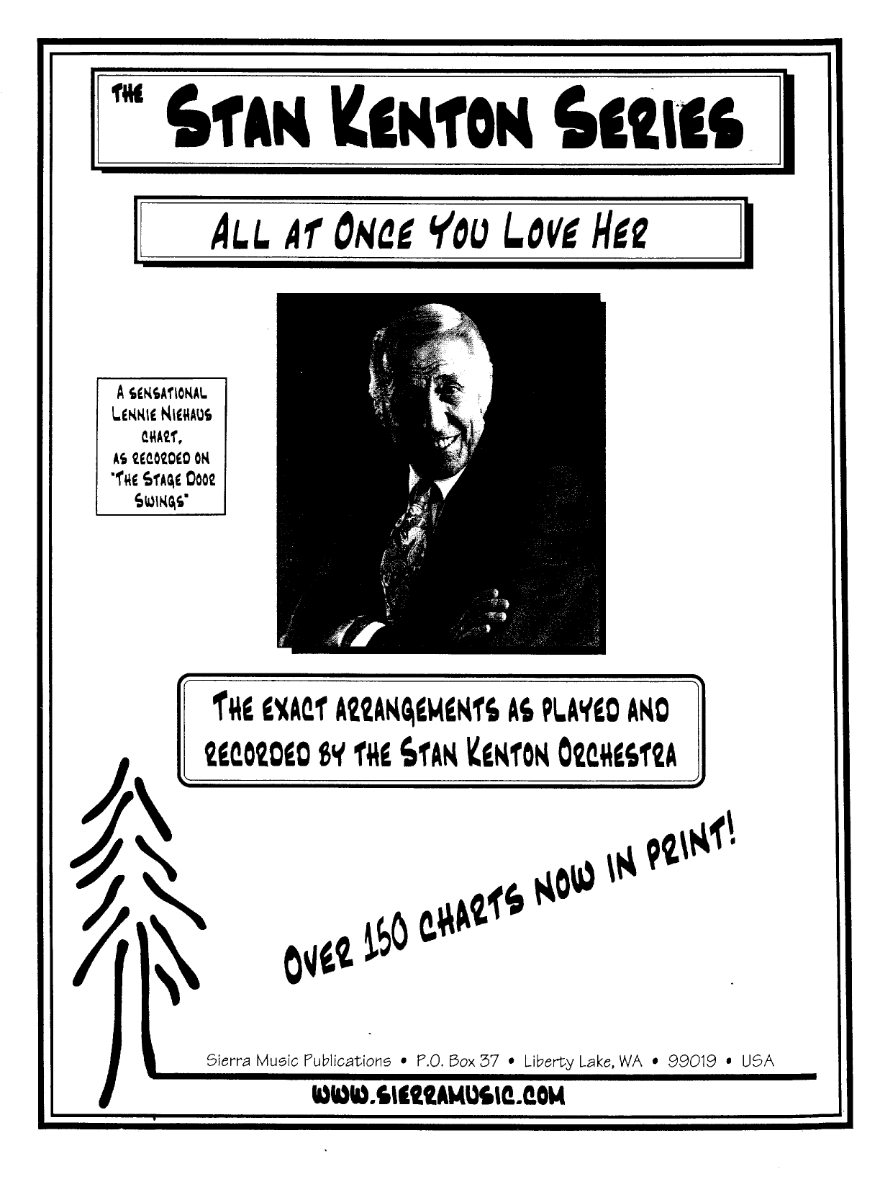
All At Once You Love Her (L.Niehaus) sheet music preview

All At Once You Love Her (L.Niehaus)

Composed by Richard Rodgers

Arranged by Lennie Niehaus

  • Ensemble: Big Band
  • Pages: 77
  • Instruments (18): Alto Saxophone 1, Alto Saxophone 2, Tenor Saxophone 1 (Solo), Tenor Saxophone 2, Baritone Saxophone, Trumpet 1, Trumpet 2, Trumpet 3, Trumpet 4, Trumpet 5, Trombone 1, Trombone 2, Trombone 3, Trombone 4, Bass Trombone 5, Piano, Bass (Solo), Drums
  • Difficulty: advanced
  • Content: Individual Parts
  • Format: PDF Download (Instant)
  • Price: $24.99

Richard Rodgers and Oscar Hammerstein II originally introduced "All At Once You Love Her" in their 1955 Broadway musical *Pipe Dream*. While the stage production itself had a modest run, the score's sophisticated melodies immediately caught the attention of jazz instrumentalists and vocalists alike. Jazz icons quickly recognized the inherent harmonic depth and lyrical contour of the composition, transforming it into a cherished vehicle for sophisticated small-group and large-ensemble interpretation. The song captures the quintessential mid-1950s Broadway-to-jazz crossover aesthetic, bridging lush, romantic traditional theater writing with the advanced harmonic language of post-war jazz. Lennie Niehaus approaches this timeless standard through a distinctly West Coast lens, balancing rich, translucent harmonic voicings with a relaxed yet driving medium swing feel. Known for his pristine counterpoint and transparent section writing honed during his years playing alto saxophone and arranging for the Stan Kenton Orchestra, Niehaus treats the melody with deep reverence while infusing the chart with clever internal movement. The arrangement opens with an evocative, atmospheric introduction that sets a contemplative mood before settling into an infectious, buoyant medium tempo. The emotional trajectory shifts seamlessly from introspective, lyrical phrasing to warm, swinging ensemble interplay, evoking the sophisticated atmosphere of a West Coast jazz club. The structural architecture of the chart showcases Niehaus’s mastery of big band coloring. Tenor Saxophone 1 takes center stage as the primary featured soloist, navigating changes that highlight the instrument's rich, breathy register against subtle, harmonically rich background figures from the brass. The sax section enjoys several lush, interlocking soli passages that demand pristine intonation, nimble fingerwork, and a unified articulation style. The brass writing relies on crisp, economical voicings rather than dense, overblown walls of sound, allowing the inner voices and moving basslines to remain completely transparent. The ensemble dynamics build organically toward a tastefully restrained shout chorus that reinterprets the main motif with clever rhythmic displacement before winding down to a tranquil, exquisitely voiced final chord. Advanced high school, collegiate, and professional jazz ensembles will find this arrangement to be an ideal showcase for developing stylistic maturity, balance, and section blend. Because the chart relies heavily on subtle dynamic control, stylistic uniformity, and clean execution rather than blistering, high-note pyrotechnics, it offers an exceptional educational vehicle for teaching ensemble listening skills. Working musicians will appreciate how naturally the chart sits on the instruments, rewarding meticulous attention to articulation, phrasing, and swing subdivision with a timeless, sophisticated sound that consistently captivates audiences. Achieving the authentic West Coast cool aesthetic in this arrangement requires strict attention to a relaxed, forward-moving medium swing feel, avoiding any tendency to rush the quarter-note pulse. The rhythm section should anchor the groove with a feather-light ride cymbal pattern and an understated, walking acoustic bass line that prioritizes clarity over volume. For the woodwinds, intricate soli passages demand absolute synchronization of articulation; short notes must be crisp without being clipped, and longer tones require a sustained, warm vibrato that matches across the section. The featured Tenor Saxophone soloist should approach the changes with a lyrical, melodic mindset, building tension gradually through the form rather than relying on rapid-fire scalar runs. Conductors must carefully monitor the dynamic balance between the brass backgrounds and the featured tenor solo, ensuring the underlying harmonies support the soloist without ever masking the melodic line. Rehearsal time should be dedicated to isolating the inner moving voices in the saxophones to ensure the countermelodies speak clearly through the texture. Q: What instruments and parts are included in this big band arrangement? A: This 18-instrument arrangement includes a full standard big band instrumentation featuring Alto Saxophone 1, Alto Saxophone 2, Tenor Saxophone 1 (with featured solo), Tenor Saxophone 2, Baritone Saxophone, a complete brass section, and a full rhythm section, accompanied by a comprehensive conductor score across its 77 pages. Q: What is the difficulty level of this Lennie Niehaus chart? A: This arrangement is well-suited for advanced high school, collegiate, and professional jazz ensembles, focusing heavily on ensemble blend, intonation, and stylistic subtlety rather than extreme technical pyrotechnics or high-register endurance. Q: What is the musical style and historical background of the piece? A: Composed originally by Richard Rodgers for the 1955 Broadway musical *Pipe Dream*, this piece is set here as a sophisticated medium swing jazz standard arranged in the signature, transparent West Coast style of Lennie Niehaus. Q: What makes this specific arrangement unique within a big band library? A: Niehaus's distinct approach features pristine counterpoint, transparent West Coast-style voicings, and an interlocking saxophone soli that treats the classic Broadway melody with both harmonic richness and modern jazz elegance. Q: What is the performance duration and tempo feel of the arrangement? A: The arrangement is written in a comfortable 4/4 meter with a relaxed, driving medium swing feel, designed to run approximately 4 to 5 minutes depending on the length of the featured tenor saxophone solo and chosen tempo.

Questions and answers

What is included in the All At Once You Love Her (L.Niehaus) PDF?
The verified current file contains a conductor score and individual parts across 77 pages.
How many instruments or parts are listed for All At Once You Love Her (L.Niehaus)?
The verified instrumentation list contains 18 entries for this Big Band arrangement.
Who is credited for All At Once You Love Her (L.Niehaus)?
Composer: Richard Rodgers. Arranger: Lennie Niehaus.
What difficulty is listed for All At Once You Love Her (L.Niehaus)?
The verified difficulty level is advanced.
Can I preview All At Once You Love Her (L.Niehaus) before buying?
Yes. The product page provides a preview generated from the current PDF file.
How is All At Once You Love Her (L.Niehaus) delivered?
After successful payment, the digital PDF is made available for download. The displayed price is $24.99.

Musicians Also Search For

All At Once You Love Her Lennie Niehaus PDFAll At Once You Love Her Lennie Niehaus sheet musicAll At Once You Love Her arranged by Lennie NiehausLennie Niehaus big band chartsLennie Niehaus jazz arrangements PDFAll At Once You Love Her Richard Rodgers sheet musicAll At Once You Love Her Richard Rodgers big band arrangementsRichard Rodgers big band chartsAll At Once You Love Her big band arrangementsAll At Once You Love Her big band PDF downloadAll At Once You Love Her jazz sheet musicbig band sheet music downloadAll At Once You Love Her conductor score PDFAll At Once You Love Her individual parts downloadAll At Once You Love Her sheet music PDFbuy All At Once You Love Her sheet musicdownload All At Once You Love Her PDFAll At Once You Love Her jazz chartsbest Lennie Niehaus big band arrangementsRichard Rodgers arranged by Lennie NiehausAll At Once You Love Her printable sheet musicbig band repertoire PDF

All arrangements by Lennie Niehaus All Richard Rodgers sheet music