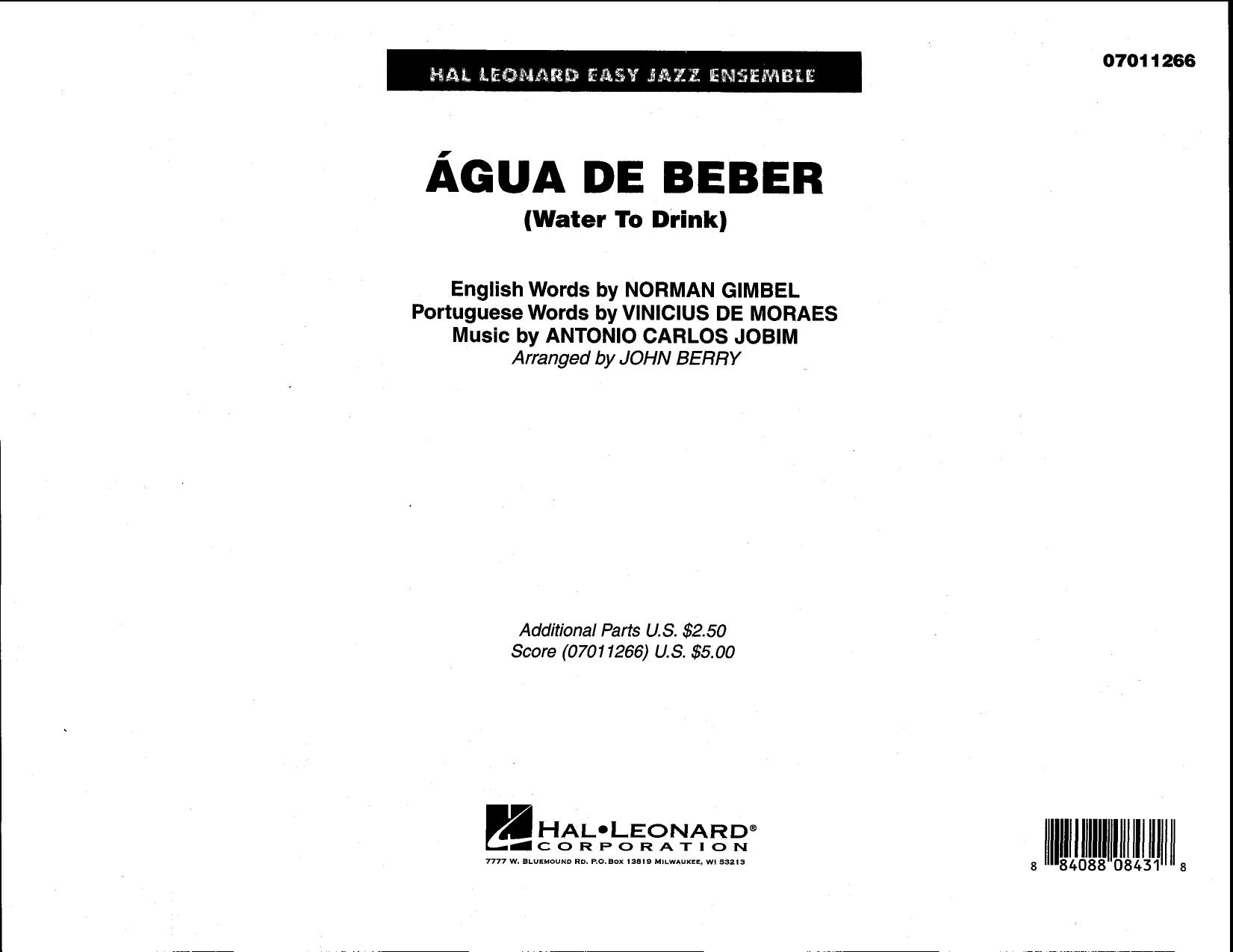
Agua De Beber (J.Berry)
Composed by Antonio Carlos Jobim
Arranged by John Berry
- Ensemble: Big Band
- Pages: 47
- Instruments (18): Alto Sax 1, Alto Sax 2, Tenor Sax 1, Tenor Sax 2, Baritone Sax, Trumpet 1, Trumpet 2, Trumpet 3, Trumpet 4, Trombone 1, Trombone 2, Trombone 3, Trombone 4, Bass, Drums, Aux. Percussion, Piano, Guitar
- Difficulty: medium
- Content: Individual Parts
- Format: PDF Download (Instant)
- Price: $24.99
Antonio Carlos Jobim and Vinícius de Moraes gifted the world an enduring masterpiece of the bossa nova canon when they penned "Água de Beber" in the early 1960s. Immortalized by landmark recordings featuring Jobim, João Gilberto, and later crossover icons like Frank Sinatra and Astrud Gilberto, the tune stands as a quintessential pillar of the Brazilian jazz movement. It bridges the sophisticated harmonic language of 20th-century art song with the hypnotic, syncopated street rhythms of Rio de Janeiro. This composition represents the golden era of bossa nova, capturing a breezy, sun-drenched euphoria blended with a subtle, sophisticated melancholy that continues to define the global jazz vocabulary. John Berry’s masterwork for big band translates the intimate, acoustic ambience of a bossa nova combo into a lush, dynamic orchestral canvas without sacrificing the genre's characteristic laid-back pulse. Anchored by a steady, infectious samba-bossa groove in 4/4 time, the arrangement balances transparent, breezy ensemble textures with full-throated harmonic swells. The mood shifts effortlessly from playful, cascading woodwind lines to warm, harmon-muted brass statements, evoking the warmth of a Copacabana sunset. Berry avoids heavy-handed percussion clichés, instead allowing the rhythm section to drive an authentic, undulating percussion bed over which the horns weave intricate countermelodies and rich, extended-chord voicings. The arrangement opens with a signature rhythm section vamp that establishes the authentic bossa feel before the saxophones introduce the iconic, serpentine melody. Berry distributes thematic material thoughtfully across the ensemble, featuring a lush reed soli that highlights the blend of the two altos and tenors, underpinned by a warm baritone anchor. Brass sections are utilized judiciously; rather than relying on constant, bombastic shout choruses, Berry crafts dynamic peaks through clever counterpoint, subtle dynamic shifts, and soaring trumpet lines that float gracefully above the heavy rhythmic pulse. Flexibility is built into the chart to showcase a featured soloist, allowing either a tenor saxophonist or a lead guitarist to stretch out over standard bossa changes while the ensemble provides a supportive, breathing cushion of sound. Advanced high school, collegiate, and community big bands will find this chart an ideal vehicle for developing stylistic versatility, light articulation, and nuanced dynamic control. While the technical demands on individual players are moderate—avoiding extreme altissimo ranges or breakneck tempos—the true challenge lies in the stylistic execution: maintaining an unhurried, floating feel while executing crisp, synchronized syncopations. Conductor and ensemble alike will find immense satisfaction in mastering the subtle harmonic turnarounds and rich voicings, making it a standout selection for festival programs, spring concerts, or sophisticated club dates. The primary technical challenge in performing John Berry's arrangement of "Água de Beber" lies in mastering the delicate balance between rhythmic precision and a relaxed, unhurried bossa nova feel. Conductor and rhythm section must work together to establish a steady, conversational groove that never drags or rushes. Drummers should utilize a crisp cross-stick pattern on the snare with an authentic bossa nova bass drum footprint, avoiding heavy rock backbeats. For the horn sections, articulation is paramount. Eighth-note lines should be played with a light, non-legato touch, ensuring that syncopated figures land squarely on the backside of the beat to maintain that authentic Brazilian laziness. Brass players should keep vibrato minimal and warm, reserving muted passages for clean, transparent intonation. During ensemble solis, dynamic restraint is critical; the accompaniment must breathe dynamically beneath the melody carriers. Rehearsals should begin by isolating the rhythm section to lock in the groove, followed by sectional balance checks on the inner-voice chord clusters before integrating the full ensemble. Q: What instruments and parts are included in this big band arrangement? A: The 47-page publication includes a full conductor score and individual parts for a standard 18-instrument big band, consisting of 5 saxophones (2 altos, 2 tenors, 1 baritone), 4 trumpets, 4 trombones, guitar, piano, bass, drums, and auxiliary percussion. Q: What is the difficulty level of this arrangement? A: This chart is graded as medium-easy to medium, making it highly accessible for advanced high school, college, and community jazz orchestras looking to expand their stylistic range into Latin and bossa nova repertoire. Q: What is the historical and stylistic background of the piece? A: Composed by Antonio Carlos Jobim with lyrics by Vinícius de Moraes, "Água de Beber" is a cornerstone of the 1960s bossa nova movement, blending cool jazz harmonies with traditional Brazilian samba rhythms. Q: What makes John Berry's arrangement unique? A: Berry successfully scales down the intimate, acoustic aesthetic of a traditional bossa combo into a rich big band setting, utilizing transparent reed solis, clever counterpoint, and tasteful harmonic voicings rather than relying on heavy-handed shout choruses. Q: What is the performance duration and tempo feel of the piece? A: The arrangement runs approximately 3 to 4 minutes and is performed at a moderate, breezy bossa nova tempo (around 120-132 BPM), prioritizing a relaxed, flowing groove over fast technical display.
Questions and answers
- What is included in the Agua De Beber (J.Berry) PDF?
- The verified current file contains a conductor score and individual parts across 47 pages.
- How many instruments or parts are listed for Agua De Beber (J.Berry)?
- The verified instrumentation list contains 18 entries for this Big Band arrangement.
- Who is credited for Agua De Beber (J.Berry)?
- Composer: Antonio Carlos Jobim. Arranger: John Berry.
- What difficulty is listed for Agua De Beber (J.Berry)?
- The verified difficulty level is medium.
- Can I preview Agua De Beber (J.Berry) before buying?
- Yes. The product page provides a preview generated from the current PDF file.
- How is Agua De Beber (J.Berry) delivered?
- After successful payment, the digital PDF is made available for download. The displayed price is $24.99.
Musicians Also Search For
Agua De Beber John Berry PDF • Agua De Beber John Berry sheet music • Agua De Beber arranged by John Berry • John Berry big band charts • John Berry jazz arrangements PDF • Agua De Beber Antonio Carlos Jobim sheet music • Agua De Beber Antonio Carlos Jobim big band arrangements • Antonio Carlos Jobim big band charts • Agua De Beber big band arrangements • Agua De Beber big band PDF download • Agua De Beber jazz sheet music • big band sheet music download • Agua De Beber conductor score PDF • Agua De Beber individual parts download • Agua De Beber sheet music PDF • buy Agua De Beber sheet music • download Agua De Beber PDF • Agua De Beber jazz charts • best John Berry big band arrangements • Antonio Carlos Jobim arranged by John Berry • Agua De Beber printable sheet music • big band repertoire PDF