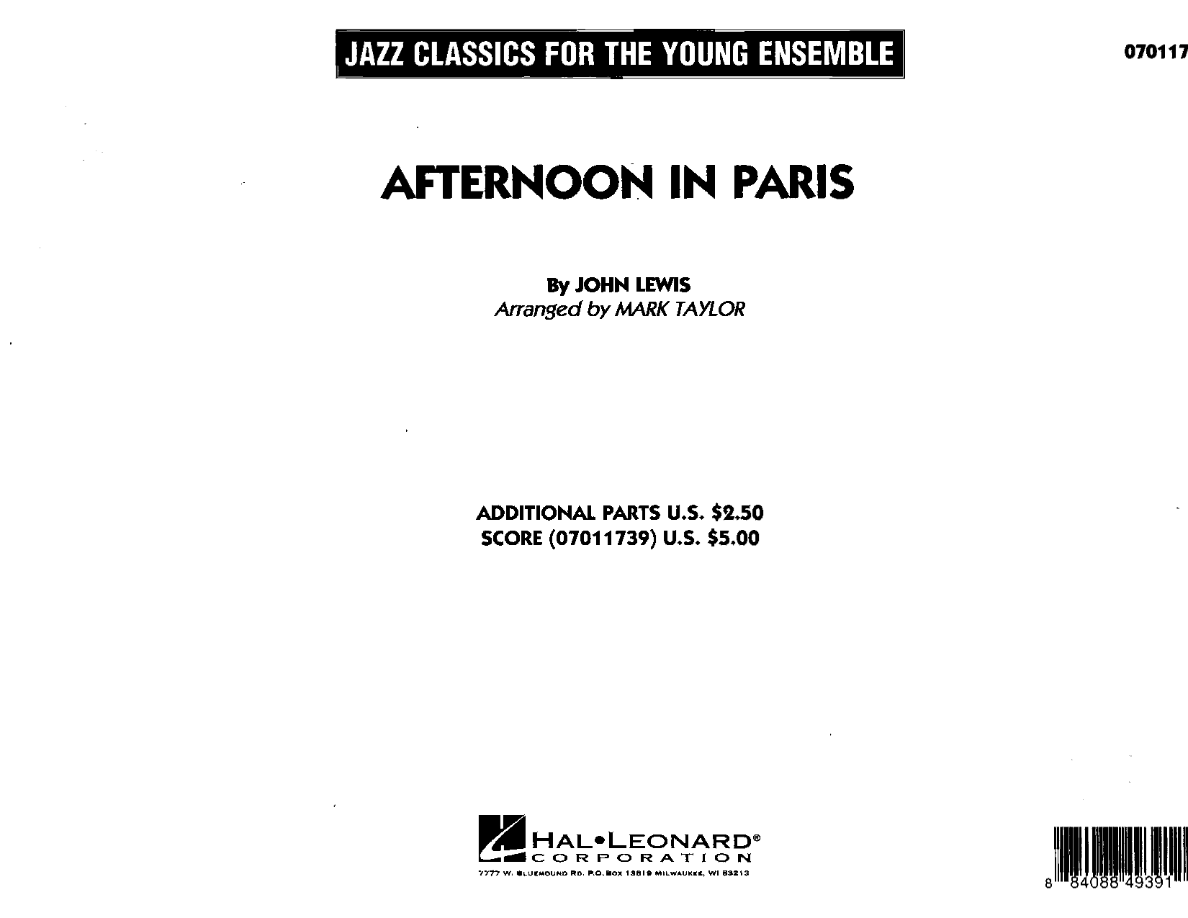
Afternoon In Paris (M.Taylor)
Composed by John Lewis
Arranged by Mark Taylor
- Ensemble: Big Band
- Pages: 62
- Instruments (18): Alto Sax 1, Alto Sax 2, Tenor Sax 1, Tenor Sax 2, Baritone Sax, Trumpet 1, Trumpet 2, Trumpet 3, Trumpet 4, Trombone 1, Trombone 2, Trombone 3, Trombone 4, Guitar, Piano, Bass, Drums, Vibes
- Difficulty: advanced
- Content: Individual Parts
- Format: PDF Download (Instant)
- Price: $24.99
John Lewis penned "Afternoon in Paris" in 1948 during his tenure with the legendary Modern Jazz Quartet, cementing its status as one of the most enduring bebop-era standards built upon the harmonic framework of "All God's Chillun Got Rhythm." This quintessential jazz anthem captures the sophisticated, cool-toned elegance of post-war Parisian jazz culture while retaining the driving, intellectual complexity of American bebop. The composition's seamless blend of contrapuntal lines and accessible yet sophisticated chord changes has made it a favorite vehicle for improvisers across generations, bridging the gap between small-group cool jazz and expansive orchestral writing. Mark Taylor’s masterful big band adaptation translates Lewis’s intimate modal and bop sensibilities into a vibrant, swinging showcase for standard 18-instrument jazz orchestra. Set in a breezy, infectious medium-up swing tempo, the arrangement opens with a crisp, rhythmically engaging introduction that immediately establishes a lighthearted, transatlantic mood. Taylor expertly balances rich, lush saxophone solis with punchy, brass-driven counterlines, evoking the sophisticated atmosphere of a Parisian café afternoon. The harmonic language expands upon the original changes with clever chromatic voice-leading and subtle reharmonizations that keep both performers and listeners thoroughly engaged from the first downbeat to the final chord. Throughout the chart, melody duties are shared dynamically across the woodwind and brass sections, highlighted by a tightly-knit saxophone soli that demands immaculate blend, articulation, and stylistic uniformity. Flexible solo spaces are integrated naturally into the form, allowing featured improvisers on tenor saxophone or trumpet to stretch out over standard blues-infused bebop changes. The arrangement builds toward a jubilant, harmonically rich shout chorus that utilizes full-ensemble interlocking rhythms without ever sounding overly dense or congested. The underlying swing feel requires precision from the rhythm section, particularly the ride cymbal and hi-hat interplay, to maintain the buoyant, forward-driving momentum characteristic of Taylor's writing style. Advanced high school, collegiate, and professional community big bands will find this chart an ideal centerpiece for festival programs or club performances. While the technical demands require proficient section playing and agile soloists, the intuitive phrasing and logical structural arc make it remarkably rewarding to rehearse. Directors will appreciate how effectively the 62-page conductor score maps out the dynamic contours and textural shifts, ensuring that ensembles can easily dial in the subtle stylistic nuances required to bring this classic jazz standard to life. Achieving success with Mark Taylor’s chart requires strict attention to a consistent, buoyant medium-swing feel, avoiding any tendency to rush the tempo. The primary technical challenge lies in the execution of the intricate saxophone soli; players must prioritize light, articulation-driven eighth-note phrasing rather than heavy tongue-strokes to preserve the buoyant Parisian aesthetic. Brass players should approach dynamic markings with restraint during background figures, ensuring the melody always projects clearly above the ensemble texture. The rhythm section functions as the engine of the performance, with the drummer maintaining a crisp, driving ride-cymbal pattern while the bassist walks a steady, acoustic-sounding quarter-note line that anchors the sophisticated harmonies. Rehearsals should initially isolate the rhythm section and horns on the tricky transitional modulations before attempting full-ensemble runs, paying close attention to clean cut-offs and unified release points on accented syncopations. Q: What instruments and parts are included in this big band arrangement? A: The 62-page package includes a full conductor score and complete parts for an 18-instrument standard big band instrumentation: 2 alto saxophones, 2 tenor saxophones, 1 baritone saxophone, 4 trumpets, 4 trombones, piano, guitar, bass, and drums. Q: What is the difficulty level of this Mark Taylor arrangement? A: This chart is graded as medium-advanced, making it well-suited for accomplished high school ensembles, university jazz bands, and professional community big bands looking for sophisticated bebop repertoire. Q: What is the historical style and background of "Afternoon in Paris"? A: Originally composed by John Lewis in 1948, the piece is a foundational bebop-era standard based on the chord changes of "All God's Chillun Got Rhythm," representing the sophisticated intersection of cool jazz and bebop. Q: What makes this specific arrangement by Mark Taylor unique? A: Taylor’s treatment stands out through its brilliant balance of lush, contrapuntal saxophone solis, clever harmonic reharmonizations, and a jubilant shout chorus that captures a breezy, mid-century Parisian atmosphere. Q: What is the recommended performance tempo and duration for this piece? A: The arrangement is designed for a brisk, medium-up swing tempo (approximately quarter note = 160–172 BPM), resulting in a performance duration of roughly 4 to 5 minutes depending on solo choruses.
Questions and answers
- What is included in the Afternoon In Paris (M.Taylor) PDF?
- The verified current file contains a conductor score and individual parts across 62 pages.
- How many instruments or parts are listed for Afternoon In Paris (M.Taylor)?
- The verified instrumentation list contains 18 entries for this Big Band arrangement.
- Who is credited for Afternoon In Paris (M.Taylor)?
- Composer: John Lewis. Arranger: Mark Taylor.
- What difficulty is listed for Afternoon In Paris (M.Taylor)?
- The verified difficulty level is advanced.
- Can I preview Afternoon In Paris (M.Taylor) before buying?
- Yes. The product page provides a preview generated from the current PDF file.
- How is Afternoon In Paris (M.Taylor) delivered?
- After successful payment, the digital PDF is made available for download. The displayed price is $24.99.
Musicians Also Search For
Afternoon In Paris Mark Taylor PDF • Afternoon In Paris Mark Taylor sheet music • Afternoon In Paris arranged by Mark Taylor • Mark Taylor big band charts • Mark Taylor jazz arrangements PDF • Afternoon In Paris John Lewis sheet music • Afternoon In Paris John Lewis big band arrangements • John Lewis big band charts • Afternoon In Paris big band arrangements • Afternoon In Paris big band PDF download • Afternoon In Paris jazz sheet music • big band sheet music download • Afternoon In Paris conductor score PDF • Afternoon In Paris individual parts download • Afternoon In Paris sheet music PDF • buy Afternoon In Paris sheet music • download Afternoon In Paris PDF • Afternoon In Paris jazz charts • best Mark Taylor big band arrangements • John Lewis arranged by Mark Taylor • Afternoon In Paris printable sheet music • big band repertoire PDF