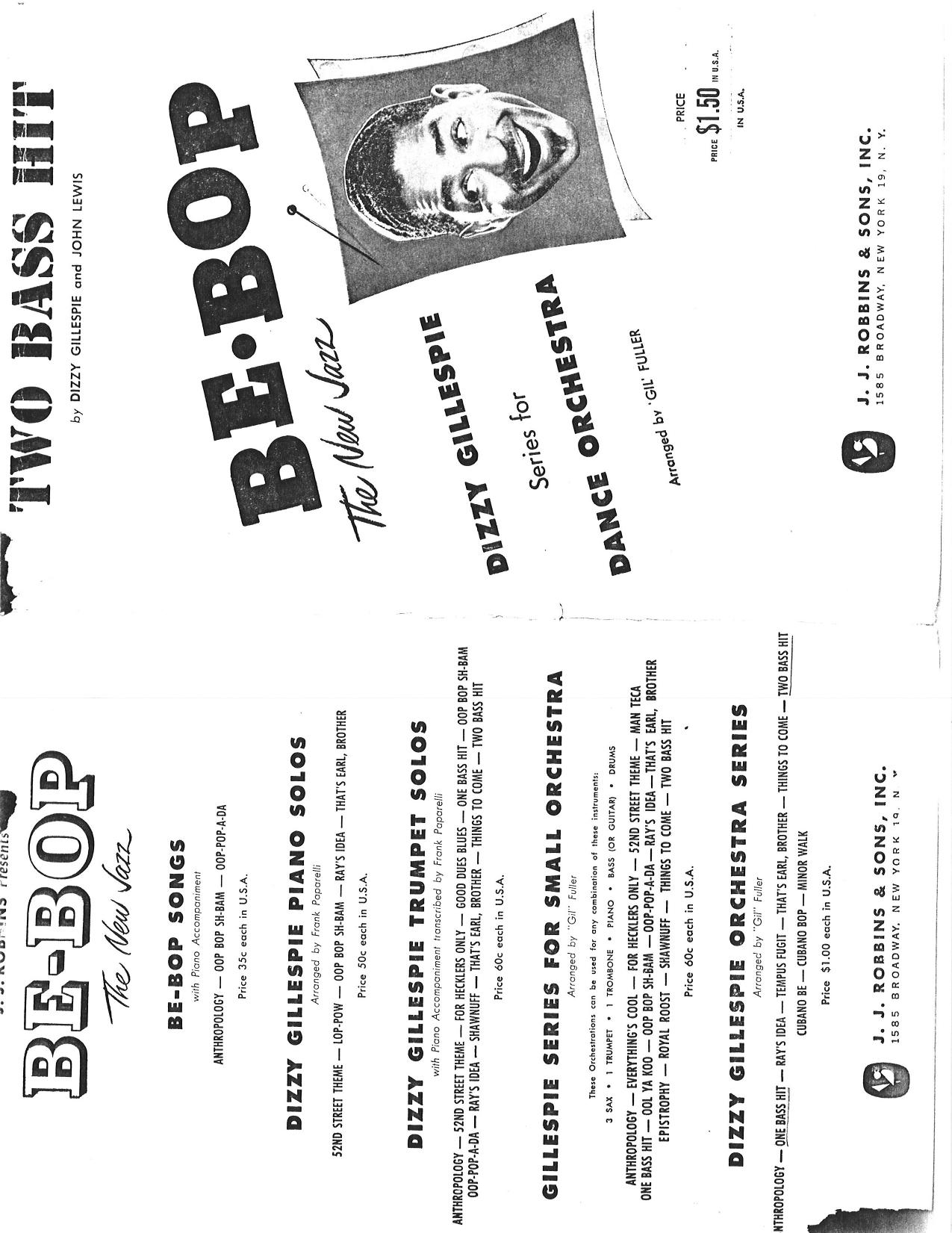
Two Bass Hit (G.Fuller) sheet music preview

Two Bass Hit (G.Fuller)

Composed by John Lewis

Arranged by Gil Fuller-D.GILLESPIE

  • Ensemble: Big Band
  • Pages: 17
  • Instruments (15): 1st Saxophone (Eb Alto), 2nd Saxophone (Bb Tenor), 3rd Saxophone (Eb Alto), 4th Saxophone (Bb Tenor), 5th Saxophone (Eb Baritone), 1st Trumpet in Bb, 2nd Trumpet in Bb, 3rd Trumpet in Bb, 1st Trombone, 2nd Trombone, 3rd Trombone, Guitar, Bass, Piano, Drums
  • Difficulty: easy
  • Content: Individual Parts
  • Format: PDF Download (Instant)
  • Price: $24.99

Originally composed by pianist John Lewis and immortalized during the pioneering bebop era by the legendary Dizzy Gillespie Big Band in their landmark 1947 RCA Victor sessions, "Two Bass Hit" stands as a monumental bridge between small-group harmonic complexity and large-ensemble jazz power. Crafted during a time when critics doubted whether the intricate, fast-moving vocabulary of bebop could successfully transition to a big band setting, this composition shattered expectations. It quickly became a cornerstone of the Gillespie repertoire, celebrated for its driving momentum and sophisticated thematic structure. Driven by an invigorating medium-up swing feel, the chart radiates an energetic, high-octane mood defined by razor-sharp rhythmic unisons and relentless forward motion. The arrangement captures the lightning-in-a-bottle spirit of 1940s modern jazz, evoking the intense excitement of after-hours 52nd Street club performances scaled up for the concert stage. The harmonic framework crackles with tension and release, featuring crisp counterlines and angular bebop head statements that demand absolute rhythmic precision from every section of the ensemble. Arranger Gil Fuller masterfully translates the intricate, linear logic of John Lewis's writing into a vibrant orchestral palette. Fuller’s approach relies on lean, transparent horn voicings that allow agile bebop lines to cut through cleanly without muddying the texture. Rather than employing heavy, wall-of-sound block chords typical of earlier swing eras, Fuller utilizes crisp sax solis, punchy brass interjections, and dynamic shout choruses that highlight the horizontal, linear nature of the composition. His signature technique balances intricate ensemble passages with wide-open spaces for blistering instrumental improvisation. Throughout the chart, the melodic weight is shared dynamically between the saxophones and brass, punctuated by classic bebop shout choruses that build unrelenting tension. Solo opportunities allow featured performers to stretch out over changes that challenge both technical facility and harmonic imagination. The primary technical challenges lie in executing lightning-fast unison lines, maintaining a steady, driving swing tempo without rushing, and articulating syncopated rhythms with punchy, modern phrasing. Conquering these hurdles provides immense satisfaction for musicians seeking an authentic taste of early big band modernism. Advanced collegiate, community, and professional jazz ensembles will find this arrangement an ideal vehicle for showcasing section cohesion and stylistic authenticity. Because of its historical significance and demanding articulation requirements, it serves as a stellar festival centerpiece or a sophisticated program opener that bridges jazz history with high-level ensemble execution. Successfully realizing this arrangement requires meticulous attention to the stylistic nuances of late-1940s bebop. Establish a rock-solid, driving medium-up swing tempo where the ride cymbal and walking bass dictate the pulse; avoid letting the band drag during complex horn unisons. Articulation is paramount: quarter notes in the brass and saxophones should generally be detached and crisp, while eighth-note lines demand a smooth, flowing bop phrasing style with natural accents on the upbeats. Key technical hurdles include navigating the rapid tempo changes and intricate chromatic passing tones embedded within the ensemble solis. Section leaders should run troublesome passages under tempo, ensuring that breath marks and phrasing match across desks before building up to performance speed. While mutes are not strictly required by the standard manuscript, players may incorporate subtle cup or straight mutes in select background figures to add period-authentic textural variety. Rehearsal time should be heavily dedicated to locking in the rhythmic syncopation of the shout choruses, ensuring that dynamic swells never obscure the clarity of the underlying harmonic movement. Q: What instruments and parts are included in this arrangement? A: This set features a full big band instrumentation spanning 17 pages, scored for 2 alto saxophones, 2 tenor saxophones, baritone saxophone, 4 trumpets, 3 trombones, piano, bass, and drums. Q: What is the difficulty level of this chart? A: This arrangement is graded as medium-difficult, primarily due to its fast bebop tempos, complex harmonic structures, and the high degree of rhythmic synchronization required across all sections. Q: What is the historical background and style of "Two Bass Hit"? A: Composed by John Lewis and arranged by Gil Fuller for the Dizzy Gillespie Big Band, this piece is an iconic swing-era bebop composition originally recorded during Gillespie's historic 1947 RCA Victor sessions. Q: What makes this specific Gil Fuller arrangement unique? A: Fuller successfully adapts small-group bebop lines into a large-ensemble format by utilizing transparent horn voicings, linear counterpoint, and crisp shout choruses instead of dense, traditional swing block-chords. Q: What is the approximate performance duration and tempo feel? A: The arrangement is designed to be performed at a driving medium-up swing tempo, typically lasting around 3 minutes depending on the length of the improvised solos taken.

Questions and answers

What is included in the Two Bass Hit (G.Fuller) PDF?
The verified current file contains individual parts across 17 pages.
How many instruments or parts are listed for Two Bass Hit (G.Fuller)?
The verified instrumentation list contains 15 entries for this Big Band arrangement.
Who is credited for Two Bass Hit (G.Fuller)?
Composer: John Lewis. Arranger: Gil Fuller-D.GILLESPIE.
What difficulty is listed for Two Bass Hit (G.Fuller)?
The verified difficulty level is easy.
Can I preview Two Bass Hit (G.Fuller) before buying?
Yes. The product page provides a preview generated from the current PDF file.
How is Two Bass Hit (G.Fuller) delivered?
After successful payment, the digital PDF is made available for download. The displayed price is $24.99.

Musicians Also Search For

Two Bass Hit Gil Fuller-D.GILLESPIE PDFTwo Bass Hit Gil Fuller-D.GILLESPIE sheet musicTwo Bass Hit arranged by Gil Fuller-D.GILLESPIEGil Fuller-D.GILLESPIE big band chartsGil Fuller-D.GILLESPIE jazz arrangements PDFTwo Bass Hit John Lewis sheet musicTwo Bass Hit John Lewis big band arrangementsJohn Lewis big band chartsTwo Bass Hit big band arrangementsTwo Bass Hit big band PDF downloadTwo Bass Hit jazz sheet musicbig band sheet music downloadTwo Bass Hit individual parts downloadTwo Bass Hit sheet music PDFbuy Two Bass Hit sheet musicdownload Two Bass Hit PDFTwo Bass Hit jazz chartsbest Gil Fuller-D.GILLESPIE big band arrangementsJohn Lewis arranged by Gil Fuller-D.GILLESPIETwo Bass Hit printable sheet musicbig band repertoire PDF

All arrangements by Gil Fuller-D.GILLESPIE All John Lewis sheet music