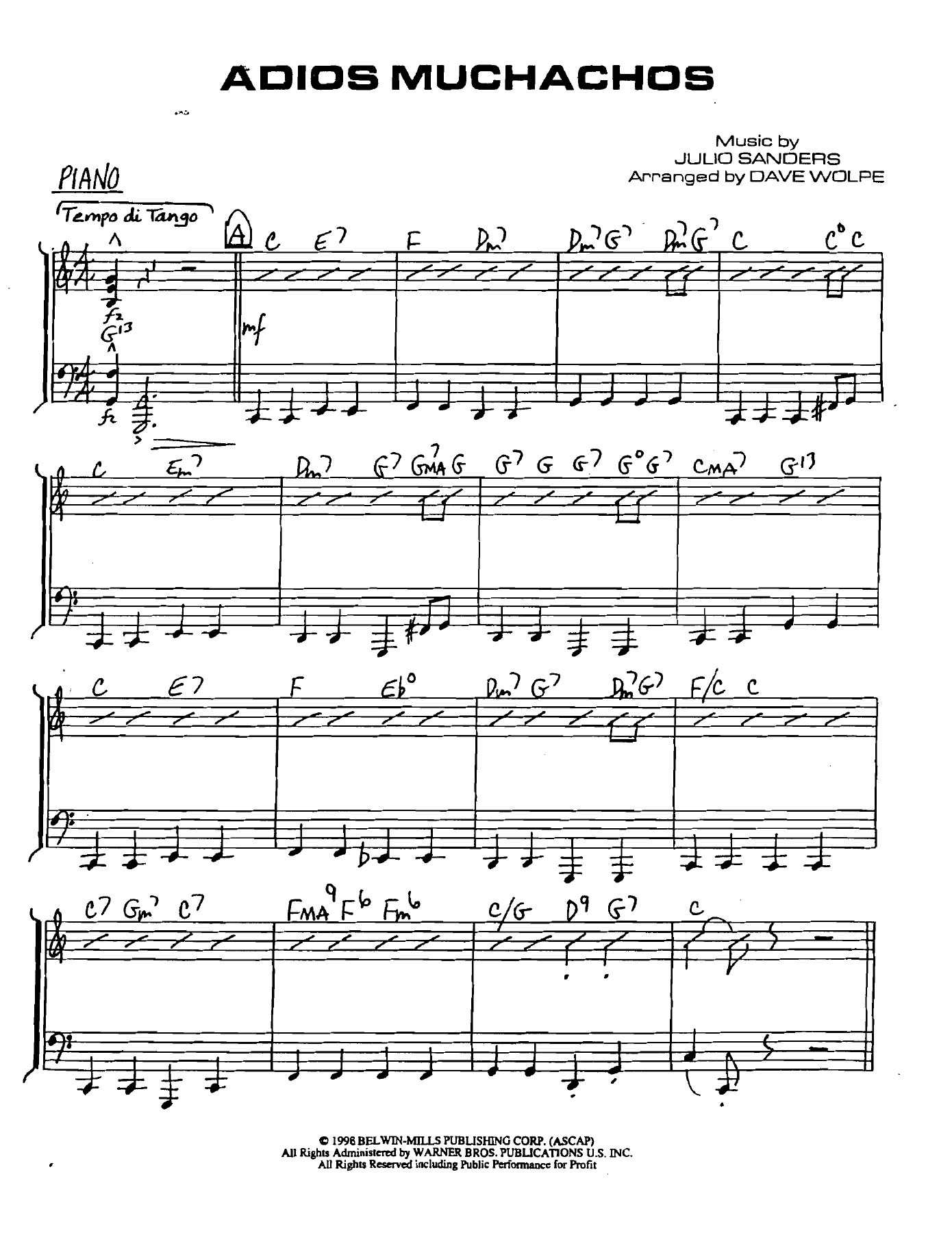
Adiosmuchachos Piano (D.Wolpe)
Composed by JULIO SANDERS
Arranged by Dave Wolpe
- Ensemble: Small Ensemble
- Style: Tango
- Pages: 4
- Instruments (1): Piano
- Difficulty: easy
- Content: Individual Parts
- Format: PDF Download (Instant)
- Price: $12.99
"Adiós Muchachos," composed by Argentinian pianist Julio César Sanders in 1927 with lyrics by César Vedani, stands as one of the most iconic and widely recognized tangos in history. Born from a casual farewell among friends in Buenos Aires, the piece quickly gained immense popularity, becoming a staple in both Argentina and Europe, notably after Carlos Gardel's influential recording in 1928. While its original lyrics convey the poignant farewell of a man on his deathbed reflecting on his life, the melody itself is often characterized by a lively and memorable, even playful, spirit. This duality of wistful sentiment and an engaging, danceable rhythm is central to the enduring appeal of "Adiós Muchachos," cementing its place as a quintessential example of the tango-canción genre, which blends instrumental tango with lyrical storytelling. Its fame extended globally, even inspiring an English adaptation, "I Get Ideas," recorded by Louis Armstrong in 1951, which became an international hit. Dave Wolpe’s arrangement of "Adiós Muchachos" for small ensemble masterfully captures the essence of this beloved tango while infusing it with his signature jazz sensibility. Wolpe, a prolific arranger with a career spanning decades and contributions to orchestras like Glenn Miller's, is known for his ability to craft charts that are both musically satisfying and accessible. This particular arrangement, titled "Adiosmuchachos Piano (D.Wolpe)," places the piano at the forefront, hinting at a prominent role for the keyboardist in carrying the melodic and harmonic weight. Given Wolpe's expertise in small ensemble writing, it is likely to feature his characteristic clear voicings, allowing each instrument to contribute distinctly to the rich texture. Expect a medium tempo, Latin groove that respects the tango's rhythmic foundation, possibly incorporating subtle jazz harmonies and counter-melodies that enhance without overshadowing the original's charm. The musical character of this arrangement leans into a sophisticated, yet accessible, interpretation of the tango. It evokes a mood of elegant nostalgia, perhaps a reflective dance rather than a mournful one. The melody, initially presented by the piano, will likely be passed to other instruments in a conversational style, offering opportunities for melodic development and interplay. While specific solo sections are not detailed, Wolpe's arrangements often include designated solo spaces that are harmonically inviting, allowing improvisers to explore the piece's structure within a jazz framework. Technical challenges would likely include maintaining a precise and authentic tango rhythm, navigating Wolpe's extended jazz harmonies, and achieving a cohesive blend within the small ensemble. The reward lies in performing a classic piece with a fresh, tasteful arrangement that appeals to both traditional tango enthusiasts and jazz audiences. This small ensemble arrangement is ideally suited for college, community, and semi-professional jazz groups. Its detailed yet flexible nature provides a strong foundation for developing musicians to engage with a classic piece of world music, while offering experienced players ample room for expressive interpretation. The four-page format suggests a concise and well-structured chart, making it manageable for groups with limited rehearsal time but a desire for high-quality, engaging repertoire. It serves as an excellent vehicle for exploring Latin rhythms, melodic phrasing, and ensemble dynamics, making it a valuable addition to any small jazz ensemble's library. Conductors should emphasize a precise, yet flowing, Latin groove at a medium tempo, ensuring the rhythmic integrity of the tango is maintained without sounding rigid. Attention to articulation is crucial; encourage crisp staccatos and smooth legato lines where indicated to capture the dance's inherent drama and elegance. The piano, carrying significant melodic and harmonic weight, should lead with confidence but also blend sensitively during ensemble passages. Balance between the instruments is key, particularly in Wolpe's typically transparent voicings, where each part contributes to the overall texture. Rehearsal should focus on rhythmic synchronization, especially in any unison or call-and-response sections, and on shaping the melodic contours to convey the piece's inherent emotional depth. Encourage musicians to listen across the ensemble to achieve a cohesive and expressive performance. Q: What instruments are typically included in this small ensemble arrangement? A: While specific instrumentation can vary for small ensembles, Dave Wolpe's arrangements for this format often include a rhythm section (piano, bass, drums) and a few melodic instruments such as trumpet, saxophone (alto/tenor), and trombone. This particular arrangement highlights the piano's role. Q: What is the difficulty level of "Adiosmuchachos Piano (D.Wolpe)"? A: This arrangement is suitable for intermediate to advanced musicians, making it appropriate for college, community, and semi-professional jazz ensembles. It offers engaging parts that require solid technical facility and an understanding of jazz and Latin idioms. Q: What is the musical style and historical context of "Adiós Muchachos"? A: "Adiós Muchachos" is a classic Argentine tango, originally composed by Julio César Sanders in 1927. It represents the tango-canción style, known for its blend of danceable rhythms and often poignant lyrical themes, and became widely famous after Carlos Gardel's recording in 1928. Q: What makes Dave Wolpe's arrangement of "Adiós Muchachos" unique? A: Dave Wolpe's arrangement distinguishes itself by applying his renowned jazz arranging techniques to this classic tango, likely featuring sophisticated voicings, clear melodic lines, and a prominent piano part. His approach provides a fresh, accessible, yet authentic interpretation for a small jazz ensemble. Q: What is the approximate performance duration or tempo for this piece? A: As a medium-tempo tango, the performance duration will typically be in the range of 3 to 5 minutes, depending on any improvised solos and the ensemble's chosen pacing. The feel should be a consistent, elegant Latin groove.
Questions and answers
- What is included in the Adiosmuchachos Piano (D.Wolpe) PDF?
- The verified current file contains individual parts across 4 pages.
- How many instruments or parts are listed for Adiosmuchachos Piano (D.Wolpe)?
- The verified instrumentation list contains 1 entries for this Small Ensemble arrangement.
- Who is credited for Adiosmuchachos Piano (D.Wolpe)?
- Composer: JULIO SANDERS. Arranger: Dave Wolpe.
- What difficulty is listed for Adiosmuchachos Piano (D.Wolpe)?
- The verified difficulty level is easy.
- What style is listed for Adiosmuchachos Piano (D.Wolpe)?
- The catalog lists the style as Tango.
- Can I preview Adiosmuchachos Piano (D.Wolpe) before buying?
- Yes. The product page provides a preview generated from the current PDF file.
- How is Adiosmuchachos Piano (D.Wolpe) delivered?
- After successful payment, the digital PDF is made available for download. The displayed price is $12.99.
Musicians Also Search For
Adiosmuchachos Piano Dave Wolpe PDF • Adiosmuchachos Piano Dave Wolpe sheet music • Adiosmuchachos Piano arranged by Dave Wolpe • Dave Wolpe small ensemble charts • Dave Wolpe jazz arrangements PDF • Adiosmuchachos Piano JULIO SANDERS sheet music • Adiosmuchachos Piano JULIO SANDERS small ensemble arrangements • JULIO SANDERS small ensemble charts • Adiosmuchachos Piano small ensemble arrangements • Adiosmuchachos Piano small ensemble PDF download • Adiosmuchachos Piano jazz sheet music • small ensemble sheet music download • Adiosmuchachos Piano individual parts download • Adiosmuchachos Piano sheet music PDF • Adiosmuchachos Piano Tango charts • Tango small ensemble arrangements • buy Adiosmuchachos Piano sheet music • download Adiosmuchachos Piano PDF • Adiosmuchachos Piano jazz charts • best Dave Wolpe small ensemble arrangements • JULIO SANDERS arranged by Dave Wolpe • Adiosmuchachos Piano printable sheet music • small ensemble repertoire PDF