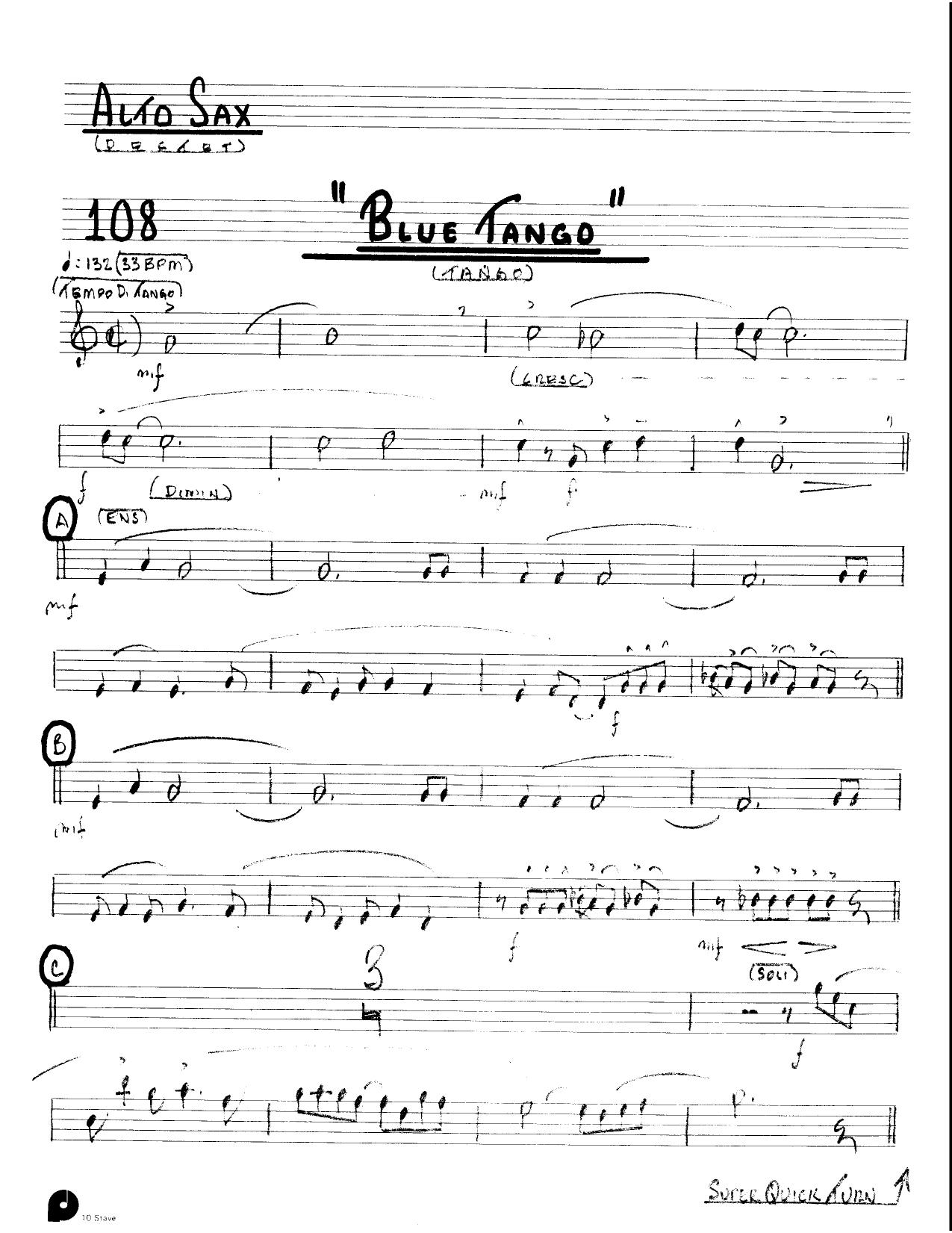
Blue Tango (Kenton Dectet #108)
Composed by Leroy Anderson
Arranged by Kenton Dectet #108
- Ensemble: Small Ensemble
- Style: Tango
- Pages: 29
- Instruments (9): Alto Sax, Tenor Sax, Baritone Sax, Trumpet 1, Trumpet 2, Trombone, Piano, Bass, Drums
- Difficulty: easy
- Content: Individual Parts
- Format: PDF Download (Instant)
- Price: $12.99
Leroy Anderson's "Blue Tango," composed in 1951 and released to widespread acclaim in 1952, stands as a landmark instrumental piece from the mid-20th century. It quickly ascended to the number one spot on the Billboard charts and was the first instrumental recording to sell over a million copies, solidifying its place in popular music history. Anderson's original orchestral version, while utilizing the Argentine tango rhythm, distinguishes itself through its focus on melody and subtlety, avoiding the bombastic tendencies often associated with the style. The piece is characterized by a suave, sensuous gait, often in D major, with a playful underlying energy conveyed through chirping woodwinds and insistent percussion. It evokes a mood that is both elegant and subtly mysterious, a "blue" interpretation of the traditional tango, where the emotional depth comes from its melodic charm rather than overt drama. This unique small ensemble arrangement, "Blue Tango (Kenton Dectet #108)," reimagines Anderson's classic within the sophisticated framework reminiscent of the Stan Kenton Dectets. While the original Kenton Dectet series focused on small dance combos with flexible instrumentation, this arrangement by Kenton Dectet #108 captures the spirit of that era by emphasizing intricate voicings and a refined balance ideal for a small jazz ensemble. The arranger's approach typically involves dense, harmonically rich textures, often featuring close-voiced chords that create a lush sound despite the reduced instrumentation. Expect a medium Latin groove, maintaining the original's characteristic tango pulse but with an added jazz inflection, allowing for a more improvisational feel within the structured arrangement. The arrangement thoughtfully distributes the iconic melody across various instruments, ensuring each voice has a moment to shine. Initial statements of the theme might feature a lead horn with harmonized counterlines, building to rich soli sections that showcase the ensemble's blend and precision. While specific solo sections are integral to jazz performance, this arrangement likely includes designated improvised solo opportunities over the established harmonic progression, offering individual players a chance for creative expression. Technical challenges will include maintaining the precise rhythmic integrity of the tango while injecting a jazz sensibility, navigating complex harmonic voicings, and executing dynamic contrasts that bring out the piece's inherent playfulness and sensuousness. The reward lies in performing a beloved classic with a fresh, intimate, and harmonically sophisticated interpretation, making it a truly engaging experience for both performers and audience. This arrangement is ideally suited for college-level jazz combos, advanced community jazz ensembles, or professional small groups looking to expand their repertoire with a distinctive and challenging piece. To capture the authentic character of "Blue Tango," conductors should emphasize a consistent, yet flexible, medium Latin tango feel, ensuring the underlying rhythmic pulse remains steady without becoming rigid. The primary technical challenge lies in achieving precise balance and blend within the intricate voicings, particularly in the harmonized melody and soli sections. Encourage musicians to listen across the ensemble, adjusting dynamics and articulation to allow inner voices to speak clearly without overpowering the lead. Special attention should be paid to the dynamic swells and fades, which are crucial for conveying the piece's sensuous and playful mood. Rehearsal tips include isolating challenging harmonic passages slowly, using a chordal instrument to clarify voicings, and practicing the rhythmic figures with a metronome to ensure unified execution. The subtle use of vibrato, where appropriate, can enhance the lyrical quality of the melodic lines. Q: What instruments are included in this arrangement? A: This small ensemble arrangement typically includes parts for a standard jazz combo configuration, such as trumpet, alto saxophone, tenor saxophone, trombone, piano, bass, and drums, allowing for flexible instrumentation within the small ensemble format. Q: What is the difficulty level of this arrangement? A: This arrangement is considered advanced intermediate to advanced, suitable for college-level jazz combos, advanced high school ensembles, or professional small groups due to its intricate voicings, rhythmic precision requirements, and improvisational opportunities. Q: What musical style and historical context does this arrangement represent? A: This arrangement is a jazz interpretation of Leroy Anderson's "Blue Tango," originally composed in 1951. It blends the classic Latin tango rhythm and melodic charm of the original with jazz harmonic sophistication and improvisational elements, reminiscent of mid-20th-century small jazz ensemble writing. Q: What makes this arrangement unique compared to other versions of "Blue Tango"? A: This arrangement by Kenton Dectet #108 is unique for its small ensemble scoring, emphasizing dense, sophisticated jazz voicings and a refined balance that provides a fresh, intimate, and harmonically rich take on Anderson's iconic piece, distinct from larger orchestral or big band treatments. Q: What is the typical performance duration and tempo for this piece? A: The typical performance duration for this arrangement is approximately 3-4 minutes, maintaining a medium Latin tango tempo (around quarter note = 120-132 bpm) to preserve the original's characteristic dance feel while allowing for expressive jazz interpretation.
Questions and answers
- What is included in the Blue Tango (Kenton Dectet #108) PDF?
- The verified current file contains individual parts across 29 pages.
- How many instruments or parts are listed for Blue Tango (Kenton Dectet #108)?
- The verified instrumentation list contains 9 entries for this Small Ensemble arrangement.
- Who is credited for Blue Tango (Kenton Dectet #108)?
- Composer: Leroy Anderson. Arranger: Kenton Dectet #108.
- What difficulty is listed for Blue Tango (Kenton Dectet #108)?
- The verified difficulty level is easy.
- What style is listed for Blue Tango (Kenton Dectet #108)?
- The catalog lists the style as Tango.
- Can I preview Blue Tango (Kenton Dectet #108) before buying?
- Yes. The product page provides a preview generated from the current PDF file.
- How is Blue Tango (Kenton Dectet #108) delivered?
- After successful payment, the digital PDF is made available for download. The displayed price is $12.99.
Musicians Also Search For
Blue Tango Kenton Dectet #108 PDF • Blue Tango Kenton Dectet #108 sheet music • Blue Tango arranged by Kenton Dectet #108 • Kenton Dectet #108 small ensemble charts • Kenton Dectet #108 jazz arrangements PDF • Blue Tango Leroy Anderson sheet music • Blue Tango Leroy Anderson small ensemble arrangements • Leroy Anderson small ensemble charts • Blue Tango small ensemble arrangements • Blue Tango small ensemble PDF download • Blue Tango jazz sheet music • small ensemble sheet music download • Blue Tango individual parts download • Blue Tango sheet music PDF • Blue Tango Tango charts • Tango small ensemble arrangements • buy Blue Tango sheet music • download Blue Tango PDF • Blue Tango jazz charts • best Kenton Dectet #108 small ensemble arrangements • Leroy Anderson arranged by Kenton Dectet #108 • Blue Tango printable sheet music • small ensemble repertoire PDF