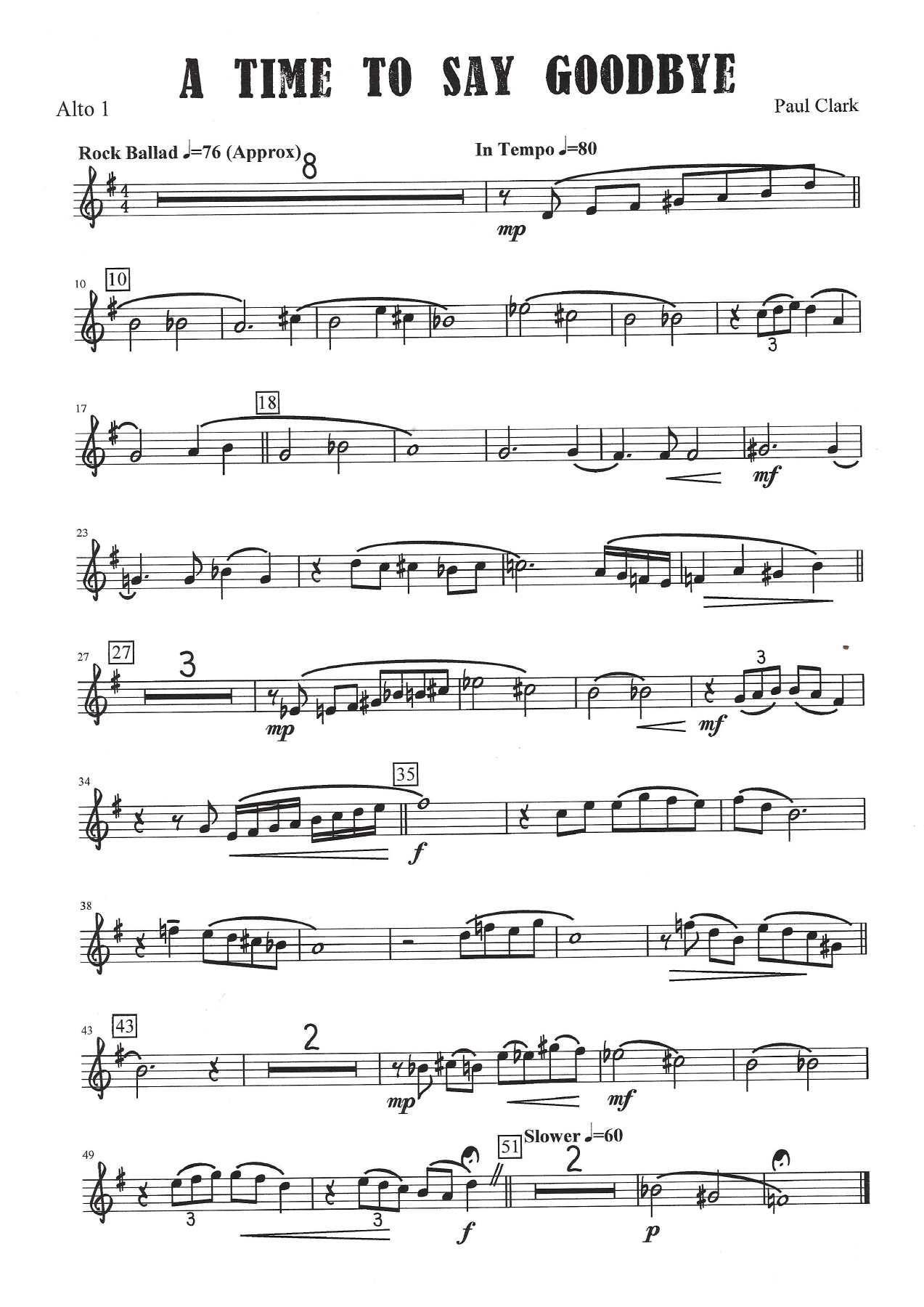
A Time To Say Goodbye (P.Clark)
Composed by Francesco Sartori, Lucio Quarantotto
Arranged by P.Clark
- Ensemble: Big Band
- Style: Jazz Standard
- Pages: 22
- Instruments (17): Alto Saxophone 1, Alto Saxophone 2, Tenor Saxophone 1, Tenor Saxophone 2, Baritone Saxophone, Trumpet 1, Trumpet 2, Trumpet 3, Trumpet 4, Trombone 1, Trombone 2, Trombone 3, Bass Trombone, Guitar, Piano, Bass, Drums
- Difficulty: medium
- Content: Individual Parts
- Format: PDF Download (Instant)
- Price: $24.99
"A Time To Say Goodbye," originally titled "Con te partirò," burst onto the global stage in 1995, famously popularized by Italian tenor Andrea Bocelli. While not initially conceived as a jazz standard, its soaring melodic lines and poignant harmonic structure have made it a compelling canvas for jazz interpretation, much like other crossover hits that find new life within the genre. The original composition by Francesco Sartori and Lucio Quarantotto is a modern classical-pop anthem, evoking themes of departure, longing, and hope. P.Clark's arrangement masterfully re-contextualizes this powerful piece into a sophisticated jazz big band setting, transforming its operatic grandeur into a rich, emotive jazz standard. P.Clark's rendition of "A Time To Say Goodbye" is conceived as a medium-slow, expressive ballad in 4/4 time, primarily in the key of C minor, with strategic modulations that heighten its emotional impact. The mood is one of profound introspection and bittersweet beauty, moving from tender vulnerability to moments of majestic power. The arrangement opens with a hushed, almost ethereal texture, often featuring delicate piano or guitar voicings setting the scene before the full ensemble gradually enters. The melodic treatment is paramount, with the iconic theme passed between various sections, allowing for rich timbral exploration. Expect lush, extended harmonies and a sophisticated harmonic palette that adds depth and complexity to the original's melodic simplicity, characteristic of P.Clark's meticulous arranging style. The arranger's distinctive approach shines through in the thoughtful orchestration and dynamic contour. P.Clark frequently employs layered voicings, particularly in the saxophone section, creating a warm, enveloping sound. Brass sections are utilized for both delicate counter-melodies and powerful, sustained chords, building to climactic moments without resorting to overt bombast. While the piece is primarily an ensemble feature, there are opportunities for a featured soloist—typically a tenor saxophone or trumpet—to interpret the melody with improvisational flair, adding a personal touch while remaining true to the piece's emotional core. Technical challenges include maintaining precise intonation in slow, sustained passages, achieving balanced ensemble blend, and navigating the nuanced dynamic shifts that are crucial to the arrangement's emotional arc. The reward lies in performing a piece that is both technically engaging and deeply moving, offering a unique blend of classical elegance and jazz sophistication. This arrangement is ideally suited for college-level big bands, advanced community ensembles, and professional jazz orchestras. Its demands for mature musicianship, control over dynamics, and sensitive interpretation make it an excellent vehicle for developing expressive performance skills. High school bands with strong lead players and a dedicated rhythm section could also tackle this piece with careful rehearsal, as the primary challenge lies in musicality and blend rather than extreme technical acrobatics. The 17-instrument scoring provides a full, resonant sound, ensuring a captivating performance that will resonate deeply with audiences. This arrangement of "A Time To Say Goodbye" thrives on expressive nuance and meticulous dynamic control. The core challenge lies in maintaining a consistent, medium-slow ballad tempo (approximately quarter note = 60-66 BPM) while allowing for natural rubato within phrases, particularly during the melodic statements. Emphasize breath control and sustained tones, especially in the saxophone and brass sections, to achieve the rich, resonant chords. Intonation is paramount in the slow, exposed voicings; encourage musicians to listen across sections and tune carefully. There are no special techniques like plunger mutes or falls, but precise articulation, from legato to gentle staccato, is crucial for shaping phrases. Rehearsal should focus on balancing the layered textures, ensuring the melody always sings above the accompaniment, and carefully building the dynamic swells to the powerful climaxes and receding gracefully into the tender resolutions. The rhythm section should provide a supportive, understated foundation, focusing on tasteful harmonic voicings and a deep pocket. Q: What instruments and parts are included in this arrangement? A: This arrangement is scored for a standard 17-piece big band, including Alto Saxophone 1 & 2, Tenor Saxophone 1 & 2, Baritone Saxophone, Trumpet 1-4, Trombone 1-4, Piano, Guitar, Bass, and Drums. Q: What is the difficulty level of "A Time To Say Goodbye (P.Clark)"? A: This arrangement is rated as medium-advanced. It requires strong ensemble blend, precise intonation, and mature musicality, making it suitable for college, advanced community, and professional big bands. Q: What is the musical style and historical context of this piece? A: This is a jazz big band arrangement of "A Time To Say Goodbye" (original title "Con te partirò"), a modern classical-pop song popularized by Andrea Bocelli in 1995. P.Clark reinterprets it as a sophisticated, medium-slow jazz ballad. Q: What makes P.Clark's arrangement unique? A: P.Clark's signature approach involves lush, extended harmonies, sophisticated voicings, and a masterful dynamic contour that transforms the original's operatic grandeur into a deeply emotive and elegant jazz standard, offering a fresh perspective on a familiar melody. Q: What is the typical performance duration and tempo for this arrangement? A: The typical performance duration is approximately 4-5 minutes, depending on interpretation. The arrangement is intended to be performed as a medium-slow ballad, generally around 60-66 beats per minute.
Musicians Also Search For
A Time To Say Goodbye P.Clark PDF • A Time To Say Goodbye P.Clark sheet music • A Time To Say Goodbye arranged by P.Clark • P.Clark big band charts • P.Clark jazz arrangements PDF • A Time To Say Goodbye Francesco Sartori, Lucio Quarantotto sheet music • A Time To Say Goodbye Francesco Sartori, Lucio Quarantotto big band arrangement • Francesco Sartori, Lucio Quarantotto big band charts • A Time To Say Goodbye big band arrangement • A Time To Say Goodbye big band PDF download • A Time To Say Goodbye jazz ensemble sheet music • big band sheet music instant download • A Time To Say Goodbye individual parts download • A Time To Say Goodbye sheet music with parts • A Time To Say Goodbye Jazz Standard chart • Jazz Standard big band arrangements • buy A Time To Say Goodbye sheet music online • download A Time To Say Goodbye PDF • A Time To Say Goodbye jazz chart • best P.Clark big band arrangements • Francesco Sartori, Lucio Quarantotto songs arranged by P.Clark • A Time To Say Goodbye printable sheet music • big band repertoire PDF