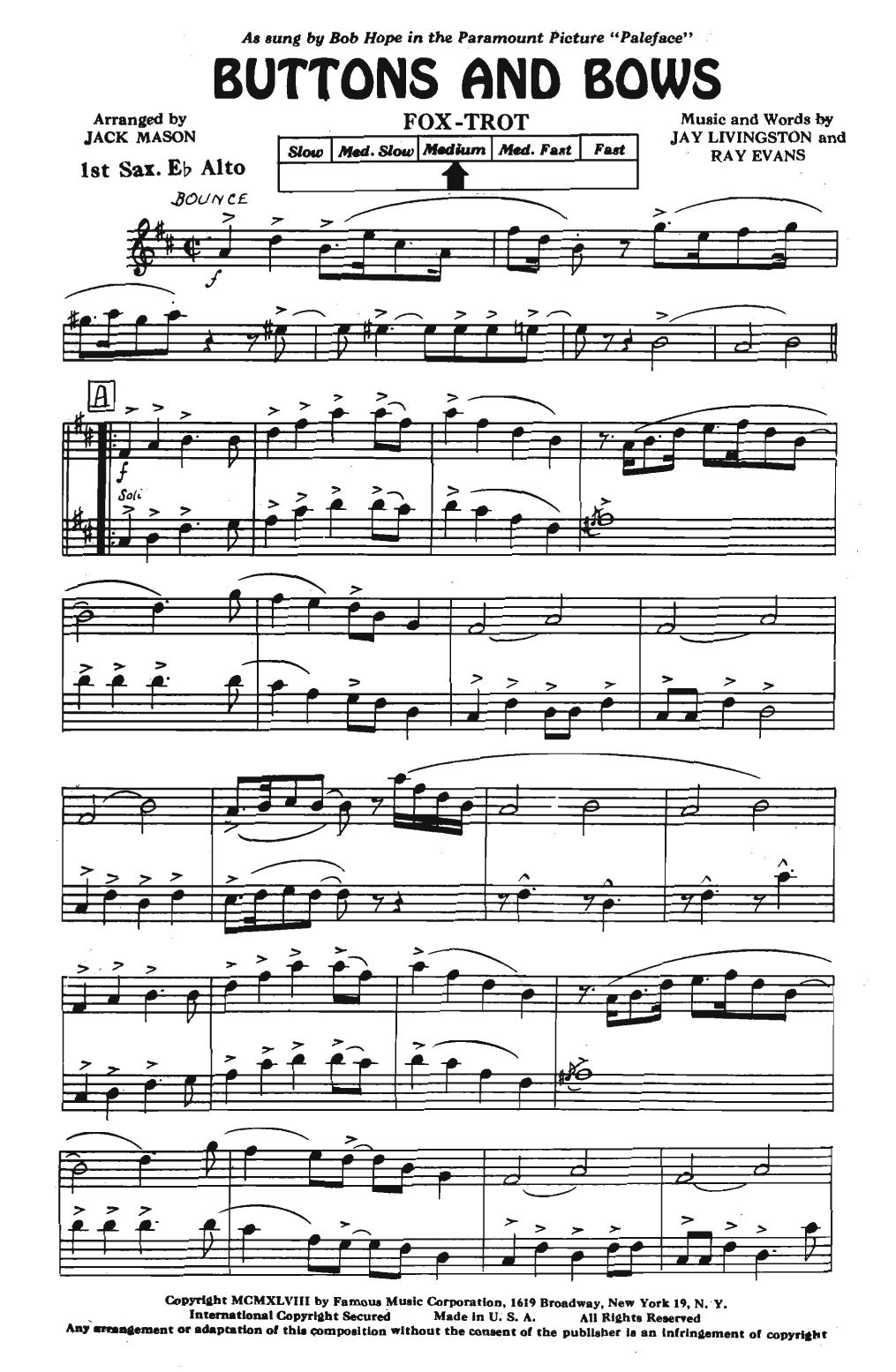
Buttons And Bows (J.Mason) sheet music preview

Buttons And Bows (J.Mason)

Composed by Jay Livingston

Arranged by Jack Mason

  • Ensemble: Big Band
  • Pages: 39
  • Instruments (16): 1st Sax. Eb Alto, 2nd Sax. Bb Tenor, 3rd Sax. Eb Alto, 4th Sax. Bb Tenor, 5th Sax. Eb Baritone, 1st Bb Trumpet, 2nd Bb Trumpet, 3rd Bb Trumpet, 1st Trombone, 2nd Trombone, 3rd Trombone, Piano, Guitar, Bass, Drums, Violins A-B
  • Difficulty: medium
  • Content: Individual Parts
  • Format: PDF Download (Instant)
  • Price: $24.99

Written by Jay Livingston and Ray Evans for the 1948 Bob Hope film *The Paleface*, "Buttons And Bows" captured the post-war American imagination, ultimately winning the Academy Award for Best Original Song and becoming a massive crossover hit for Dinah Shore. While conceived as a novelty Western tune, its infectious melody and robust harmonic framework quickly attracted the attention of jazz and pop instrumentalists of the late 1940s and 1950s. This timeless composition bridges the gap between traditional Tin Pan Alley songwriting and the swinging idioms of the mid-century big band era, offering a playful yet structurally sophisticated vehicle for jazz interpretation. Jack Mason’s masterful big band arrangement injects a vibrant, driving swing feel into the familiar melody, transforming the cinematic folk-pop tune into a bona fide jazz ensemble showcase. Operating at a brisk, buoyant medium-up tempo, the arrangement opens with a bright, crisp introductory vamp that immediately establishes a cheerful and energetic mood. Mason expertly balances rich, full-ensemble block voicings with transparent, counter-melodic writing that highlights the interplay between the brass and reed sections. The harmonic language remains largely diatonic and wonderfully swinging, yet incorporates clever secondary dominants and chromatic passing chords that give the chart a sophisticated edge without alienating listeners or compromising its inherent accessibility. Throughout the chart, the melodic weight is shared dynamically across the ensemble, featuring tightly knit sax solis that demand precise articulation and clean execution. The brass section punctuates the arrangement with snappy, characteristically idiomatic swing figures, setting up a magnificent, high-energy shout chorus that serves as the emotional peak of the chart. Featured solo space allows a standout instrumentalist to stretch out over standard blues-infused changes, backed by crisp comping figures from the rhythm section. Technical challenges primarily center on maintaining a consistent, driving macro-beat at faster tempos, executing lightweight staccato eighth-note phrasing, and managing dynamic contrasts between the roaring shout chorus and the more delicate, plunger-muted or muted-brass background textures. Advanced high school, collegiate, and community jazz ensembles will find this 39-page, 7-instrument configuration to be an exceptionally rewarding addition to their repertoire books. Because of its manageable yet stimulating technical demands, it functions brilliantly as an audience-pleasing concert opener, a mid-set mood-lifter, or a festival chart designed to showcase a band's section work, stylistic versatility, and rhythmic cohesion. Directors seeking to inject authentic mid-century swing era flair into their programs will discover that Mason's arrangement offers the perfect blend of nostalgic charm and robust big band writing. Achieving an authentic mid-century swing feel is the primary objective for realizing this Jack Mason arrangement successfully. The rhythm section must anchor the tempo, driving the ensemble with a steady, buoyant ride-cymbal pulse while avoiding any tendency to rush during the energetic brass shout choruses. Horn players should focus on uniform articulation, applying a distinct jazz-eighth-note interpretation where offbeats are slightly accented and sustained notes feature a controlled, warm vibrato. Pay close attention to dynamic markings: the dynamic balance must heavily favor the rhythm section and accompanying background figures when soloists are featured. Trumpets and trombones should utilize cup or straight mutes where indicated to create the authentic timbral contrast essential for the backing textures. Rehearsals should initially isolate the saxophone soli to ensure flawless unison intonation and clean tongue-slur patterns before integrating the full ensemble. Directors should rehearse the transition into the shout chorus meticulously, ensuring that the dynamic build feels organic rather than abrupt. Q: What instruments and parts are included in this arrangement? A: This publication includes a comprehensive 39-page score and parts tailored for a 7-instrument ensemble configuration, specifically featuring Alto Saxophone, Tenor Saxophone, Trumpet, Trombone, and a complete rhythm section including Piano. Q: What is the difficulty level of this arrangement? A: This chart is graded at a medium difficulty level, making it exceptionally well-suited for advanced high school bands, collegiate ensembles, and community big bands looking to refine their swing articulation and section blend. Q: What musical style and historical context does this arrangement represent? A: It is arranged in a classic mid-century swing style, taking Jay Livingston's 1948 Academy Award-winning popular song and reimagining it through the lens of traditional post-war jazz big band arranging. Q: What makes Jack Mason's arrangement unique? A: Mason uniquely balances lighthearted novelty charm with sophisticated big band writing, incorporating clever harmonic substitutions, tightly knit sax solis, and a driving shout chorus that elevates the original pop tune into a dynamic jazz chart. Q: What is the recommended tempo and performance duration for this piece? A: The arrangement is designed to be performed at a brisk, upbeat medium-swing tempo (approximately 144 to 152 beats per minute), yielding a performance duration of roughly 3 to 4 minutes depending on solo extensions.

Questions and answers

What is included in the Buttons And Bows (J.Mason) PDF?
The verified current file contains individual parts across 39 pages.
How many instruments or parts are listed for Buttons And Bows (J.Mason)?
The verified instrumentation list contains 16 entries for this Big Band arrangement.
Who is credited for Buttons And Bows (J.Mason)?
Composer: Jay Livingston. Arranger: Jack Mason.
What difficulty is listed for Buttons And Bows (J.Mason)?
The verified difficulty level is medium.
Can I preview Buttons And Bows (J.Mason) before buying?
Yes. The product page provides a preview generated from the current PDF file.
How is Buttons And Bows (J.Mason) delivered?
After successful payment, the digital PDF is made available for download. The displayed price is $24.99.

Musicians Also Search For

Buttons And Bows Jack Mason PDFButtons And Bows Jack Mason sheet musicButtons And Bows arranged by Jack MasonJack Mason big band chartsJack Mason jazz arrangements PDFButtons And Bows Jay Livingston sheet musicButtons And Bows Jay Livingston big band arrangementsJay Livingston big band chartsButtons And Bows big band arrangementsButtons And Bows big band PDF downloadButtons And Bows jazz sheet musicbig band sheet music downloadButtons And Bows individual parts downloadButtons And Bows sheet music PDFbuy Buttons And Bows sheet musicdownload Buttons And Bows PDFButtons And Bows jazz chartsbest Jack Mason big band arrangementsJay Livingston arranged by Jack MasonButtons And Bows printable sheet musicbig band repertoire PDF

All arrangements by Jack Mason All Jay Livingston sheet music