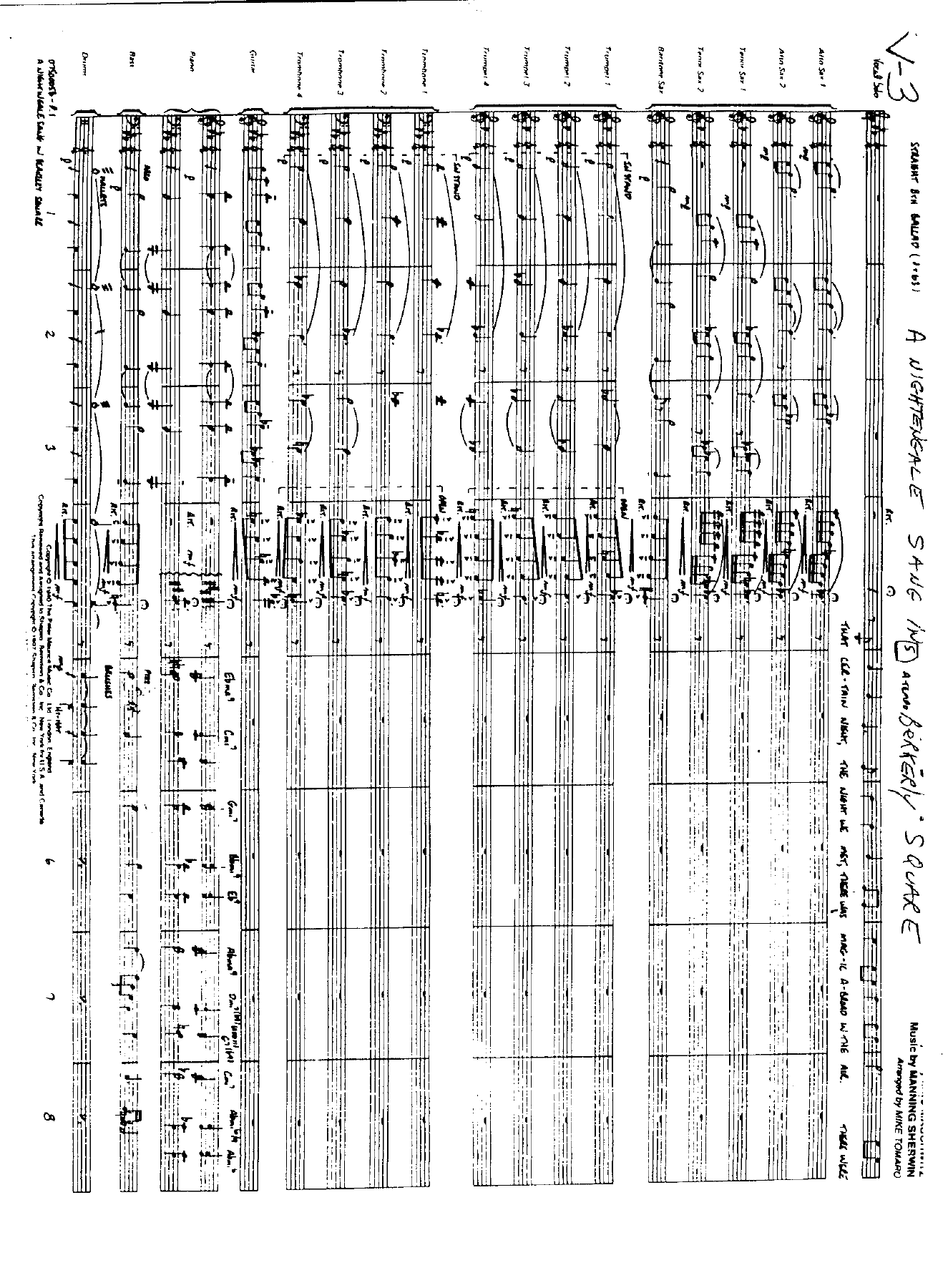
A Nightingale Sang In Berkeley Square (M.Tomaro)
Composed by Manning Sherwin
Arranged by M.Tomaro
- Ensemble: Big Band Vocal
- Style: Jazz Standard
- Pages: 92
- Difficulty: advanced
- Content: Sheet Music
- Format: PDF Download (Instant)
- Price: $24.99
"A Nightingale Sang in Berkeley Square," a timeless romantic ballad, emerged from the creative partnership of lyricist Eric Maschwitz and composer Manning Sherwin in 1939, published in 1940. Penned in the small French fishing village of Le Lavandou shortly before the outbreak of World War II, the song quickly became a cherished standard, its evocative imagery of London's Mayfair capturing the hearts of a generation. It gained significant popularity during the war years, notably through recordings by British artists like Vera Lynn, and later crossed the Atlantic with versions by American big bands such as Glenn Miller and Ray Noble. The song's enduring appeal lies in its sentimental narrative of a magical, improbable encounter in Berkeley Square, an event so enchanting it conjures the impossible image of a nightingale singing in central London. This blend of romantic fantasy and sophisticated melody cemented its place in the Great American Songbook and as a perennial jazz standard. M.Tomaro's big band vocal arrangement of this classic transforms the original's gentle charm into a lush, sophisticated jazz ballad. Set in the key of E-flat major, it maintains a medium-slow, expressive swing feel, allowing the rich harmonic textures to unfold gracefully. The arrangement opens with a beautifully voiced introduction, setting a mood of tender elegance before the vocal soloist enters, carrying the iconic melody with warmth and introspection. Tomaro, known for his masterful command of contemporary jazz orchestration, employs sophisticated voicings and extended harmonies throughout, elevating the song's inherent beauty without sacrificing its emotional core. His signature approach often involves intricate counterlines and carefully crafted ensemble soli sections that provide depth and dynamic contrast. The arrangement features the vocal soloist prominently, carrying the main melodic statements through the initial choruses. Following the vocal feature, an improvisational section is typically provided for a tenor saxophone soloist, offering a moment for expressive jazz improvisation over the rich harmonic landscape. Tomaro's arrangement then builds through a meticulously constructed shout chorus, where the full ensemble engages in powerful, yet nuanced, melodic and rhythmic interplay, showcasing the band's collective strength and dynamic control. The chart concludes with a return to the tender, reflective mood of the opening, often featuring the vocalist once more or a delicate ensemble coda. Technical challenges include precise blend and balance within the brass and saxophone sections, particularly in the dense harmonic passages, and maintaining a consistent, flowing ballad tempo. The reward for performers is the opportunity to deliver a deeply moving and musically satisfying rendition of a beloved standard. This arrangement is ideally suited for college and community big bands with strong vocal and instrumental soloists, as well as professional ensembles seeking a refined and engaging ballad for their repertoire. Its Grade 3+ difficulty rating indicates a chart that demands solid musicianship, requiring a mature understanding of jazz phrasing, dynamics, and ensemble cohesion. The detailed scoring and thoughtful construction provide ample opportunity for bands to showcase their expressive capabilities and deliver a performance that resonates with audiences. This arrangement thrives on a cohesive, expressive ballad feel at a medium-slow swing tempo. Conductors should emphasize a relaxed, yet precise, rhythmic pulse, avoiding any tendency to rush. Key technical challenges include achieving accurate intonation and blend within the rich, often dense, harmonic voicings, particularly in the saxophone and brass soli sections. Encourage players to listen across sections to ensure chords are balanced and resonant. The vocal soloist should be encouraged to interpret the melody with warmth and sensitivity, allowing the lyrics to convey their romantic narrative. The improvisational tenor saxophone solo requires a player with a strong melodic sense and harmonic awareness to navigate the sophisticated chord changes. Dynamics are crucial; ensure a wide range from delicate pianissimos to full, yet controlled, fortissimos, especially in the shout chorus, which should build to an emotional peak before a graceful return to the softer conclusion. Rehearsal time should focus on shaping phrases, achieving seamless transitions between sections, and perfecting the ensemble's collective breath and release. Q: What instruments and parts are included in this arrangement? A: This arrangement is scored for a standard big band instrumentation, typically including five saxophones (2 alto, 2 tenor, 1 baritone), four trumpets, four trombones, and a full rhythm section (piano, bass, drums, guitar), plus a featured vocal soloist. Q: What is the difficulty level of M.Tomaro's arrangement of "A Nightingale Sang in Berkeley Square"? A: This arrangement is rated Grade 3+, making it suitable for college, advanced high school, community, and professional big bands. It requires solid musicianship, good intonation, and an understanding of jazz ballad phrasing. Q: What musical style and historical context does this piece represent? A: This is a classic jazz standard, originally a romantic British popular song from 1939, renowned for its lyrical beauty and sophisticated melody. It embodies the elegant ballad style of the mid-20th century. Q: What makes M.Tomaro's arrangement of "A Nightingale Sang in Berkeley Square" unique? A: M.Tomaro's treatment is distinguished by its lush, extended harmonies, sophisticated voicings, and a meticulously crafted structure that features the vocal soloist, an improvisational tenor saxophone solo, and a powerful, yet nuanced, ensemble shout chorus. Q: What is the typical performance duration and tempo for this arrangement? A: As a medium-slow swing ballad, the performance duration typically ranges from 4 to 6 minutes, depending on the length of the improvised solo and the conductor's interpretation of the tempo.
Musicians Also Search For
A Nightingale Sang In Berkeley Square M.Tomaro PDF • A Nightingale Sang In Berkeley Square M.Tomaro sheet music • A Nightingale Sang In Berkeley Square arranged by M.Tomaro • M.Tomaro big band vocal charts • M.Tomaro jazz arrangements PDF • A Nightingale Sang In Berkeley Square Manning Sherwin sheet music • A Nightingale Sang In Berkeley Square Manning Sherwin big band vocal arrangement • Manning Sherwin big band vocal charts • A Nightingale Sang In Berkeley Square big band vocal arrangement • A Nightingale Sang In Berkeley Square big band vocal PDF download • A Nightingale Sang In Berkeley Square jazz ensemble sheet music • big band vocal sheet music instant download • A Nightingale Sang In Berkeley Square sheet music with parts • A Nightingale Sang In Berkeley Square Jazz Standard chart • Jazz Standard big band vocal arrangements • buy A Nightingale Sang In Berkeley Square sheet music online • download A Nightingale Sang In Berkeley Square PDF • A Nightingale Sang In Berkeley Square jazz chart • best M.Tomaro big band vocal arrangements • Manning Sherwin songs arranged by M.Tomaro • A Nightingale Sang In Berkeley Square printable sheet music • big band vocal repertoire PDF