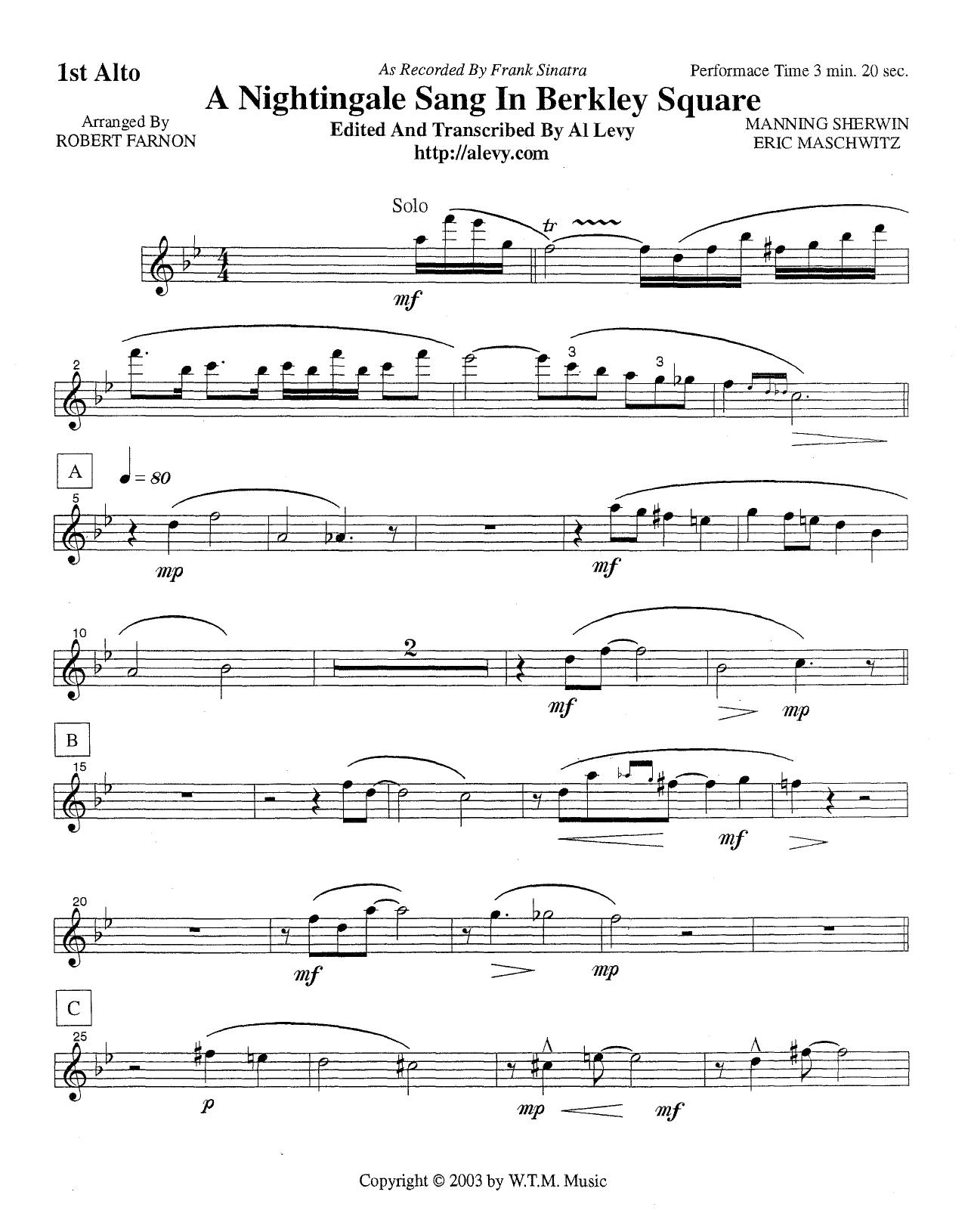
A Nightingale Sang In Berkley Square (R.Farnon) sheet music preview

A Nightingale Sang In Berkley Square (R.Farnon)

Composed by Manning Sherwin

Arranged by Frank Sinatra & Nelson Riddle

  • Ensemble: Big Band
  • Pages: 44
  • Instruments (18): 1st Alto Saxophone, 2nd Alto Saxophone, 1st Tenor Saxophone, 2nd Tenor Saxophone, Baritone Saxophone, 1st Trumpet, 2nd Trumpet, 3rd Trumpet, 4th Trumpet, 1st Trombone, 2nd Trombone, 3rd Trombone, 4th Trombone, Vocal, Piano, Guitar, Drums, Bass
  • Difficulty: medium
  • Content: Individual Parts
  • Format: PDF Download (Instant)
  • Price: $24.99

Manning Sherwin and Eric Maschwitz’s timeless 1939 British romantic standard found its definitive mid-century American expression when it entered the vocal jazz canon, most notably immortalized through legendary interpretations by artists like Frank Sinatra with lush orchestration by Nelson Riddle. Representing the pinnacle of the Golden Age of vocal jazz and sophisticated ballad writing, the song paints a whimsical yet deeply nostalgic picture of wartime London romance. Over the decades, it has evolved from a popular sentimental hit into an essential vehicle for jazz ensembles seeking to explore rich harmonic textures, sophisticated melodic phrasing, and a deeply expressive ballad style. Crafted in a lush, romantic slow-ballad tempo with a rubato-leaning framework that settles into a gentle, rolling 12/8 or slow 4/4 swing feel, the arrangement radiates an atmosphere of cinematic elegance and bittersweet nostalgia. The mood shifts fluidly from introspective tenderness to sweeping, cinematic grandeur, evoking the misty, gaslit streets of Mayfair through cascading woodwind textures and warm brass pads. The emotional landscape is sophisticated and contemplative, requiring the ensemble to sustain intense lyrical focus and dynamic nuance from the opening chord to the final fading cadence. Nelson Riddle’s signature arranging genius is stamped all over this chart, characterized by inventive harmonic extensions, floating woodwind countermelodies, and a remarkably transparent yet rich vertical voice-leading style. Unlike standard heavy-handed big band charts, this version treats the 10-instrument ensemble as a miniature studio orchestra, utilizing clever instrumental doublings, muted brass sighs, and delicate sax solis to mirror the iconic Sinatra-Riddle aesthetic. The arrangement avoids predictable parallel motion in favor of lush, impressionistic chord clusters that stretch traditional functional harmony, creating moments of breathtaking tension and release. The melody is primarily carried by the saxophone section and featured soloists, supported by rich chordal accompaniment from the brass and rhythm sections. Technical challenges center less on raw velocity and much more on intonation, breath control, and stylistic unity during exposed lyrical passages. Balance is critical; because the scoring is compact (10 instruments), every player functions almost like a chamber musician where individual timbres are completely exposed. Advanced high school, collegiate, and professional jazz ensembles will find this arrangement profoundly rewarding, as it demands mature listening skills, exquisite dynamic control, and a deep appreciation for classic vocal phrasing translated into instrumental jazz. Navigating this arrangement successfully requires an uncompromising focus on ensemble blend, intonation, and subtle rubato pacing. The tempo should remain flexible yet anchored, avoiding a rigid mechanical grid to allow the romantic sentiment of the line to breathe naturally. Conductors must pay close attention to dynamic markings; the transition from intimate, whispered pianissimos in the muted brass to the soaring, warm fortes of the full ensemble must be executed without forcing the tone. Woodwinds should prioritize a velvety, blended timbre, ensuring that inner-voice movements are heard clearly without masking the primary melody. Saxophone players need to lean into the warm, late-night ballad vibrato style of the era. Rehearsal time should be heavily invested in tuning the dense, extended chord structures slowly, chord by chord, before attempting full-tempo runs. Ensure that the rhythm section maintains an ultra-light, feather-touch time feel, letting the bass provide a deep, warm anchor while the piano and guitar add color with discreet, tasteful chord voicings. Q: What instruments and parts are included in this 10-instrument arrangement? A: The instrumentation features a compact 10-piece big band configuration comprising Alto Saxophone, Tenor Saxophone, Baritone Saxophone, Trumpet, and Trombone parts, alongside a complete rhythm section framework. Q: What is the difficulty level of this arrangement? A: This chart is best suited for advanced high school, collegiate, and professional jazz ensembles due to its heavy demand for mature intonation, subtle dynamic control, and sophisticated ballad phrasing. Q: What is the historical background of this musical style? A: This arrangement reflects the golden era of mid-century vocal jazz and sophisticated arranging, famously championed by master orchestrators like Nelson Riddle in their work with iconic vocalists. Q: What makes this specific arrangement unique compared to standard big band charts? A: Instead of relying on heavy shout choruses or driving swing grooves, it utilizes a cinematic, chamber-orchestra approach with impressionistic harmonies, transparent textures, and delicate woodwind countermelodies. Q: What is the recommended performance duration and tempo feel? A: The piece is structured as a lush, slow-tempo romantic ballad in 4/4 time, typically clocking in around 3.5 to 4.5 minutes depending on the expressive rubato applied by the conductor.

Questions and answers

What is included in the A Nightingale Sang In Berkley Square (R.Farnon) PDF?
The verified current file contains individual parts across 44 pages.
How many instruments or parts are listed for A Nightingale Sang In Berkley Square (R.Farnon)?
The verified instrumentation list contains 18 entries for this Big Band arrangement.
Who is credited for A Nightingale Sang In Berkley Square (R.Farnon)?
Composer: Manning Sherwin. Arranger: Frank Sinatra & Nelson Riddle.
What difficulty is listed for A Nightingale Sang In Berkley Square (R.Farnon)?
The verified difficulty level is medium.
Can I preview A Nightingale Sang In Berkley Square (R.Farnon) before buying?
Yes. The product page provides a preview generated from the current PDF file.
How is A Nightingale Sang In Berkley Square (R.Farnon) delivered?
After successful payment, the digital PDF is made available for download. The displayed price is $24.99.

Musicians Also Search For

A Nightingale Sang In Berkley Square Frank Sinatra & Nelson Riddle PDFA Nightingale Sang In Berkley Square Frank Sinatra & Nelson Riddle sheet musicA Nightingale Sang In Berkley Square arranged by Frank Sinatra & Nelson RiddleFrank Sinatra & Nelson Riddle big band chartsFrank Sinatra & Nelson Riddle jazz arrangements PDFA Nightingale Sang In Berkley Square Manning Sherwin sheet musicA Nightingale Sang In Berkley Square Manning Sherwin big band arrangementsManning Sherwin big band chartsA Nightingale Sang In Berkley Square big band arrangementsA Nightingale Sang In Berkley Square big band PDF downloadA Nightingale Sang In Berkley Square jazz sheet musicbig band sheet music downloadA Nightingale Sang In Berkley Square individual parts downloadA Nightingale Sang In Berkley Square sheet music PDFbuy A Nightingale Sang In Berkley Square sheet musicdownload A Nightingale Sang In Berkley Square PDFA Nightingale Sang In Berkley Square jazz chartsbest Frank Sinatra & Nelson Riddle big band arrangementsManning Sherwin arranged by Frank Sinatra & Nelson RiddleA Nightingale Sang In Berkley Square printable sheet musicbig band repertoire PDF

All arrangements by Frank Sinatra & Nelson Riddle All Manning Sherwin sheet music