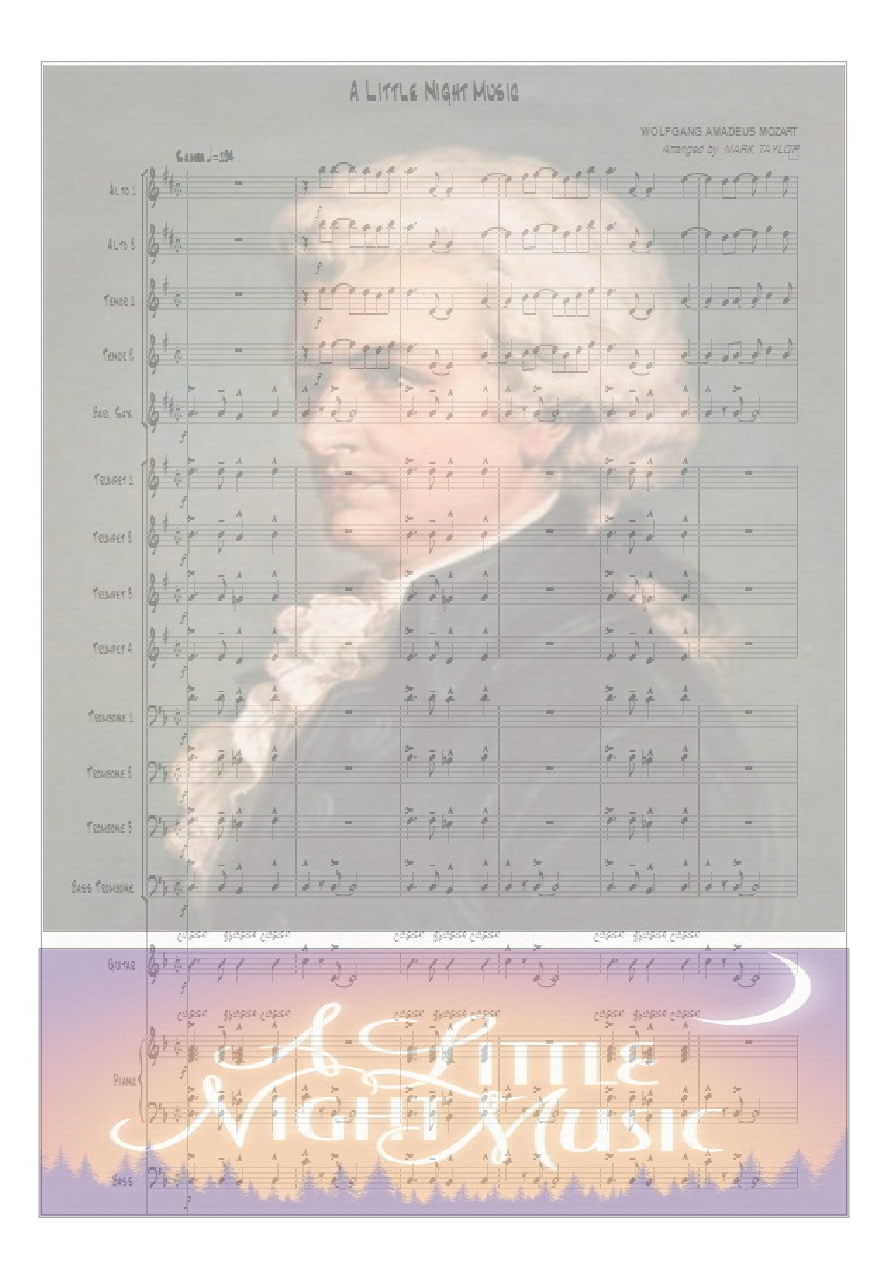
A Little Night Music (W.A.Mozart-M. Taylor)
Composed by Stephen Sondheim
Arranged by W. A.Mozart-M. Taylor
- Ensemble: Big Band Dance
- Style: Samba
- Pages: 52
- Instruments (18): Alto Saxophone 1, Alto Saxophone 2, Tenor Saxophone 1, Tenor Saxophone 2, Baritone Saxophone, Trumpet 1, Trumpet 2, Trumpet 3, Trumpet 4, Trombone 1, Trombone 2, Trombone 3, Bass Trombone, Guitar, Piano, Bass, Drum Set, Vibes
- Difficulty: advanced
- Content: Individual Parts
- Format: PDF Download (Instant)
- Price: $24.99
Stephen Sondheim's "A Little Night Music" premiered on Broadway in 1973, captivating audiences with its sophisticated wit and lush, waltz-driven score. The musical, set in turn-of-the-century Sweden, is perhaps best known for the iconic ballad "Send In The Clowns," but its entire score is a masterclass in theatrical composition. While not a traditional jazz standard, Sondheim's melodic genius and harmonic depth have long attracted jazz interpreters, who find ample material for reharmonization and rhythmic reinvention within his works. This particular arrangement takes a daring and innovative step, reimagining the essence of Sondheim's theatrical elegance through the vibrant lens of a big band samba. W. A. Mozart-M. Taylor's arrangement transforms the original material into a high-energy, Latin-infused showcase. The piece is set at a brisk tempo, driven by a pulsating samba groove in 4/4, immediately establishing an exhilarating and festive mood. The key is bright and accessible, allowing the intricate rhythmic interplay to shine without undue harmonic complexity. The arrangement opens with a captivating rhythmic figure, establishing the samba feel before the melody emerges, often fragmented and passed between sections, building anticipation. The overall character is one of sophisticated exuberance, balancing the inherent drama of Sondheim's composition with the infectious joy of the samba. Taylor's distinctive arranging approach is evident throughout this chart. Known for his ability to fuse disparate musical styles, he masterfully integrates Sondheim's melodic contours into a contemporary big band framework. Expect rich, layered voicings in the saxophone section, often playing intricate soli passages that demand precision and blend. The brass sections contribute punchy, syncopated figures, driving the rhythm and adding dramatic accents. There are compelling moments where the full ensemble comes together for powerful tutti statements, contrasted with lighter, more transparent textures featuring individual sections. While not explicitly stated, Taylor's incorporation of "Mozart" in the arranger credit hints at a classical sensibility in the melodic treatment or counterpoint, cleverly woven into the modern samba. The arrangement features significant interplay among all sections. The melody is shared dynamically, with the saxophones often carrying the primary melodic line, punctuated by brass interjections. There are ample opportunities for featured solos, typically over the samba vamp, allowing individual improvisers to explore the Latin harmonic landscape. Technical challenges include maintaining rhythmic precision in the fast samba feel, executing tight ensemble figures, and navigating the dynamic contrasts that build and release tension. The reward lies in the sheer excitement generated by a well-executed performance, showcasing the band's rhythmic agility and expressive power. This arrangement is ideally suited for advanced high school, college, community, and professional big bands looking for a challenging yet incredibly rewarding piece that pushes stylistic boundaries. This samba arrangement demands rhythmic precision and a strong internal pulse from every musician. The primary technical challenge lies in maintaining the brisk samba groove consistently throughout, particularly in the intricate rhythmic figures in the saxophone soli sections. Encourage drummers and percussionists to lay down a solid foundation, emphasizing the authentic samba feel rather than a generic Latin rhythm. Brass players should focus on clean articulation and precise cut-offs to achieve the desired punch and clarity in their syncopated figures. Tempo should be maintained at a lively pace, around quarter note = 180-200 BPM, ensuring the energy remains high. There are no specific extended techniques like plungers or doits required, but attention to dynamic shaping is crucial; sudden dynamic shifts and swells are integral to the piece's dramatic impact. Rehearsal time should be dedicated to isolating and perfecting the saxophone soli passages and brass ensemble figures, ensuring impeccable blend and intonation. Additionally, practice the transitions between melodic statements and solo sections to maintain seamless flow and energy. Q: What instruments are included in this arrangement? A: This arrangement is scored for a standard 17-piece big band: Alto Saxophone 1, Alto Saxophone 2, Tenor Saxophone 1, Tenor Saxophone 2, Baritone Saxophone, Trumpet 1, Trumpet 2, Trumpet 3, Trumpet 4, Trombone 1, Trombone 2, Trombone 3, Trombone 4, Piano, Bass, Drums, and Guitar. A full conductor's score is also included. Q: What is the difficulty level of this arrangement? A: This arrangement is considered advanced, suitable for college, community, and professional big bands. It requires strong rhythmic proficiency, precise ensemble playing, and capable improvisers. Q: What is the musical style and historical context of this piece? A: This is a big band samba arrangement of a theme from Stephen Sondheim's 1973 musical "A Little Night Music." It reimagines the original theatrical material through a high-energy Latin jazz lens. Q: What makes this arrangement unique? A: Its uniqueness stems from the innovative fusion of Stephen Sondheim's sophisticated melodies with a driving big band samba groove, showcasing the arranger W. A. Mozart-M. Taylor's distinctive ability to blend classical sensibility with contemporary jazz energy. Q: What is the approximate performance duration and tempo? A: The approximate performance duration is 4-5 minutes, depending on the length of improvised solos. The tempo is a brisk samba, typically around quarter note = 180-200 BPM.
Musicians Also Search For
A Little Night Music W. A.Mozart-M. Taylor PDF • A Little Night Music W. A.Mozart-M. Taylor sheet music • A Little Night Music arranged by W. A.Mozart-M. Taylor • W. A.Mozart-M. Taylor big band dance charts • W. A.Mozart-M. Taylor jazz arrangements PDF • A Little Night Music Stephen Sondheim sheet music • A Little Night Music Stephen Sondheim big band dance arrangement • Stephen Sondheim big band dance charts • A Little Night Music big band dance arrangement • A Little Night Music big band dance PDF download • A Little Night Music jazz ensemble sheet music • big band dance sheet music instant download • A Little Night Music conductor score PDF • A Little Night Music individual parts download • A Little Night Music sheet music with parts • A Little Night Music Samba chart • Samba big band dance arrangements • buy A Little Night Music sheet music online • download A Little Night Music PDF • A Little Night Music jazz chart • best W. A.Mozart-M. Taylor big band dance arrangements • Stephen Sondheim songs arranged by W. A.Mozart-M. Taylor • A Little Night Music printable sheet music • big band dance repertoire PDF