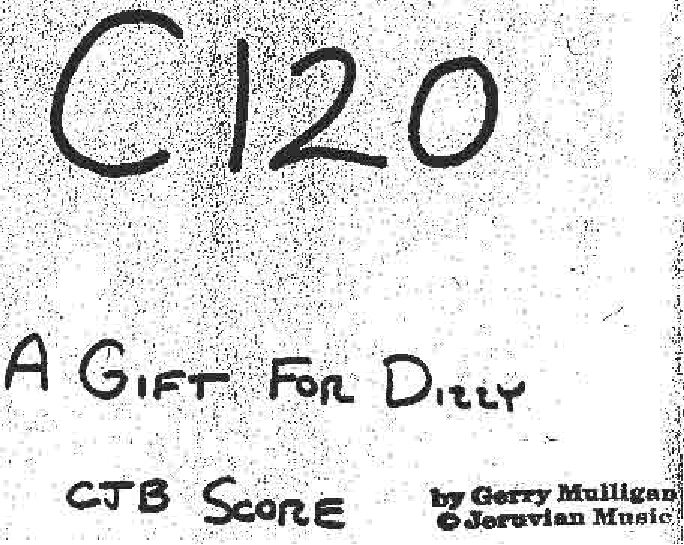
A Gift For Dizzy (G.Mulligan) sheet music preview

A Gift For Dizzy (G.Mulligan)

Composed by Gerry Mulligan

Arranged by Gerry Mulligan

  • Ensemble: Big Band
  • Pages: 46
  • Instruments (15): Solo Baritone Saxophone, Alto Saxophone I, Alto Saxophone II, Tenor Saxophone, Baritone Saxophone, Trumpet I, Trumpet II, Trumpet III, Trumpet IV, Trombone I, Trombone II, Trombone III, Piano, Bass, Drums
  • Difficulty: medium
  • Content: Individual Parts
  • Format: PDF Download (Instant)
  • Price: $24.99

Bebop royalty meets West Coast cool in "A Gift For Dizzy," a sophisticated and historically significant composition penned and arranged by the legendary baritone saxophonist Gerry Mulligan. Conceived as a direct homage to the peerless trumpet innovator John Birks "Dizzy" Gillespie, this chart captures the playful yet fiercely intellectual spirit of late-1940s and 1950s modern jazz. Mulligan, a cornerstone figure of the cool jazz movement, brilliantly bridges the gap between the high-octane energy of East Coast bebop and the relaxed, counterpoint-driven sophistication of West Coast arrangement. Rather than relying on a massive, wall-of-sound brass section, Mulligan’s writing treats the big band as an expanded chamber jazz ensemble, favoring linear clarity, ingenious voice-leading, and harmonic transparency over dense, traditional block voicing. The musical character of this arrangement is defined by an infectious, driving medium-up swing feel set in a bright, conversational tempo. Mulligan establishes a playful, angular melodic motif that bounces between the registers with a deceptively effortless grace, evoking the wit and virtuosic whimsy associated with Gillespie’s persona. The mood is buoyant, sophisticated, and relentlessly swinging, driven by an airtight rhythmic interplay that demands crisp articulation and a forward-moving pulse. Instead of heavy, bombastic shout choruses, the arrangement builds tension through interlocking horn lines, clever dynamic shifts, and seamless transitions between ensemble sections and structured counterpoint, reflecting Mulligan's lifelong fascination with pianoless-quartet-style horizontal writing scaled up for a larger ensemble. Mulligan’s distinctive arranging approach shines through the unique 8-instrument instrumentation—featuring Alto Saxophone, Tenor Saxophone, Baritone Saxophone, Trumpet, Trombone, and a dynamic rhythm section framework—which avoids traditional big band redundancy. The bari sax naturally takes a commanding, foundational role, often anchoring the countermelodies or locking in with the trombone to create a rich, pillowy low-end texture, while the alto and tenor weave intricate, contrapuntal lines reminiscent of his famous Concert Jazz Band configurations. The arrangement features designated solo space that invites players to stretch out in a genuine bop vocabulary, demanding a strong sense of harmonic navigation. The technical challenges lie primarily in the lightweight, agile articulation required across all horns; the passages demand clean fingerwork, precise intonation, and a unified articulation style to let Mulligan’s intricate counterpoint breathe properly. Advanced high school, collegiate, and professional jazz ensembles will find this 46-page masterwork to be an exceptionally rewarding addition to their repertoire. Because of its leaner 8-instrument voicing, individual players cannot hide behind a massed section; every part is exposed, independent, and crucial to the overall harmonic architecture. Performing "A Gift For Dizzy" offers students and seasoned professionals alike a masterclass in ensemble listening, stylistic balance, and the art of swinging with a cool, understated intensity that honors two of jazz music's greatest architects. Navigating "A Gift For Dizzy" successfully requires a disciplined approach to balance, lightweight articulation, and stylistic cohesion. * **Tempo & Feel:** Maintain a steady, driving medium-up swing feel without rushing. The pulse should be anchored firmly by the rhythm section, allowing the horns to float above the beat with relaxed, eighth-note swing subdivisions. Avoid heavy tongue attacks; aim for a buoyant, speech-like articulation where accented notes are lifted rather than hammered. * **Technical Challenges:** The primary hurdle for the wind section is the execution of Mulligan's linear counterpoint at tempo. Because the arrangement utilizes an 8-instrument configuration, dynamic independence is vital. Players must actively listen across sections to ensure that inner-voice countermelodies do not inadvertently mask the primary melodic statement. * **Rehearsal Strategy:** Begin rehearsals with the rhythm section alone to lock in the harmonic and rhythmic foundation. When adding the horns, isolate the contrapuntal passages and practice them slowly at first, ensuring uniform phrasing, breath marks, and stylistic intent before pushing toward performance tempo. Q: What instruments and parts are included in this arrangement? A: This arrangement is scored for an 8-instrument ensemble featuring Alto Saxophone, Tenor Saxophone, Baritone Saxophone, Trumpet, Trombone, and a full rhythm section, spanning a comprehensive 46-page score and parts format. Q: What is the difficulty level of this arrangement? A: It is geared toward advanced high school, collegiate, and professional jazz ensembles due to its exposed 8-instrument writing, intricate linear counterpoint, and demands for agile bop-style articulation. Q: What is the style and historical context of the piece? A: Written and arranged by Gerry Mulligan as a tribute to Dizzy Gillespie, the piece fuses the harmonic complexity and rhythmic drive of bebop with the relaxed counterpoint characteristic of West Coast cool jazz. Q: What makes this particular arrangement unique? A: Mulligan’s distinct approach scales his signature chamber-jazz, pianoless-quartet philosophy up to a larger ensemble, utilizing transparent harmonic voicings and independent horn lines rather than traditional, heavy block-chord big band writing. Q: What is the recommended performance tempo and duration? A: The chart is designed for a bright, driving medium-up swing tempo, typically resulting in a performance duration of approximately 4 to 5 minutes depending on solo extensions.

Questions and answers

What is included in the A Gift For Dizzy (G.Mulligan) PDF?
The verified current file contains a conductor score and individual parts across 46 pages.
How many instruments or parts are listed for A Gift For Dizzy (G.Mulligan)?
The verified instrumentation list contains 15 entries for this Big Band arrangement.
Who is credited for A Gift For Dizzy (G.Mulligan)?
Composer: Gerry Mulligan. Arranger: Gerry Mulligan.
What difficulty is listed for A Gift For Dizzy (G.Mulligan)?
The verified difficulty level is medium.
Can I preview A Gift For Dizzy (G.Mulligan) before buying?
Yes. The product page provides a preview generated from the current PDF file.
How is A Gift For Dizzy (G.Mulligan) delivered?
After successful payment, the digital PDF is made available for download. The displayed price is $24.99.

Musicians Also Search For

A Gift For Dizzy Gerry Mulligan PDFA Gift For Dizzy Gerry Mulligan sheet musicA Gift For Dizzy arranged by Gerry MulliganGerry Mulligan big band chartsGerry Mulligan jazz arrangements PDFA Gift For Dizzy Gerry Mulligan big band arrangementsA Gift For Dizzy big band arrangementsA Gift For Dizzy big band PDF downloadA Gift For Dizzy jazz sheet musicbig band sheet music downloadA Gift For Dizzy conductor score PDFA Gift For Dizzy individual parts downloadA Gift For Dizzy sheet music PDFbuy A Gift For Dizzy sheet musicdownload A Gift For Dizzy PDFA Gift For Dizzy jazz chartsbest Gerry Mulligan big band arrangementsA Gift For Dizzy printable sheet musicbig band repertoire PDF

All arrangements by Gerry Mulligan All Gerry Mulligan sheet music