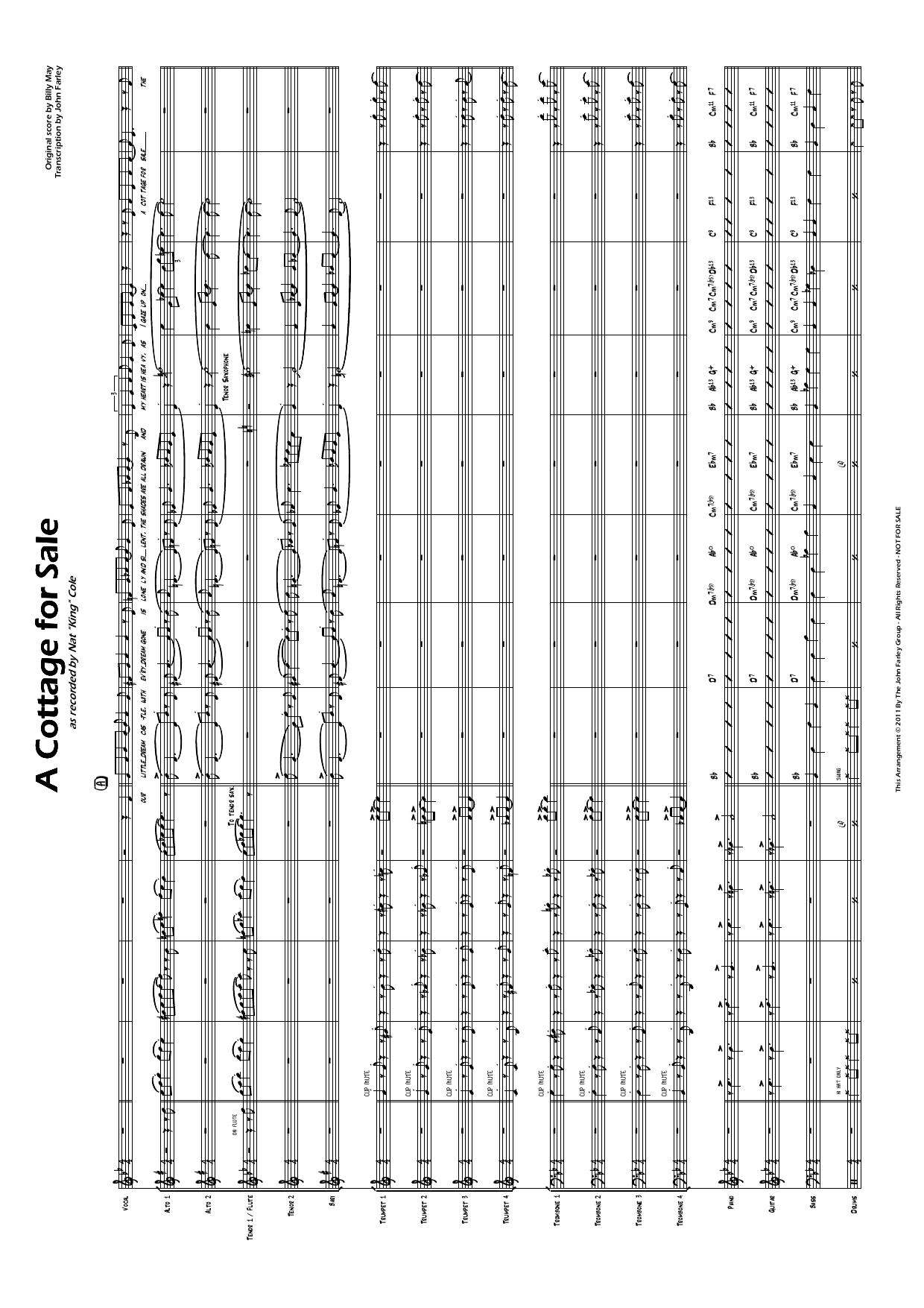
A Cottage For Sale (B.May)
Composed by Willard Robison
Arranged by Billy May
- Ensemble: Big Band
- Style: Jazz Standard
- Pages: 25
- Instruments (19): Vocal, Alto Saxophone 1, Alto Saxophone 2, Tenor Saxophone 1, Flute, Tenor Saxophone 2, Baritone Saxophone, Trumpet 1, Trumpet 2, Trumpet 3, Trumpet 4, Trombone 1, Trombone 2, Trombone 3, Trombone 4, Piano, Guitar, Bass, Drums
- Difficulty: easy
- Content: Individual Parts
- Format: PDF Download (Instant)
- Price: $24.99
"A Cottage For Sale," penned by Willard Robison in 1929, emerged during a pivotal era in American popular music, bridging the late Tin Pan Alley tradition with the burgeoning jazz age. Originally a poignant ballad, it quickly became a jazz standard, cherished for its evocative melody and melancholic lyrics that paint a picture of lost love and bittersweet memories. Artists like Frank Sinatra, Billie Holiday, and Sarah Vaughan have immortalized the tune, each lending their unique interpretive genius to its enduring emotional depth. Its timeless appeal lies in its universal theme of longing and nostalgia, making it a staple in the jazz vocal repertoire and a testament to the enduring power of a well-crafted song. Billy May's arrangement of "A Cottage For Sale" transforms this classic ballad into a sophisticated big band vehicle, characterized by his signature "slurping" brass and lush, often unexpected, voicings. While the original is a slow ballad, May's treatment likely leans into a medium-slow swing feel, allowing for both expressive melodic lines and the rhythmic drive inherent in his big band writing. The arrangement is crafted in a key that complements the vocal range, likely a comfortable mid-range for a standard jazz vocalist. May's genius lies in his ability to maintain the song's inherent melancholy while infusing it with a vibrant, orchestral sheen. Expect rich, harmonically complex brass and saxophone soli sections that showcase his distinctive harmonic palette, often employing extended chords and subtle dissonances that resolve beautifully, creating a sense of wistful elegance. This arrangement features the vocal soloist prominently, carrying the primary melodic statement with the band providing a supportive, yet intricate, backdrop. Beyond the vocal feature, anticipate sophisticated ensemble passages where the saxophones and brass engage in call-and-response or interwoven countermelodies, all meticulously crafted in May's inimitable style. While there might not be extensive open solo sections in the traditional sense, May's arrangements often feature brief, melodic instrumental fills or obbligatos that serve as miniature solos, adding color and texture. Technical challenges include precise articulation in the brass, particularly in May's characteristic glissandi and slurs, and achieving a blended, balanced sound within the dense saxophone voicings. The rewarding aspect lies in performing a master arranger's work, bringing to life the nuanced emotional landscape of the song through a powerful big band setting. This arrangement is ideally suited for college-level jazz ensembles, community big bands with experienced musicians, and professional groups. The demands on intonation, blend, and stylistic interpretation require a mature ensemble capable of navigating complex harmonies and rhythmic subtleties. The expressive depth required for the vocal part, combined with the intricate ensemble writing, makes it a challenging yet incredibly fulfilling piece to perform, offering both musicians and audiences a rich, authentic big band experience rooted in the golden age of jazz. Conductors should emphasize a medium-slow swing feel, ensuring the rhythm section maintains a steady, unhurried pulse without dragging. Attention to the vocal soloist's phrasing is paramount; the band must breathe with the vocalist, providing a supportive cushion rather than overpowering. Key technical challenges include precise execution of Billy May’s characteristic brass glissandi and "slurp" effects, which require careful coordination and breath control across the section. Saxophone sections should focus on achieving a warm, blended sound in the often-dense voicings, paying close attention to intonation, especially in sustained chords. Rehearsal time should be dedicated to balancing the intricate soli passages and ensuring dynamic contrasts are clearly defined, allowing the emotional arc of the piece to unfold naturally. Mutes, particularly cup and straight mutes for brass, may be indicated to achieve specific timbral effects, and their quick changes should be rehearsed for seamless transitions. Q: What instruments and parts are included in this arrangement? A: This arrangement is scored for an 18-instrument big band, including a Vocal part, Alto Saxophone 1, Alto Saxophone 2, Tenor Saxophone 1 (doubling Flute), Tenor Saxophone 2, Baritone Saxophone, Trumpet 1-4, Trombone 1-3, Bass Trombone, Piano, Bass, Drums, and Guitar. Q: What is the difficulty level of this arrangement? A: This arrangement is considered advanced, suitable for college-level, community, or professional big bands. It requires experienced musicians capable of navigating complex harmonies, precise articulation, and nuanced stylistic interpretation. Q: What is the musical style and historical context of "A Cottage For Sale (B.May)"? A: This is a jazz standard ballad, originally composed by Willard Robison in 1929, arranged in the classic big band style by Billy May. It embodies the melancholic yet sophisticated sound of the mid-20th century jazz orchestra. Q: What makes Billy May's arrangement of "A Cottage For Sale" unique? A: Billy May's signature "slurping" brass, lush and harmonically rich voicings, and sophisticated ensemble writing distinguish this arrangement. It transforms the ballad into a vibrant big band feature while preserving its emotional depth. Q: What is the typical performance duration or tempo for this piece? A: While variable based on interpretation, this arrangement is best performed at a medium-slow swing tempo, allowing for expressive phrasing and the full realization of its melancholic character. Performance duration is typically around 3-4 minutes.
Questions and answers
- What is included in the A Cottage For Sale (B.May) PDF?
- The verified current file contains a conductor score and individual parts across 25 pages.
- How many instruments or parts are listed for A Cottage For Sale (B.May)?
- The verified instrumentation list contains 19 entries for this Big Band arrangement.
- Who is credited for A Cottage For Sale (B.May)?
- Composer: Willard Robison. Arranger: Billy May.
- What difficulty is listed for A Cottage For Sale (B.May)?
- The verified difficulty level is easy.
- What style is listed for A Cottage For Sale (B.May)?
- The catalog lists the style as Jazz Standard.
- Can I preview A Cottage For Sale (B.May) before buying?
- Yes. The product page provides a preview generated from the current PDF file.
- How is A Cottage For Sale (B.May) delivered?
- After successful payment, the digital PDF is made available for download. The displayed price is $24.99.
Musicians Also Search For
A Cottage For Sale Billy May PDF • A Cottage For Sale Billy May sheet music • A Cottage For Sale arranged by Billy May • Billy May big band charts • Billy May jazz arrangements PDF • A Cottage For Sale Willard Robison sheet music • A Cottage For Sale Willard Robison big band arrangements • Willard Robison big band charts • A Cottage For Sale big band arrangements • A Cottage For Sale big band PDF download • A Cottage For Sale jazz sheet music • big band sheet music download • A Cottage For Sale conductor score PDF • A Cottage For Sale individual parts download • A Cottage For Sale sheet music PDF • A Cottage For Sale Jazz Standard charts • Jazz Standard big band arrangements • buy A Cottage For Sale sheet music • download A Cottage For Sale PDF • A Cottage For Sale jazz charts • best Billy May big band arrangements • Willard Robison arranged by Billy May • A Cottage For Sale printable sheet music • big band repertoire PDF