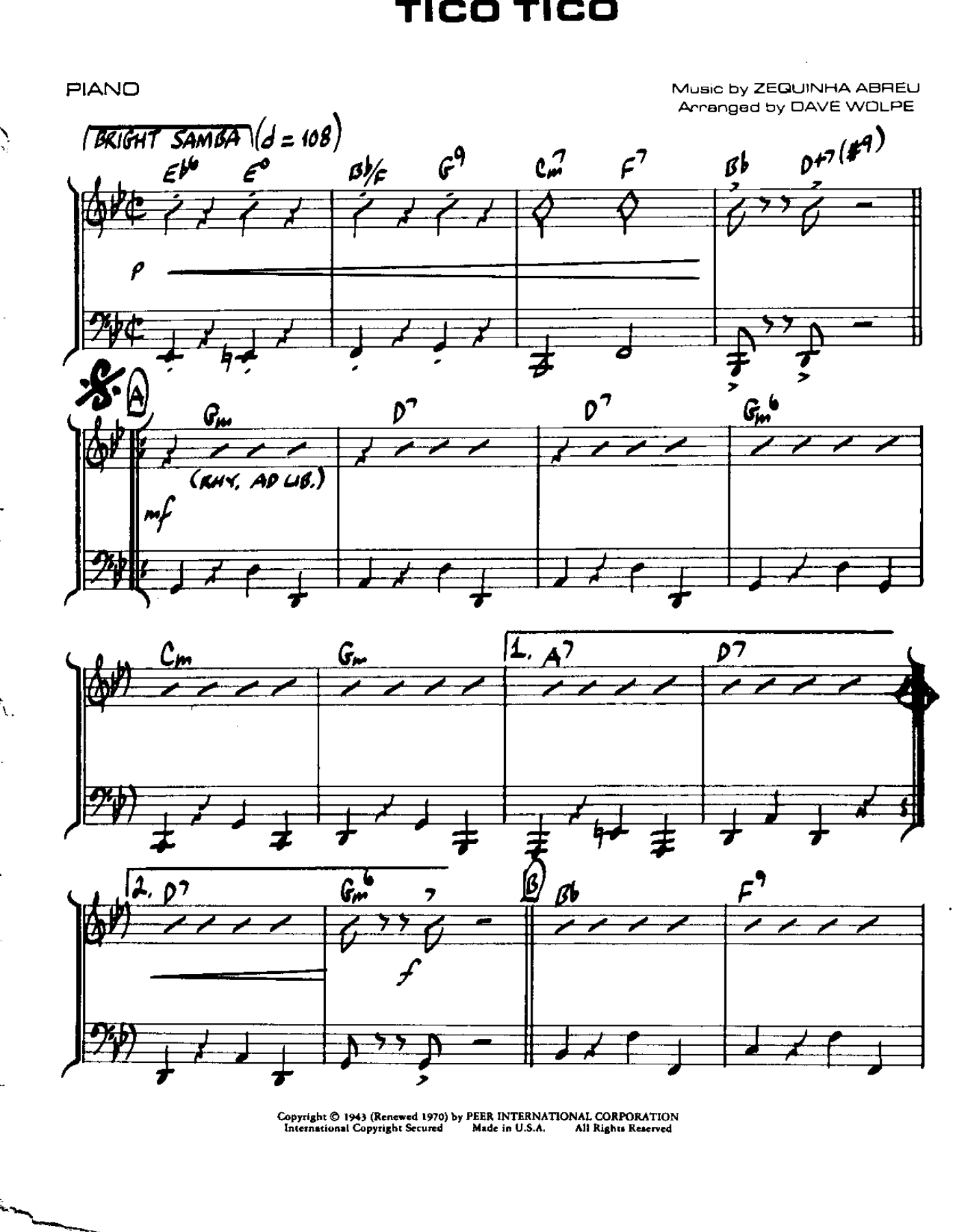
32- Tico Tico (D.Wolpe)
Composed by Zequinha de Abreu
Arranged by Dave Wolpe
- Ensemble: Small Ensemble
- Style: Jazz Standard
- Pages: 16
- Instruments (7): Eb Alto Saxophone (Part II), Bass, Drums, Piano, Bb Tenor Saxophone (Part III), Trombone (Part IV), Bb Trumpet (Part I)
- Difficulty: easy
- Content: Individual Parts
- Format: PDF Download (Instant)
- Price: $12.99
"Tico-Tico no Fubá," originally composed by Zequinha de Abreu in 1917, stands as a vibrant cornerstone of Brazilian choro music, a genre that emerged in Rio de Janeiro in the 1870s. Initially titled "Tico-Tico no Farelo," the piece received its current name in 1931 to avoid confusion with another work. While choro often translates to "lament," its musical character is frequently upbeat and rhythmic, a quality perfectly embodied by "Tico-Tico." The piece gained international renown in the 1940s, propelled into global consciousness by artists such as Carmen Miranda, who performed it in the 1947 film *Copacabana*, and Ethel Smith, whose Hammond organ rendition in the 1944 film *Bathing Beauty* became a chart-topping sensation. Its infectious energy and intricate melodic lines have solidified its status as a beloved jazz standard, transcending its choro origins to become a staple in diverse musical settings worldwide. Dave Wolpe's arrangement of "Tico-Tico" masterfully captures the essence of this Brazilian classic while infusing it with a distinctive jazz sensibility. Designed for a small ensemble, this chart maintains the original's characteristic up-tempo Latin groove, demanding precision and rhythmic vitality from all players. Wolpe, known for his ability to craft engaging and accessible arrangements, typically employs clear voicings and dynamic contrasts that highlight the strengths of each section. In this particular treatment, expect bright, driving rhythms and a playful mood, evoking the image of the "rufous-collared sparrow in the cornmeal" that the title suggests. The arrangement is likely to feature crisp articulation and a relentless forward momentum, characteristic of Wolpe's approach to Latin-infused jazz. The melody of "Tico-Tico" is often shared, creating a dynamic interplay across the ensemble. While specific solo sections are integral to many jazz arrangements, Wolpe's version for small ensemble may feature either written-out improvisational passages or clearly designated solo opportunities over the driving rhythmic backdrop. Technical challenges will include maintaining the brisk tempo with rhythmic accuracy, executing rapid melodic lines, and achieving a cohesive ensemble sound that balances individual brilliance with collective precision. The rewarding aspect of performing this piece lies in its sheer exuberance and the audience's inevitable delight, making it a fantastic showcase for a tight-knit group. The arrangement's 16 pages suggest a concise yet comprehensive treatment, allowing for focused rehearsal and impactful performance. This arrangement is ideally suited for college and advanced high school jazz ensembles, as well as community jazz groups aiming for a polished, professional sound. Its demands for rhythmic precision and ensemble tightness make it an excellent vehicle for developing advanced ensemble skills. While not overly complex harmonically, the rhythmic intricacies and the need for stylistic authenticity require musicians with a solid grasp of jazz and Latin idioms. Professional small ensembles will also find this a delightful and engaging piece to add to their repertoire, offering a fresh take on a familiar classic. Conductors should emphasize a precise, driving Latin feel, maintaining a consistent up-tempo pulse throughout, ideally around quarter note = 200-220 bpm. The rhythmic accuracy, particularly in syncopated figures and unison lines, is paramount to capturing the authentic "Tico-Tico" energy. Encourage musicians to articulate with clarity and crispness, especially in the brass and saxophone sections, to ensure the rapid melodic passages cut through. While no specific special techniques like plunger mutes are explicitly required, a bright, open sound from the brass and a vibrant, unified tone from the saxophones will enhance the overall effect. Rehearsal should focus on locking in the rhythmic groove with the rhythm section, ensuring clean transitions between melodic statements, and balancing dynamics to highlight featured lines. Pay close attention to any written-out solo sections, ensuring they are executed with stylistic flair and confidence. Q: What instruments are included in this arrangement? A: This arrangement is for a small jazz ensemble, typically including a standard rhythm section (piano, bass, drums) and a horn section that could feature various combinations of trumpets, trombones, and saxophones, depending on the specific voicing. Q: What is the difficulty level of this arrangement? A: This arrangement is suitable for college and advanced high school jazz ensembles, as well as proficient community groups. It requires strong rhythmic precision and a solid grasp of jazz and Latin idioms. Q: What is the musical style and historical context of "Tico-Tico"? A: "Tico-Tico no Fubá" is a Brazilian choro written in 1917 by Zequinha de Abreu. It is characterized by an up-tempo Latin groove and gained international fame in the 1940s, becoming a jazz standard. Q: What makes Dave Wolpe's arrangement of "Tico-Tico" unique? A: Dave Wolpe's arrangement maintains the original's vibrant Latin energy while applying his signature clear voicings and dynamic contrasts, making it an engaging and accessible chart for small jazz ensembles. The arrangement is known for its fresh take on the classic. Q: What is the approximate performance duration or tempo for this piece? A: "Tico-Tico" is an up-tempo piece, and this arrangement should be performed with a brisk Latin groove, typically around 200-220 beats per minute. The total performance duration will depend on the inclusion of solos and repeats, but it is generally a concise and energetic piece.
Questions and answers
- What is included in the 32- Tico Tico (D.Wolpe) PDF?
- The verified current file contains individual parts across 16 pages.
- How many instruments or parts are listed for 32- Tico Tico (D.Wolpe)?
- The verified instrumentation list contains 7 entries for this Small Ensemble arrangement.
- Who is credited for 32- Tico Tico (D.Wolpe)?
- Composer: Zequinha de Abreu. Arranger: Dave Wolpe.
- What difficulty is listed for 32- Tico Tico (D.Wolpe)?
- The verified difficulty level is easy.
- What style is listed for 32- Tico Tico (D.Wolpe)?
- The catalog lists the style as Jazz Standard.
- Can I preview 32- Tico Tico (D.Wolpe) before buying?
- Yes. The product page provides a preview generated from the current PDF file.
- How is 32- Tico Tico (D.Wolpe) delivered?
- After successful payment, the digital PDF is made available for download. The displayed price is $12.99.
Musicians Also Search For
32- Tico Tico Dave Wolpe PDF • 32- Tico Tico Dave Wolpe sheet music • 32- Tico Tico arranged by Dave Wolpe • Dave Wolpe small ensemble charts • Dave Wolpe jazz arrangements PDF • 32- Tico Tico Zequinha de Abreu sheet music • 32- Tico Tico Zequinha de Abreu small ensemble arrangements • Zequinha de Abreu small ensemble charts • 32- Tico Tico small ensemble arrangements • 32- Tico Tico small ensemble PDF download • 32- Tico Tico jazz sheet music • small ensemble sheet music download • 32- Tico Tico individual parts download • 32- Tico Tico sheet music PDF • 32- Tico Tico Jazz Standard charts • Jazz Standard small ensemble arrangements • buy 32- Tico Tico sheet music • download 32- Tico Tico PDF • 32- Tico Tico jazz charts • best Dave Wolpe small ensemble arrangements • Zequinha de Abreu arranged by Dave Wolpe • 32- Tico Tico printable sheet music • small ensemble repertoire PDF