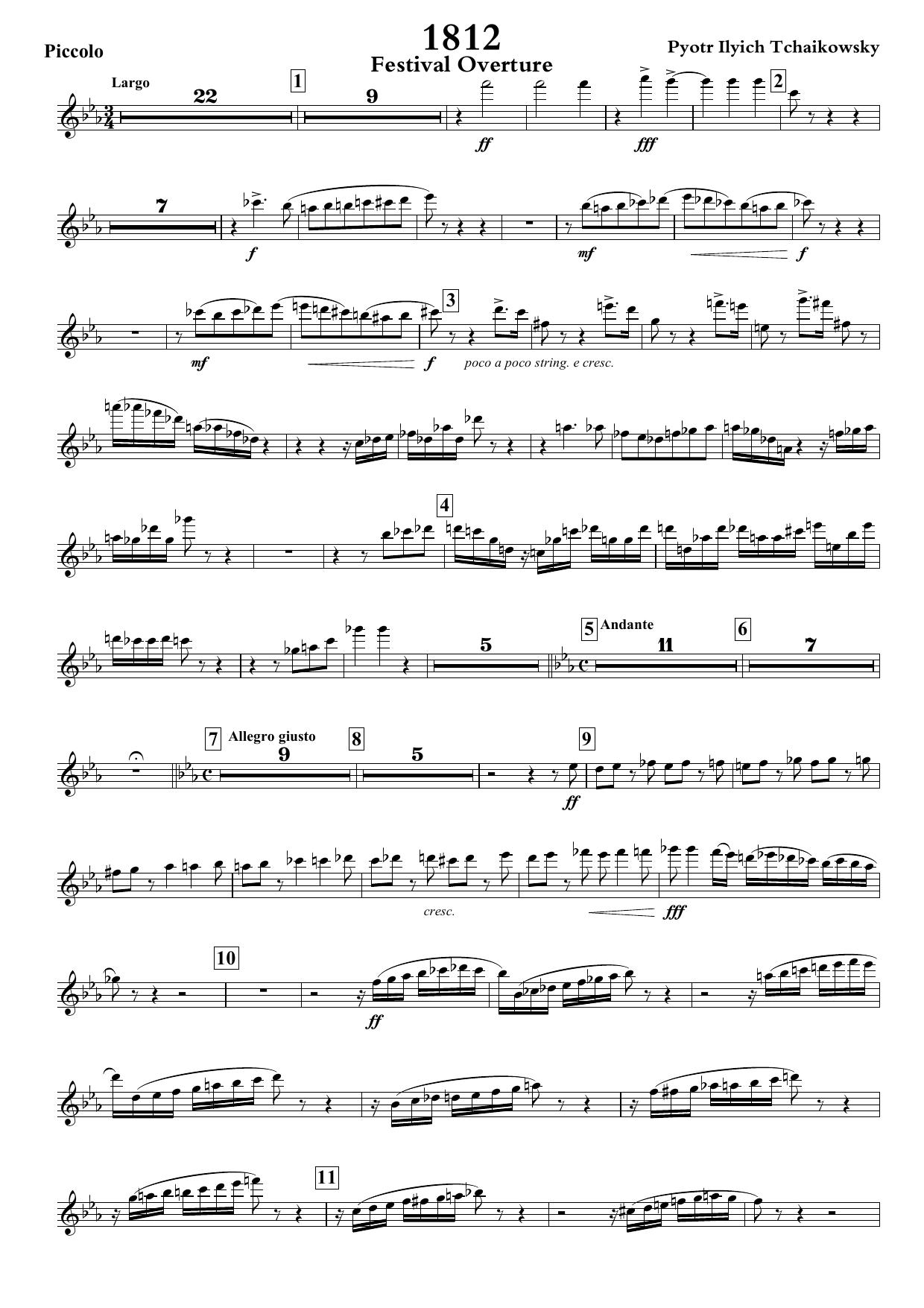
1812 Overture 2
Composed by Pyotr Ilyich Tchaikovsky
- Ensemble: Concert Band
- Pages: 147
- Instruments (16): Flute, Oboe, Clarinet, Bass Clarinet, Alto Sax, Tenor Sax, Baritone Sax, Trumpet, French Horn, Trombone, Baritone, Tuba, Piano, Bass, Drums, Percussion
- Difficulty: advanced
- Content: Individual Parts
- Format: PDF Download (Instant)
- Price: $22.99
Pyotr Ilyich Tchaikovsky's "1812 Overture" stands as one of classical music's most iconic and bombastic compositions, originally penned in 1880 to commemorate Russia's defense against Napoleon's invasion. While not a jazz standard in its original form, its monumental themes, dramatic dynamic shifts, and instantly recognizable melodies offer a fertile ground for imaginative reinterpretation. This particular arrangement, titled "1812 Overture 2," boldly reimagines Tchaikovsky's grandeur through a distinctly jazz lens, transforming the classical warhorse into a sophisticated and swinging concert band showpiece. It bridges the chasm between classical gravitas and jazz improvisation, creating a unique listening and performing experience that is both familiar and refreshingly new. The musical character of "1812 Overture 2" is a captivating blend of reverence and reinvention. It primarily establishes a medium-up swing feel in 4/4, though it skillfully navigates through various grooves, including moments of straight-eighth Latin influence and powerful, driving rock-fusion sections. The original E-flat major tonality is often maintained or cleverly alluded to, providing a grounding point before venturing into more harmonically adventurous territory with extended chords, reharmonizations, and blues-inflected voicings. The overall mood oscillates between triumphant fanfares, playful melodic deconstructions, and deeply soulful, lyrical passages, evoking a sense of epic narrative imbued with jazz's inherent spontaneity and cool. Expect dynamic contrasts from whispering pianissimo to full-throttle fortissimo, mirroring the original's dramatic scope. The unknown arranger of "1812 Overture 2" demonstrates an exceptional command of both Tchaikovsky's original material and contemporary jazz arranging techniques. Distinctive features include intricate counterpoint among the woodwinds, particularly between the Flute, Oboe, and Clarinet, which often carry fragmented melodic ideas or provide rich harmonic padding. There are several powerful soli sections, where instrument families (e.g., the saxophone section or brass) unite for cohesive, driving lines, contrasted by moments where individual voices emerge. A notable feature is the clever integration of Tchaikovsky's famous themes into a jazz idiom; the "La Marseillaise" theme, for instance, might appear as a bluesy call-and-response, while the Russian folk songs are given a sophisticated, swinging treatment. The arrangement features several exciting shout choruses that build to exhilarating climaxes, showcasing the full power of the concert band. Featured solo opportunities are strategically placed, offering improvisational space over sophisticated chord changes, likely for Alto Saxophone, Trumpet, and Trombone, providing a platform for individual expression within the ensemble's framework. This arrangement is highly suitable for advanced high school, collegiate, community, and professional concert bands. Its technical demands, which include complex rhythms, extended ranges for some instruments, and nuanced stylistic interpretation, require a mature ensemble with strong individual players. The rewarding aspect lies in the blend of familiar melodies with challenging jazz harmonies and rhythms, offering both a nod to tradition and a leap into innovation. The sheer scale and ambition of the piece make it an impressive and memorable addition to any concert program, guaranteed to engage both performers and audience members. "1812 Overture 2" demands a meticulous approach to rhythmic precision and stylistic authenticity. Conductors should emphasize a consistent medium-up swing feel throughout the primary sections, ensuring a clear distinction between swung eighths and any straight-eighth passages. Key technical challenges include navigating rapid sixteenth-note runs in the woodwinds, maintaining blend and balance during intricate soli sections, and executing precise dynamic shifts that mirror the original's dramatic intent. The brass section will need strong endurance for sustained fortissimo passages and accurate articulation for fanfares. Special attention should be given to the improvised solo sections; while chord changes are provided, encouraging stylistic improvisation that respects the overall jazz aesthetic is crucial. Rehearsal tips include isolating challenging rhythmic figures, particularly where Tchaikovsky's themes are reharmonized or syncopated. Work on ensemble tuning within the extended harmonies, and ensure that the "cannon shots" (often represented by percussion or powerful brass chords) are impactful but integrated musically. The piece benefits from a clear understanding of its narrative arc, allowing the band to convey the journey from classical bombast to jazz sophistication with conviction. Q: What instruments are included in the "1812 Overture 2" arrangement? A: This arrangement is scored for 16 instruments, typical of a concert band setting. It includes Flute, Oboe, Clarinet, Bass Clarinet, Alto Saxophone, Tenor Saxophone, Baritone Saxophone, Trumpet, French Horn, Trombone, Euphonium, Tuba, and a comprehensive percussion section. Q: What is the difficulty level of "1812 Overture 2"? A: "1812 Overture 2" is considered advanced. It requires strong technical proficiency from all sections, a solid understanding of jazz idioms, and mature musicality to navigate its complex rhythms, harmonies, and stylistic demands. Q: What musical style and historical context does this arrangement represent? A: This arrangement presents a jazz interpretation of Pyotr Ilyich Tchaikovsky's "1812 Overture," originally composed in 1880. It blends the grandeur of late Romantic classical music with contemporary jazz harmonies, rhythms, and improvisational elements. Q: What makes this arrangement of "1812 Overture" unique? A: Its uniqueness lies in its ambitious fusion of classical and jazz, transforming Tchaikovsky's iconic themes into swinging soli sections, sophisticated reharmonizations, and opportunities for jazz improvisation, all while maintaining the original's dramatic scope. Q: What is the approximate performance duration and tempo feel of this piece? A: While specific duration can vary with interpretation, "1812 Overture 2" typically runs between 8-10 minutes. The predominant tempo feel is a medium-up swing, though it incorporates various grooves and tempo changes throughout.
Musicians Also Search For
1812 Overture 2 Pyotr Ilyich Tchaikovsky sheet music • 1812 Overture 2 Pyotr Ilyich Tchaikovsky concert band arrangement • Pyotr Ilyich Tchaikovsky concert band charts • 1812 Overture 2 concert band arrangement • 1812 Overture 2 concert band PDF download • 1812 Overture 2 jazz ensemble sheet music • concert band sheet music instant download • 1812 Overture 2 individual parts download • 1812 Overture 2 sheet music with parts • buy 1812 Overture 2 sheet music online • download 1812 Overture 2 PDF • 1812 Overture 2 jazz chart • 1812 Overture 2 printable sheet music • concert band repertoire PDF