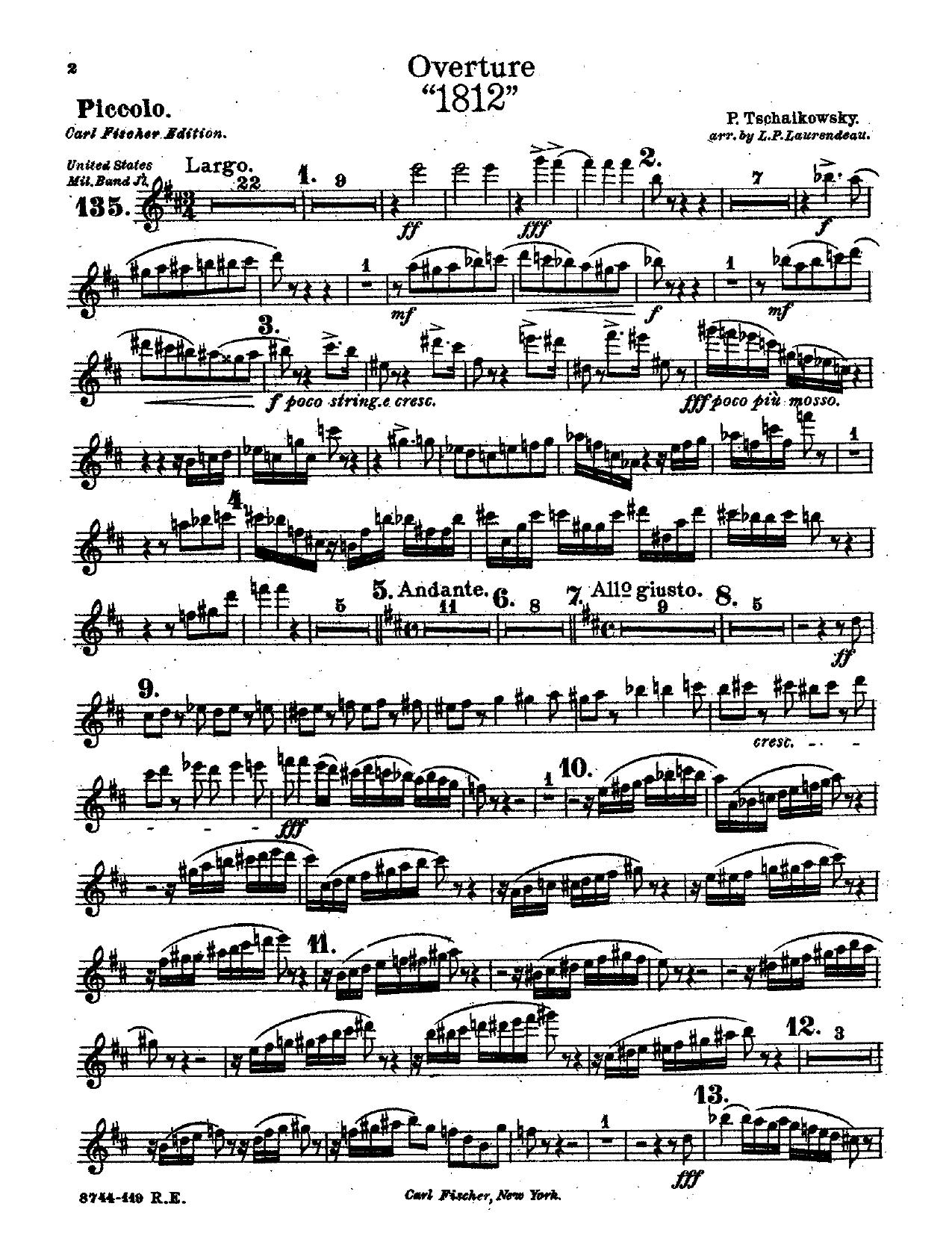
1812 Overture 1 (L.P. Laurendeau)
Composed by Pyotr Ilyich Tchaikovsky
- Ensemble: Concert Band
- Pages: 56
- Instruments (14): Piccolo, Flute in C, Oboes, Bassoons, Eb Clarinet, Solo Bb Clarinet, 1st Bb Clarinet, 2nd & 3rd Bb Clarinets, Alto Clarinet, Bass Clarinet, Soprano Saxophone, Alto Saxophone, Tenor Saxophone, Baritone Saxophone
- Difficulty: advanced
- Content: Individual Parts
- Format: PDF Download (Instant)
- Price: $22.99
Pyotr Ilyich Tchaikovsky's monumental "1812 Overture," originally composed in 1880 to commemorate Russia's defense against Napoleon's invasion, is an iconic work of the Romantic era, renowned for its dramatic scope, powerful orchestration, and the unforgettable inclusion of cannon fire and church bells. While its original form is a staple of classical concert halls, its grand themes and instantly recognizable melodies have long captivated arrangers across genres. This particular arrangement, "1812 Overture 1" by L.P. Laurendeau, reimagines Tchaikovsky's epic in a captivating jazz concert band setting, offering a fresh perspective on a familiar masterpiece. Laurendeau's treatment transforms the classical bombast into a sophisticated, medium-swing jazz experience, maintaining the original's emotional core while infusing it with rhythmic vitality and harmonic richness characteristic of early 20th-century jazz orchestration. The musical character of this arrangement is defined by a consistent, medium-swing feel, primarily in 4/4 time, though it cleverly navigates the original's shifting meters and dramatic pauses. The overall mood is one of celebratory grandeur, infused with the infectious energy of a classic big band. Laurendeau masterfully translates Tchaikovsky's thematic material into a jazz idiom, often presenting the main melodies as full ensemble soli sections, showcasing the concert band's collective power. The arrangement frequently employs lush, block-chord voicings for the brass and woodwinds, creating a rich, harmonically dense sound that is both familiar and distinctly jazz. While the original's key centers are largely respected, Laurendeau introduces subtle blues inflections and extended harmonies, particularly in transitional passages, adding a layer of jazz sophistication without losing the melodic integrity of the source material. Laurendeau's distinctive approach is evident in his meticulous re-orchestration and clever melodic distribution. The arrangement features prominent melodic lines carried by the alto saxophone and clarinet in unison or octaves, often supported by the flute and oboe, giving the woodwind section a central role. Brass sections contribute powerful fanfares and rhythmic punctuations, building to climactic shout choruses that evoke the grandeur of the original while swinging with undeniable force. While specific improvised solos are not explicitly notated in this early jazz-era arrangement, the open, often call-and-response nature of certain sections provides opportunities for stylistic interpretation and expressive playing from lead voices. Technical challenges include maintaining precise ensemble articulation in the intricate soli passages, achieving a unified swing feel across the diverse instrumentation, and navigating the dynamic contrasts essential to Tchaikovsky's original vision. The reward lies in performing a truly unique fusion of classical majesty and jazz exuberance, offering both musicians and audiences a compelling and surprising musical journey. This arrangement is ideally suited for advanced high school, college, community, and professional concert bands seeking a challenging yet highly rewarding piece that bridges classical and jazz traditions. Its substantial instrumentation (16 distinct parts across 56 pages) demands a well-balanced and proficient ensemble capable of executing complex ensemble figures and maintaining a cohesive jazz aesthetic. The blend of familiar melodies with fresh, swinging harmonies makes it an excellent choice for concert programs looking to engage diverse audiences and showcase the versatility of the modern concert band. Conductors should establish a consistent, medium-swing feel from the outset, emphasizing a relaxed yet driving pulse. Articulation is paramount; differentiate clearly between sustained notes, staccato figures, and marcato accents to bring out the rhythmic nuances inherent in the jazz interpretation. Pay close attention to dynamics, as Laurendeau retains much of Tchaikovsky's dramatic range, from delicate woodwind passages to powerful brass fanfares. Rehearsal time should focus on balancing the intricate woodwind soli sections, ensuring clarity and blend. For the brass, precise attacks and releases are crucial, particularly in the shout choruses, to achieve maximum impact. While no specific jazz techniques like plunger mutes or falls are explicitly notated, encouraging a stylistic approach to phrasing, especially in the lead voices, will enhance the jazz character. Sectional rehearsals are highly recommended for the woodwinds and brass to perfect their respective soli passages before combining. Q: What instruments are included in this arrangement? A: This arrangement is scored for a concert band with 16 distinct instrument parts, including Flute, Oboe, Clarinet, Bass Clarinet, Alto Saxophone, and other standard concert band instrumentation. The full score is 56 pages. Q: What is the difficulty level of "1812 Overture 1 (L.P. Laurendeau)"? A: This arrangement is considered advanced, suitable for proficient high school, college, community, and professional concert bands. It requires strong ensemble playing, precise articulation, and a solid understanding of jazz rhythmic interpretation. Q: What is the musical style and historical context of this arrangement? A: This is a jazz arrangement of Pyotr Ilyich Tchaikovsky's "1812 Overture," reimagined in a medium-swing style. It represents an early 20th-century jazz orchestration approach to a classical masterpiece. Q: What makes this L.P. Laurendeau arrangement unique? A: Laurendeau's arrangement uniquely transforms Tchaikovsky's classical epic into a sophisticated, medium-swing jazz concert band piece. It features lush block-chord voicings, prominent woodwind soli, and powerful brass shout choruses, blending classical grandeur with jazz vitality. Q: What is the approximate performance duration or tempo of this piece? A: The arrangement maintains a consistent medium-swing tempo throughout. While the exact duration can vary with interpretation, expect a performance time similar to a standard concert band overture, likely in the 6-8 minute range, depending on the conductor's pacing.
Questions and answers
- What is included in the 1812 Overture 1 (L.P. Laurendeau) PDF?
- The verified current file contains individual parts across 56 pages.
- How many instruments or parts are listed for 1812 Overture 1 (L.P. Laurendeau)?
- The verified instrumentation list contains 14 entries for this Concert Band arrangement.
- Who is credited for 1812 Overture 1 (L.P. Laurendeau)?
- Composer: Pyotr Ilyich Tchaikovsky.
- What difficulty is listed for 1812 Overture 1 (L.P. Laurendeau)?
- The verified difficulty level is advanced.
- Can I preview 1812 Overture 1 (L.P. Laurendeau) before buying?
- Yes. The product page provides a preview generated from the current PDF file.
- How is 1812 Overture 1 (L.P. Laurendeau) delivered?
- After successful payment, the digital PDF is made available for download. The displayed price is $22.99.
Musicians Also Search For
1812 Overture 1 Pyotr Ilyich Tchaikovsky sheet music • 1812 Overture 1 Pyotr Ilyich Tchaikovsky concert band arrangements • Pyotr Ilyich Tchaikovsky concert band charts • 1812 Overture 1 concert band arrangements • 1812 Overture 1 concert band PDF download • 1812 Overture 1 jazz sheet music • concert band sheet music download • 1812 Overture 1 individual parts download • 1812 Overture 1 sheet music PDF • buy 1812 Overture 1 sheet music • download 1812 Overture 1 PDF • 1812 Overture 1 jazz charts • 1812 Overture 1 printable sheet music • concert band repertoire PDF