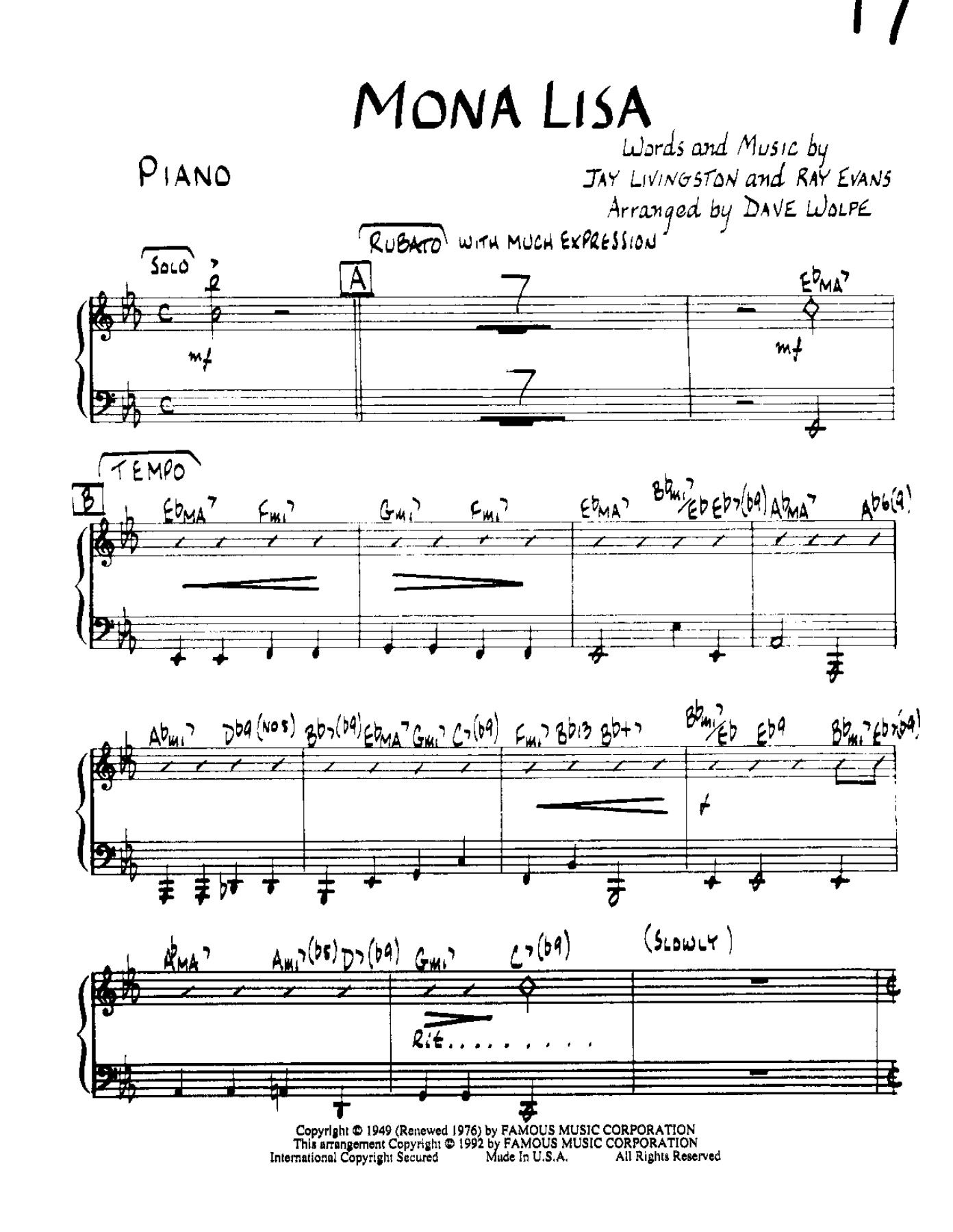
Mona Lisa-Piano (comp. Jay Livingston)
Composed by Jay Livingston, Ray Evans
Arranged by Unknown Arranger
- Ensemble: Small Ensemble
- Style: Ballad
- Pages: 3
- Difficulty: easy
- Content: Sheet Music
- Format: PDF Download (Instant)
- Price: $12.99
The timeless ballad "Mona Lisa," originally composed by the prolific songwriting duo Jay Livingston and Ray Evans, emerged as a cultural phenomenon in 1950. Its enduring popularity is largely attributed to Nat King Cole's iconic rendition, which topped the charts and earned an Academy Award for Best Original Song. This piece epitomizes the sophisticated, romantic balladry prevalent in the mid-20th century, a golden era for vocal jazz and pop standards. Its melodic simplicity, coupled with a rich harmonic foundation, has cemented its status as a beloved standard, frequently revisited by jazz instrumentalists and vocalists alike. The song's evocative nature, drawing parallels between a mysterious woman and Leonardo da Vinci's masterpiece, has captivated audiences for decades, making it a staple in the Great American Songbook. This small ensemble arrangement of "Mona Lisa" is presented as a slow, reflective ballad, designed to evoke a profound sense of intimacy and melancholic beauty. The arrangement is primarily in the key of E-flat major, lending itself to a warm, resonant timbre that enhances the song's inherent romanticism. The tempo should be approached with a delicate rubato feel, allowing for expressive phrasing and dynamic nuance rather than a strict metronomic pulse. The mood is one of tender introspection, building to moments of understated passion before returning to a contemplative serenity. The arrangement's strength lies in its ability to translate the song's vocal lyricism into an instrumental tapestry, maintaining the original's emotional core while offering new interpretative possibilities. While the arranger remains unknown, their approach to "Mona Lisa" demonstrates a clear understanding of ballad aesthetics and small ensemble dynamics. The arrangement features the piano prominently, carrying the primary melodic statements with elegant voicings that are both harmonically rich and idiomatically appropriate. The melodic lines are often doubled or harmonized in a way that creates a lush, sustained sound, emphasizing the song's lyrical quality. There are no extended soli sections or shout choruses, as the focus remains on the cohesive ensemble sound and the expressive contour of the melody. Instead, the arrangement relies on subtle counter-melodies and harmonic embellishments to provide interest and depth. The technical demands are moderate, focusing more on musicality, blend, and sensitive phrasing than on virtuosic display. Performing this arrangement is a rewarding experience, particularly for ensembles capable of achieving a high level of musical sensitivity and dynamic control. The melody is primarily carried by the piano, with other instruments providing harmonic support and subtle counterpoint. There are no designated improvised solo sections, allowing the ensemble to focus on a unified interpretation of the written material. The challenge lies in maintaining a consistent, expressive tone throughout the slow tempo, ensuring that each phrase breathes naturally and contributes to the overall narrative. This arrangement is ideally suited for college-level ensembles, community jazz groups, or professional musicians seeking a refined and heartfelt rendition of a classic standard. Its three-page length makes it concise yet musically complete, perfect for setting a reflective mood in a concert program or intimate performance setting. Approach "Mona Lisa" as a slow, expressive ballad, emphasizing a flexible rubato feel rather than a strict tempo. The designated tempo is around quarter note = 50-60 bpm, but encourage musicians to breathe with the phrases. The primary technical challenge lies in achieving a unified, sustained tone, especially in the long notes and harmonized sections. Focus on blend and intonation, particularly in the softer dynamics. Piano voicings should be executed with warmth and clarity, ensuring the melody sings above the accompaniment. No special techniques like mutes or falls are required; the focus is purely on lyrical playing and sensitive dynamic shaping. Rehearsal should prioritize listening across the ensemble, ensuring that the harmonic motion is smooth and the melodic lines are beautifully articulated and balanced. Q: What instruments or parts are included in this "Mona Lisa" arrangement? A: This arrangement is for a small ensemble, with the primary melodic lines and harmonic foundation centered around the piano. Specific instrumentation beyond the piano would need to be inferred or provided separately, but it's designed for a compact group. Q: What is the difficulty level of this arrangement? A: This arrangement is rated as moderate difficulty. It requires strong musicality, excellent blend, and sensitive phrasing, but does not demand advanced technical virtuosity or extended improvisation. Q: What is the musical style and historical context of "Mona Lisa"? A: "Mona Lisa" is a classic jazz ballad from 1950, famously performed by Nat King Cole. It embodies the romantic, sophisticated pop and jazz standards of the mid-20th century, characterized by lush harmonies and lyrical melodies. Q: What makes this specific arrangement unique compared to other versions of "Mona Lisa"? A: This arrangement distinguishes itself through its focus on a cohesive small ensemble sound, with the piano taking a prominent role in carrying the melody through elegant, harmonically rich voicings. It emphasizes a unified, expressive interpretation over individual improvisation. Q: What is the typical performance duration or tempo for this arrangement? A: This arrangement is intended as a slow ballad, with a suggested tempo around quarter note = 50-60 bpm. Performance duration will vary slightly based on expressive rubato, but typically ranges from 3 to 4 minutes.
Musicians Also Search For
Mona Lisa-Piano Unknown Arranger PDF • Mona Lisa-Piano Unknown Arranger sheet music • Mona Lisa-Piano arranged by Unknown Arranger • Unknown Arranger small ensemble charts • Unknown Arranger jazz arrangements PDF • Mona Lisa-Piano Jay Livingston, Ray Evans sheet music • Mona Lisa-Piano Jay Livingston, Ray Evans small ensemble arrangement • Jay Livingston, Ray Evans small ensemble charts • Mona Lisa-Piano small ensemble arrangement • Mona Lisa-Piano small ensemble PDF download • Mona Lisa-Piano jazz ensemble sheet music • small ensemble sheet music instant download • Mona Lisa-Piano sheet music with parts • Mona Lisa-Piano Ballad chart • Ballad small ensemble arrangements • buy Mona Lisa-Piano sheet music online • download Mona Lisa-Piano PDF • Mona Lisa-Piano jazz chart • best Unknown Arranger small ensemble arrangements • Jay Livingston, Ray Evans songs arranged by Unknown Arranger • Mona Lisa-Piano printable sheet music • small ensemble repertoire PDF