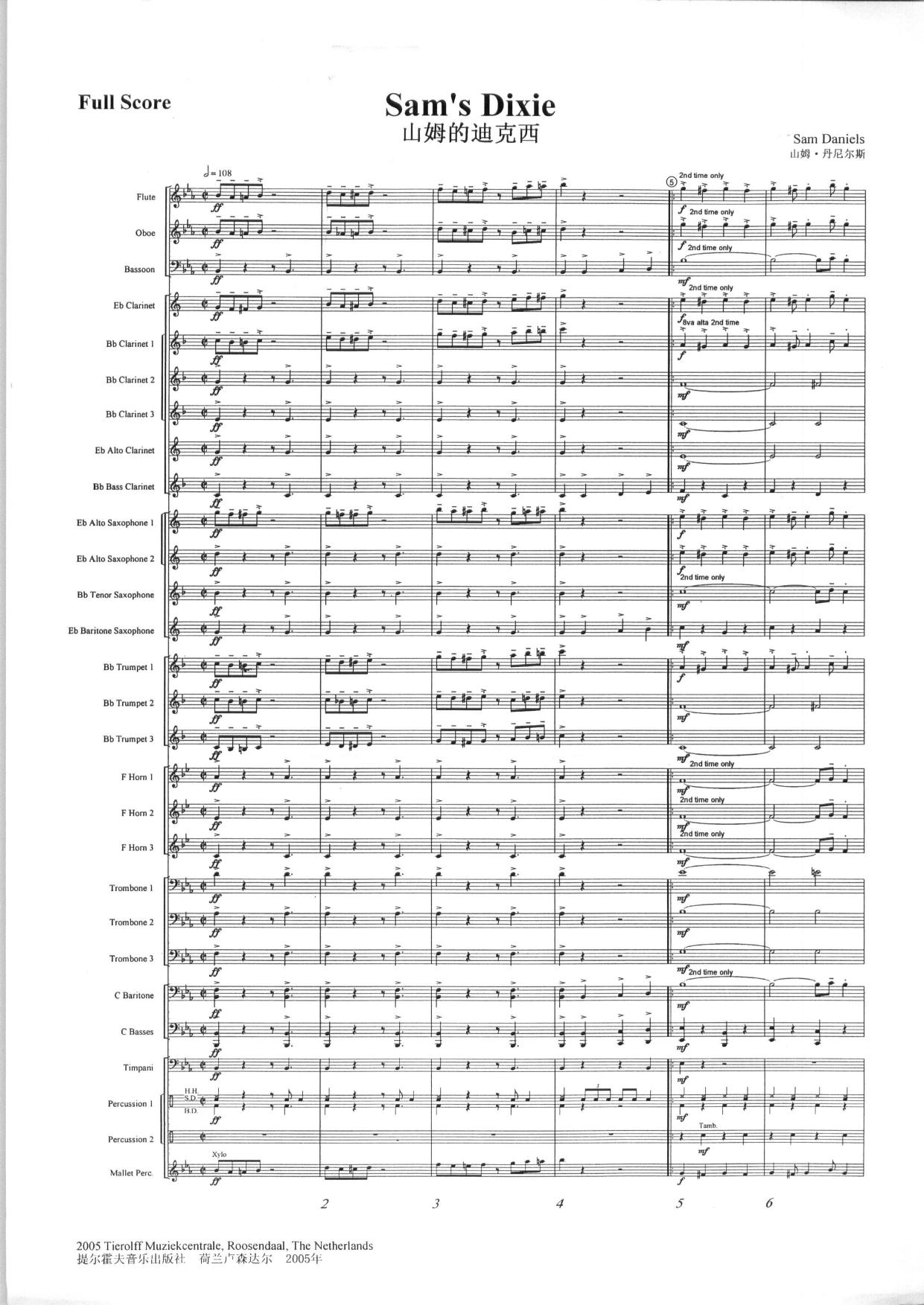
Sam's Dixie (S.Daniels)
Compuesto por S. Daniels
- Tipo de conjunto: Concert Band
- Páginas: 42 páginas
- Instrumentos (27): Flute, Oboe, Bassoon, Eb Clarinet, 1st Clarinet, 2nd Clarinet, 3rd Clarinet, Alto Clarinet, Bass Clarinet, 1st Alto Saxophone, 2nd Alto Saxophone, Tenor Saxophone, Baritone Saxophone, 1st & 2nd Horn, 3rd Horn, 1st Trumpet, 2nd Trumpet, 3rd Trumpet, 1st Trombone, 2nd Trombone, 3rd Trombone, Baritone, Tuba, Timpani, Percussion 1, Percussion 2, Mallet Percussion
- Dificultad: medium
- Contenido: Partes individuales
- Formato: Descarga PDF (Instantánea)
- Precio: $22.99
"Sam's Dixie," obra original de S. Daniels, emerge del vibrante tapiz de la música estadounidense de principios del siglo XX, capturando el espíritu contagioso y la energía improvisada característicos del jazz Dixieland tradicional. Aunque su contexto histórico exacto es algo elusivo, el título y la instrumentación sugieren sus raíces en los movimientos de resurgimiento Dixieland o composiciones influenciadas por el estilo de Nueva Orleans, popular entre 1910 y 1930. Este arreglo para banda de concierto de "Sam's Dixie" es una exploración enérgica y exuberante del idioma Dixieland, predominantemente en un brillante 2/4 o *cut-time*, enfatizando un pulso alegre y propulsor. La tonalidad, probablemente en una clave mayor como Si bemol o Fa, contribuye a su ambiente optimista. El arreglista, aunque anónimo, demuestra una profunda comprensión de las voces Dixieland y la adaptación orquestal, traduciendo los característicos *obbligatos* de clarinete, las líneas principales de trompeta y los *smears* de trombón a una banda de concierto completa sin sacrificar el encanto original. Espere una articulación nítida, ritmos sincopados que impulsan la pieza y una atmósfera general de alegría. El arreglo equilibra hábilmente los distintos timbres de las secciones de viento madera y metal, creando un sonido rico y completo que se mantiene fiel a la esencia desenfadada del estilo. La melodía a menudo rota entre las secciones de flautín/flauta, clarinetes y trompetas, asegurando un paisaje textural variado. Las secciones de *soli* para las maderas, particularmente los clarinetes, son prominentes, imitando las improvisaciones virtuosas del estilo original. Es probable que haya oportunidades de solo destacadas para instrumentos como el clarinete, la trompeta o el trombón, permitiendo que los músicos individuales brillen con improvisaciones cortas e idiomáticas o solos escritos que capturan el lenguaje melódico de la época. El arreglo se construye a través de contrastes dinámicos y densidad textural, culminando en un coro *shout* que une todas las secciones en una declaración poderosa y armónicamente rica. Los desafíos técnicos incluyen mantener una articulación precisa a un tempo rápido, navegar contramelodías intrincadas y lograr una sensación rítmica unificada pero flexible. El aspecto gratificante reside en la pura alegría de interpretar esta música enérgica y la inevitable respuesta positiva del público. Este arreglo es ideal para bandas de concierto de preparatoria, universidad y comunitarias que buscan explorar los sonidos fundamentales del jazz en un entorno de concierto. Su naturaleza accesible pero atractiva lo convierte en una excelente opción para desarrollar la precisión rítmica, la mezcla del conjunto y la comprensión de los estilos de jazz temprano. Las líneas melódicas claras y las armonías bien elaboradas proporcionan un marco sólido para que las bandas experimenten la energía contagiosa del Dixieland, convirtiéndolo en una valiosa adición a cualquier programa de concierto que busque una pieza que sea tanto históricamente significativa como inmensamente agradable de interpretar. "Sam's Dixie" exige una sensación de 2/4 o *cut-time* enérgica y propulsora, con un fuerte énfasis en la articulación precisa y la claridad rítmica. Apunte a un tempo de negra = 160-180 BPM, asegurando que las corcheas tengan una calidad nítida, ligeramente separada en lugar de un *legato swing*. Los desafíos técnicos incluyen rápidas carreras de viento madera, particularmente en las partes de clarinete y flauta, que requieren una digitación limpia y apoyo respiratorio. Los metales deben enfocarse en un tono brillante y enfocado y ataques precisos, especialmente en las figuras sincopadas. La sección de trombones se beneficiará de la incorporación de sutiles *glissandi* o "smears" cuando sea apropiado para capturar el carácter Dixieland, aunque estos deben ejecutarse con buen gusto y sin exagerar. El ensayo debe priorizar el unísono rítmico y la claridad en las contramelodías, asegurando que las líneas individuales contribuyan a la textura general sin volverse turbias. Preste mucha atención a los contrastes dinámicos para resaltar las tareas melódicas rotativas y aumentar la emoción hacia el coro *shout*. No se requieren sordinas especiales explícitamente, pero los metales deben estar preparados para sonidos brillantes y abiertos. P: ¿Qué instrumentos se incluyen en este arreglo de "Sam's Dixie"? R: Este arreglo está orquestado para una banda de concierto completa de 16 instrumentos, incluyendo específicamente flautín, flauta, oboe, clarinete, clarinete bajo y un complemento completo de metales y percusión, distribuidos en 42 páginas de partitura y partes. P: ¿Cuál es el nivel de dificultad de "Sam's Dixie" para banda de concierto? R: Este arreglo es adecuado para bandas de concierto de preparatoria, universidad y comunitarias. Presenta desafíos técnicos moderados, particularmente en articulación y precisión rítmica a un tempo vivo, lo que lo convierte en una excelente pieza para el desarrollo de conjuntos. P: ¿Qué estilo musical y contexto histórico representa "Sam's Dixie"? R: "Sam's Dixie" es una pieza de tempo rápido firmemente arraigada en la tradición del jazz Dixieland de principios del siglo XX. Captura el espíritu alegre e improvisador y el contrapunto colectivo característico del jazz de Nueva Orleans. P: ¿Qué hace que este arreglo específico de "Sam's Dixie" sea único? R: Este arreglo traduce de manera única la naturaleza íntima e improvisada del jazz Dixieland al entorno de la banda de concierto más amplia, distribuyendo hábilmente los roles tradicionales en todo el conjunto mientras mantiene el carácter auténtico, presentando melodías rotativas y secciones de *soli* enérgicas. P: ¿Cuál es la duración aproximada de la interpretación y el tempo recomendado para esta pieza? R: Si bien la duración específica puede variar con la interpretación, "Sam's Dixie" generalmente se interpreta en un rango de 2:30 a 3:30 minutos. Debe tocarse a un tempo brillante y propulsor, idealmente alrededor de negra = 160-180 BPM, con una sensación clara de 2/4 o *cut-time*.
Preguntas y respuestas
- ¿Qué contiene el PDF de «Sam's Dixie (S.Daniels)»?
- El archivo verificado contiene partitura de director y partes individuales en 42 páginas.
- ¿Cuántos instrumentos o partes se indican para «Sam's Dixie (S.Daniels)»?
- La lista verificada contiene 27 entradas para este arreglo de Concert Band.
- ¿Qué créditos aparecen para «Sam's Dixie (S.Daniels)»?
- Compositor: S. Daniels.
- ¿Qué dificultad se indica para «Sam's Dixie (S.Daniels)»?
- La dificultad verificada es medium.
- ¿Puedo ver una vista previa de «Sam's Dixie (S.Daniels)»?
- Sí. La página del producto muestra una vista previa del PDF actual.
- ¿Cómo se entrega «Sam's Dixie (S.Daniels)»?
- Tras confirmar el pago, el PDF digital queda disponible para descargar. El precio mostrado es $22.99.
Los músicos también buscan
Sam's Dixie S. Daniels partituras • Sam's Dixie S. Daniels concert band arreglos • S. Daniels concert band partituras • Sam's Dixie concert band arreglos • Sam's Dixie concert band PDF descargar • Sam's Dixie jazz partituras • concert band partituras descargar • Sam's Dixie partitura director PDF • Sam's Dixie partes individuales descargar • Sam's Dixie partituras PDF • comprar Sam's Dixie partituras • descargar Sam's Dixie PDF • Sam's Dixie partituras imprimibles • concert band repertorio PDF