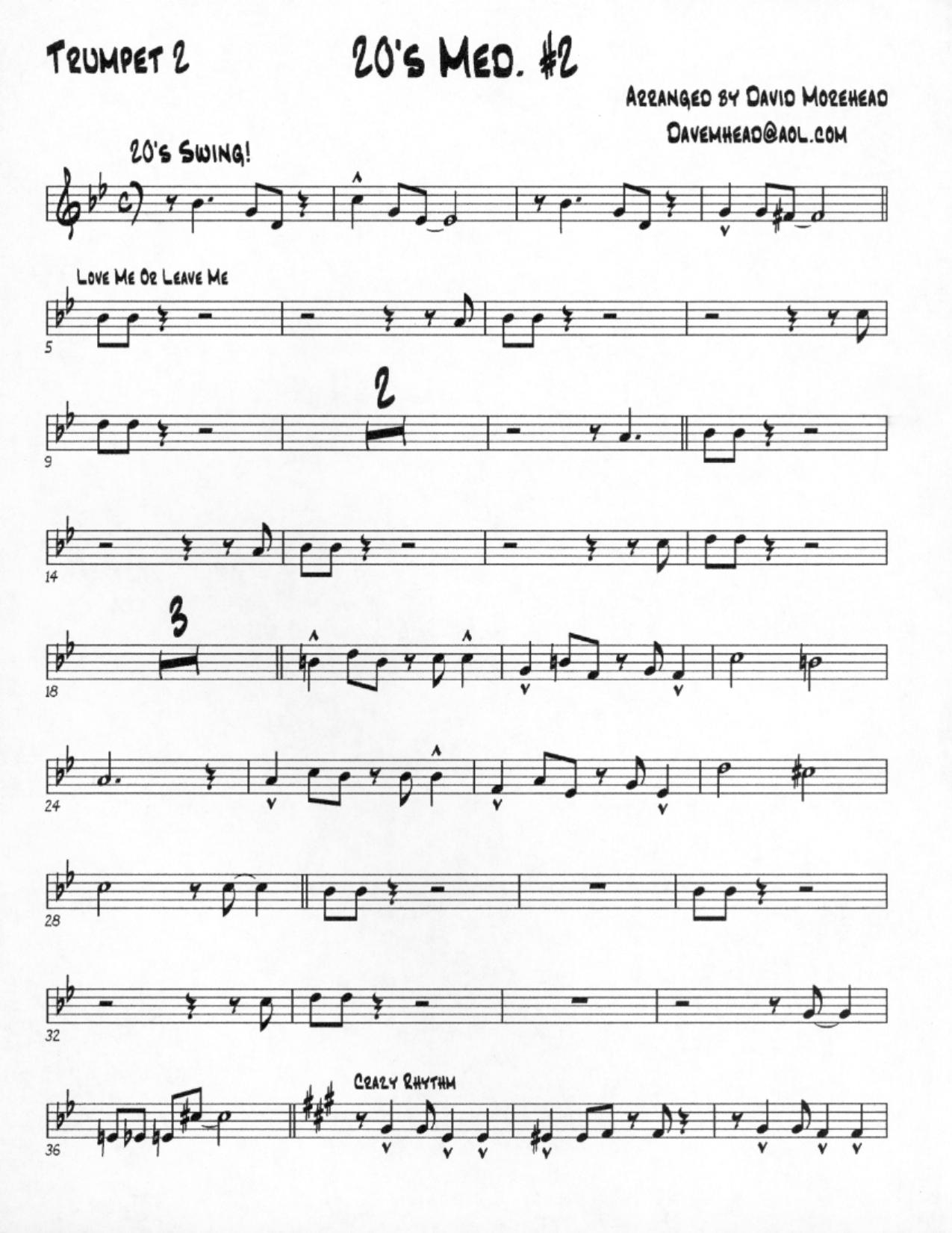
20s2_trumpet2 (D.Morehead)
Composed by David Morehead
Arranged by David Morehead
- Ensemble: Small Ensemble
- Style: Dixieland
- Pages: 3
- Difficulty: easy
- Content: Sheet Music
- Format: PDF Download (Instant)
- Price: $12.99
"20s2_trumpet2 (D.Morehead)" transports musicians and audiences alike back to the vibrant, syncopated world of early jazz, specifically the Dixieland era that flourished in the 1920s. This period, characterized by its collective improvisation, spirited melodies, and driving rhythmic energy, laid the foundational groundwork for much of the jazz that followed. While the original composer, David Morehead, penned this piece in a contemporary context, it is deeply steeped in the stylistic conventions and joyous exuberance of traditional Dixieland. It evokes the lively atmosphere of New Orleans street parades and speakeasy dance floors, making it a quintessential representation of jazz's formative years. The piece is designed to capture the spontaneous, celebratory feel that made Dixieland a beloved and enduring genre, rather than being a direct transcription of a historical work. The musical character of "20s2_trumpet2 (D.Morehead)" is defined by an up-tempo, driving 2-beat feel, typical of classic Dixieland. While the specific key is not provided, Morehead's arrangements in this style often favor accessible keys like C, F, or Bb to facilitate the collective improvisation and melodic interplay characteristic of the genre. The mood is unequivocally ebullient and infectious, designed to evoke smiles and toe-tapping. The energy is consistently high, propelled by a strong rhythmic foundation and interwoven melodic lines. This arrangement prioritizes clarity and melodic distinction within the ensemble, ensuring that each voice contributes to the overall jubilant tapestry. It aims to be a feel-good piece that brings a sense of historical authenticity and pure musical joy to any performance. David Morehead's approach to Dixieland arrangements is marked by a deep respect for the tradition combined with a practical understanding of modern ensemble needs. For "20s2_trumpet2 (D.Morehead)", his signature techniques include carefully crafted melodic lines that allow for individual expression while maintaining ensemble cohesion. Expect clear, articulate voicings that highlight the brass and reed sections, often featuring a prominent trumpet lead, as suggested by the title. While traditional Dixieland often features extensive collective improvisation, Morehead structures this arrangement to provide both written material that captures the style's essence and ample opportunities for improvised solos, particularly for the trumpet. His arrangements frequently feature a dynamic interplay between ensemble sections and solo breaks, building to spirited shout choruses that underscore the piece's celebratory nature. There are no complex modulations or extended harmonies that would detract from the authentic Dixieland sound; rather, the focus is on rhythmic precision, melodic charm, and the infectious energy of the era. Performance of "20s2_trumpet2 (D.Morehead)" will find the trumpet carrying the primary melody for significant portions, often in a bright, declarative manner. There are featured solo sections, most notably for the trumpet, providing an opportunity for individual improvisation within the Dixieland framework. Technical challenges will include maintaining a crisp, energetic articulation at an up-tempo, ensuring rhythmic precision in the collective sections, and navigating the characteristic Dixieland melodic ornamentation. The reward lies in the sheer joy of performing this spirited music, the opportunity for expressive improvisation, and the audience's enthusiastic response to its infectious charm. This arrangement is highly suitable for high school, college, and community jazz ensembles looking to explore or master the Dixieland style. Its clear structure and engaging musical content make it an excellent teaching tool for understanding early jazz idioms, while still offering enough challenge and expressive freedom for more experienced players to find it deeply rewarding. Conductors should emphasize a crisp, driving 2-beat feel at an up-tempo, ensuring the rhythm section provides a solid, unwavering foundation. Articulation is key; encourage brass players to use a bright, staccato approach for melodic figures, while woodwinds should maintain a light, agile sound. The collective improvisation sections, particularly the "Dixieland chorus," require careful listening and balance, with the lead trumpet maintaining melodic prominence while other voices weave around it. Rehearsal should focus on rhythmic precision in the ensemble passages and developing a cohesive, yet spontaneous, sound in the improvised sections. Encourage soloists, especially the trumpet, to embrace the melodic and rhythmic vocabulary of Dixieland, utilizing bends, scoops, and blues inflections. No special mutes or extended techniques are explicitly required, though optional plunger mute work could add authentic color to brass solos. Q: What instruments and parts are included in the "20s2_trumpet2 (D.Morehead)" arrangement? A: This arrangement is designed for a small Dixieland-style ensemble. While specific instrumentation is not detailed, it typically includes parts for trumpet, clarinet, trombone, and a rhythm section comprising piano, bass, and drums. Q: What is the difficulty level of this arrangement? A: "20s2_trumpet2 (D.Morehead)" is rated as an intermediate-level arrangement, suitable for high school, college, and community jazz ensembles. It offers engaging challenges in articulation and ensemble precision, alongside opportunities for improvisation. Q: What musical style and historical context does "20s2_trumpet2 (D.Morehead)" represent? A: This piece is firmly rooted in the Dixieland jazz style of the 1920s. It captures the spirited, collective improvisation and infectious rhythmic energy characteristic of early New Orleans jazz. Q: What makes David Morehead's arrangement of "20s2_trumpet2" unique? A: David Morehead's arrangement uniquely blends traditional Dixieland stylistic elements with a clear, structured approach, making it accessible for modern ensembles. It features well-defined melodic lines, spirited ensemble sections, and prominent solo opportunities, particularly for the trumpet. Q: What is the typical performance duration and tempo for "20s2_trumpet2 (D.Morehead)"? A: The arrangement is intended for an up-tempo, driving 2-beat feel. While exact duration can vary with improvised solos, a typical performance would likely range from 3 to 5 minutes, depending on the number and length of solos taken.
Musicians Also Search For
20s2_trumpet2 David Morehead PDF • 20s2_trumpet2 David Morehead sheet music • 20s2_trumpet2 arranged by David Morehead • David Morehead small ensemble charts • David Morehead jazz arrangements PDF • 20s2_trumpet2 David Morehead small ensemble arrangement • 20s2_trumpet2 small ensemble arrangement • 20s2_trumpet2 small ensemble PDF download • 20s2_trumpet2 jazz ensemble sheet music • small ensemble sheet music instant download • 20s2_trumpet2 sheet music with parts • 20s2_trumpet2 Dixieland chart • Dixieland small ensemble arrangements • buy 20s2_trumpet2 sheet music online • download 20s2_trumpet2 PDF • 20s2_trumpet2 jazz chart • best David Morehead small ensemble arrangements • 20s2_trumpet2 printable sheet music • small ensemble repertoire PDF