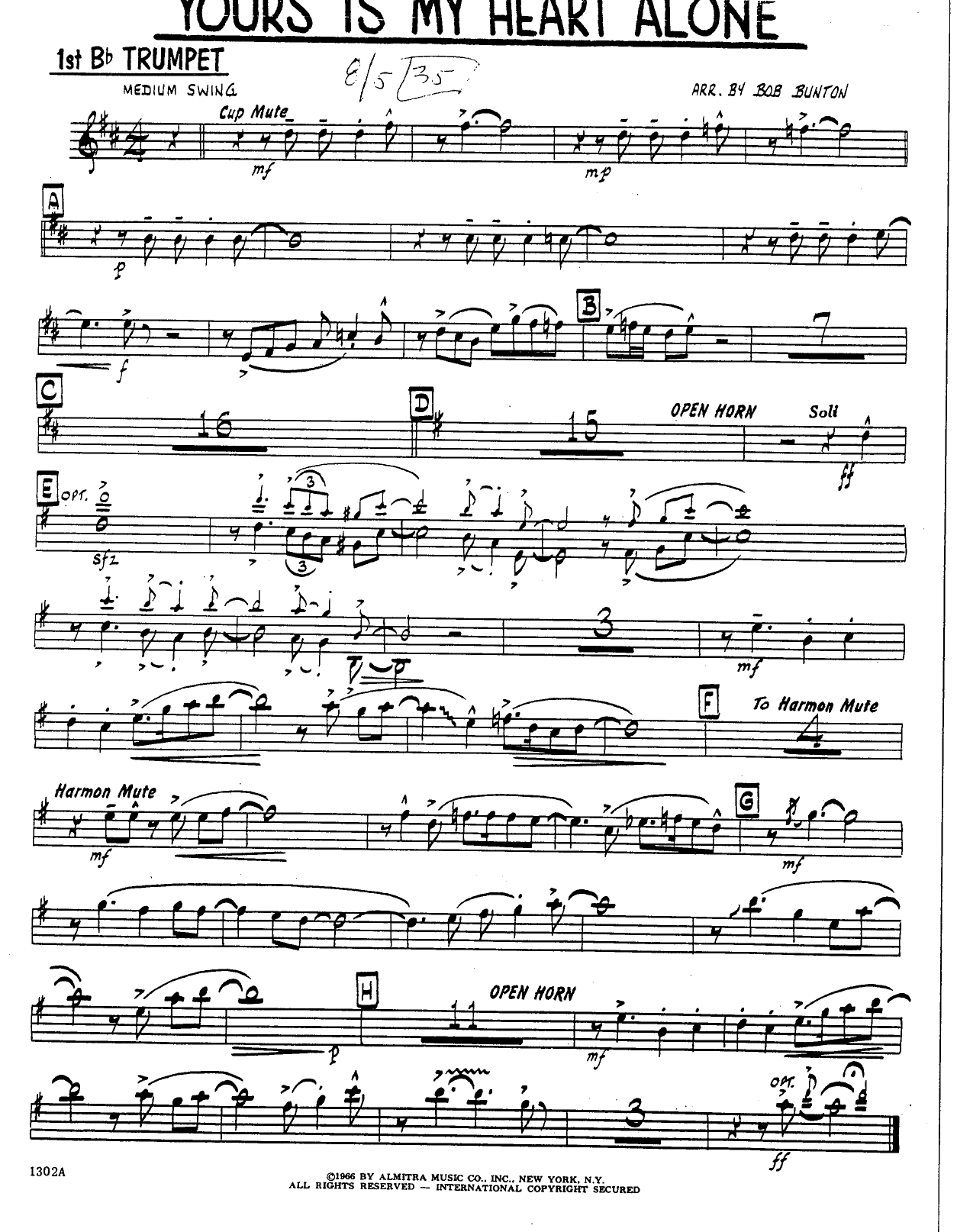
Yours Is My Heart Alone (B.Bunton-Lehar) sheet music preview

Yours Is My Heart Alone (B.Bunton-Lehar)

Composed by Franz Lehár

Arranged by Glen Miller

  • Ensemble: Big Band
  • Pages: 35
  • Instruments (17): 1st Bb Trumpet, 2nd Bb Trumpet, 3rd Bb Trumpet, 4th Bb Trumpet, 1st Trombone, 2nd Trombone, 3rd Trombone, 4th Trombone, 1st Eb Alto Sax, 3rd Eb Alto Sax, 2nd Bb Tenor Sax, 4th Bb Tenor Sax, 5th Eb Baritone Sax, Bass, Drums, Guitar, Piano
  • Difficulty: medium
  • Content: Individual Parts
  • Format: PDF Download (Instant)
  • Price: $24.99

Franz Lehár originally composed the timeless melody for his 1929 operetta *The Land of Smiles*, where it triumphed as the iconic tenor aria "Dein ist mein ganzes Herz". Transformed over subsequent decades into a cherished standard within the American songbook, the composition found a brilliant new life during the golden era of swing through the legendary Glenn Miller Orchestra. The iconic treatment featured here encapsulates the sophisticated arranging genius associated with Miller’s stable—specifically highlighting the signature harmonic and textural concepts that defined the soundscape of 1940s big band jazz. Bridging European operatic romanticism with American swing syncopation, the work stands out as an ingenious translation of classical lyricism into a high-energy, danceable jazz idiom. Propelled by a vibrant medium-up swing groove, the chart opens in F major before executing smooth, artful key modulations that elevate the emotional intensity. The mood balances sophisticated elegance with infectious rhythmic drive, evoking the suave elegance of metropolitan ballroom culture alongside the raw excitement of a packed 1940s dance hall. Rather than relying on a traditional spoken introduction, the arrangement dives straight into the thematic material, establishing a lush, captivating atmosphere from downbeat one. The emotional arc builds progressively, moving from warm, inviting melodic statements to roaring, triumphant climaxes that showcase the full dynamic breadth of a powerhouse jazz ensemble. The arranging approach relies heavily on classic Miller-era voicings, most notably utilizing the distinctive clarinet-led reed section blending smoothly with two altos and two tenors. Though this specific woodwind configuration was more frequently reserved for relaxed ballads, it functions remarkably well within this up-tempo framework, cutting through the ensemble texture with pristine clarity. The first chorus features the reeds delivering the primary melody backed by subtle, muted brass. An eight-measure modulation shifts the key to A-flat major, seamlessly handing developmental weight to the trombone section while trumpets add punchy counter-lines during the middle eight. A secondary modulation into D-flat major sparks a thrilling shout chorus, pairing soaring, harmonized reeds against wide-open, assertive brass declarations to drive the composition toward its rousing finale. Carrying the melodic weight demands precision from the entire woodwind and brass families, with particular technical focus placed on the synchronized phrasing of the reed section and the agility of the lower brass. Performers will encounter intricate swing subdivisions, dynamic contrast management, and tight ensemble blend requirements that test articulation uniformity across all sections. Advanced high school, collegiate, and professional big bands will find this chart exceptionally rewarding, as it offers an authentic masterclass in 1940s stylistic execution. Programmatic placement benefits immensely from utilizing this piece as a sophisticated stylistic anchor or dynamic showstopper in any comprehensive swing-era concert repertoire. Achieving an authentic period sound requires meticulous attention to articulation and balance. The overarching tempo should settle comfortably into a bright medium swing feel (approx. 152–160 BPM)—avoiding a rushed feel so the underlying triplet subdivisions remain relaxed and buoyant. The primary technical challenge lies in the execution of the tight reed soli sections; the lead clarinet must project clearly over the saxophones while maintaining a uniform vibrato and blend characteristic of the classic 1940s style. Brass players must exercise strict dynamic control during the muted accompaniment passages in the opening chorus, ensuring the cup and straight mutes do not choke the core tone quality. When executing the key modulations into A-flat and D-flat major, conductors should rehearse the transitional measures independently to secure seamless intonation shifts across the ensemble. Encourage the rhythm section—particularly the piano and guitar—to lay down a steady, unhurried quarter-note pulse that anchors the driving swing momentum without heavy-handed percussion accents. Q: What instruments and specific parts are included in this 35-page big band arrangement? A: This arrangement is scored for an 8-instrument ensemble format featuring Alto Saxophone, Tenor Saxophone, Trumpet, Trombone, Piano, and additional core rhythm section components, complete across a comprehensive 35-page publication. Q: What is the designated difficulty level for this chart? A: It is well-suited for advanced high school, collegiate, and professional community big bands that possess strong section-playing capabilities and familiarity with 1940s swing articulation. Q: What is the historical and stylistic background of this piece? A: Originally written by classical composer Franz Lehár as a 1929 operatic aria, this jazz adaptation mirrors the iconic swing-era big band style famously recorded by Glenn Miller and arranged by Bill Finegan. Q: What makes this specific arrangement unique compared to standard swing charts? A: It uniquely adapts a soaring European operatic melody into a driving swing vehicle, utilizing a rare up-tempo application of Miller's signature clarinet-led reed configuration paired with dynamic modulations and a striking trombone-featured chorus. Q: What is the ideal performance tempo and duration for this arrangement? A: The piece is designed for a bright medium swing feel at approximately 152 to 160 BPM, resulting in a performance duration of roughly 3 minutes.

Questions and answers

What is included in the Yours Is My Heart Alone (B.Bunton-Lehar) PDF?
The verified current file contains a conductor score and individual parts across 35 pages.
How many instruments or parts are listed for Yours Is My Heart Alone (B.Bunton-Lehar)?
The verified instrumentation list contains 17 entries for this Big Band arrangement.
Who is credited for Yours Is My Heart Alone (B.Bunton-Lehar)?
Composer: Franz Lehár. Arranger: Glen Miller.
What difficulty is listed for Yours Is My Heart Alone (B.Bunton-Lehar)?
The verified difficulty level is medium.
Can I preview Yours Is My Heart Alone (B.Bunton-Lehar) before buying?
Yes. The product page provides a preview generated from the current PDF file.
How is Yours Is My Heart Alone (B.Bunton-Lehar) delivered?
After successful payment, the digital PDF is made available for download. The displayed price is $24.99.

Musicians Also Search For

Yours Is My Heart Alone Glen Miller PDFYours Is My Heart Alone Glen Miller sheet musicYours Is My Heart Alone arranged by Glen MillerGlen Miller big band chartsGlen Miller jazz arrangements PDFYours Is My Heart Alone Franz Lehár sheet musicYours Is My Heart Alone Franz Lehár big band arrangementsFranz Lehár big band chartsYours Is My Heart Alone big band arrangementsYours Is My Heart Alone big band PDF downloadYours Is My Heart Alone jazz sheet musicbig band sheet music downloadYours Is My Heart Alone conductor score PDFYours Is My Heart Alone individual parts downloadYours Is My Heart Alone sheet music PDFbuy Yours Is My Heart Alone sheet musicdownload Yours Is My Heart Alone PDFYours Is My Heart Alone jazz chartsbest Glen Miller big band arrangementsFranz Lehár arranged by Glen MillerYours Is My Heart Alone printable sheet musicbig band repertoire PDF

All arrangements by Glen Miller All Franz Lehár sheet music