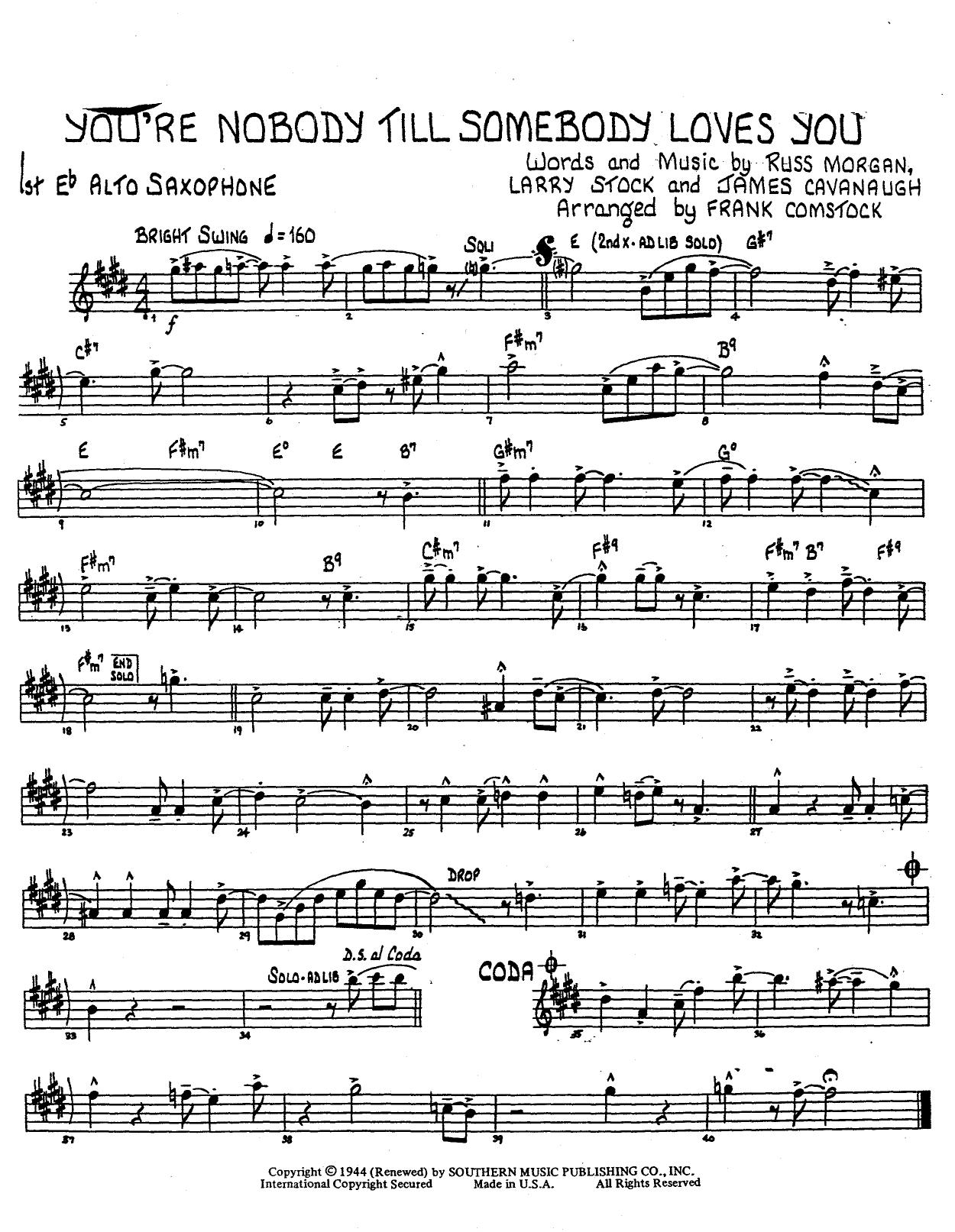
You're Nobody Till Somebody Loves You (F.Comstock) sheet music preview

You're Nobody Till Somebody Loves You (F.Comstock)

Composed by Kay Kyser

Arranged by Frank Comstock

  • Ensemble: Big Band
  • Pages: 16
  • Instruments (14): 1st Eb Alto Saxophone, 2nd Eb Alto Saxophone, 1st Bb Tenor Saxophone, 2nd Bb Tenor Saxophone, Eb Baritone Saxophone, 1st Bb Trumpet, 2nd Bb Trumpet, 3rd Bb Trumpet, 1st Trombone, 2nd Trombone, 3rd Trombone, Bass, Drums, Piano
  • Difficulty: easy
  • Content: Individual Parts
  • Format: PDF Download (Instant)
  • Price: $24.99

Written originally by Larry Stock, James Cavanaugh, and Russ Morgan, "You're Nobody Till Somebody Loves You" achieved its first major wave of popularity through Russ Morgan in 1944 and later cemented its status as an enduring pop-jazz standard via Dean Martin’s iconic 1964 swinging rendition. The tune bridges the gap between classic Tin Pan Alley songcraft and mid-century Las Vegas swagger, relying on a sturdy, infectious 32-bar form that begs for a robust, brass-forward interpretation. Its lyric strikes a universal chord, balancing sentimental vulnerability with an upbeat, finger-snapping bravado that has made it a favorite vehicle for vocalists and instrumentalists alike across generations. Frank Comstock’s inspired big band treatment infuses the standard with a driving medium-up swing feel, anchored by crisp, punchy horn stabs and a buoyant walking bassline. The key center is chosen specifically to maximize the resonance of the brass section while keeping the wind parts sitting comfortably in their most vibrant registers. Comstock crafts a mood that is simultaneously sophisticated and relentlessly cheerful, evoking the high-rolling energy of mid-century supper clubs. The energy builds steadily from a cheeky, understated opening head statement into a full-throated, harmonically rich arrangement that showcases classic mid-century West Coast big band arranging finesse—clean counterpoint, clever section interplay, and an undeniable forward momentum. In this layout tailored for an 8-instrument ensemble (featuring a tight horn roster of Alto Sax, Tenor Sax, Baritone Sax, Trumpet, Trombone, and rhythm section support across 16 pages), Comstock brilliantly redistributes traditional full-big-band counterlines into a leaner, punchier sonic footprint. The melodic heavy lifting is shared dynamically between the saxophone section and the trumpet, utilizing tight block-chord voicings that punch through the texture without requiring a massive personnel roster. Solos are integrated seamlessly into the structural arc, allowing individual players space to stretch out over changes that mirror the vocal cadence of the original hit. Technical demands center primarily on stylistic precision—clean articulation, uniform swing eighth notes, and tight dynamic control—rather than blinding finger speed, making every phrase rewarding to rehearse and execute. Advanced high school ensembles, collegiate jazz groups, and professional freelance dance orchestras will find this chart to be an exceptional programming choice. Because the 8-instrument configuration requires absolute independence from every player, it demands good listening skills across the smaller section while delivering the full, satisfying impact of a 17-piece orchestra. It functions equally well as a high-energy concert opener, a sophisticated festival selection, or a centerpiece for a vintage-style dance set, rewarding precision with an authentic, crowd-pleasing big band aesthetic. Nailing the authenticity of Frank Comstock’s chart requires strict adherence to a relaxed yet driving medium swing feel (approx. 132–138 BPM). Avoid rushing the quarter-note pulse; the groove must sit comfortably in the pocket to allow the swung eighth notes to breathe naturally, utilizing a typical "da-dot, da-dot" articulation rather than a rigid staccato. The primary technical challenge lies in balancing the 8-instrument texture so that inner-voice harmonies within the saxophones and brass do not get buried. Conductors should emphasize dynamic contrast—subtly dropping the volume under solo sections while maintaining a sharp, ringing edge on tutti ensemble hits. Brass players should incorporate stylistic plunger effects or natural cup mutes only where indicated for color, though clean, open-horn fatness is generally preferred for the primary shout choruses. Rehearsal should begin with the rhythm section locked into a steady, unhurried groove before layering in the horn lines section by section. Pay close attention to syncopated figures shared between the trombone and baritone saxophone; these low-register anchors drive the harmonic foundation and must be articulated with absolute unison precision to give the chart its signature punch. Q: What instruments and parts are included in this arrangement? A: This arrangement is scored for an 8-instrument ensemble, featuring parts for Alto Saxophone, Tenor Saxophone, Baritone Saxophone, Trumpet, Trombone, and a complete rhythm section rhythm framework spanning 16 total pages. Q: What is the difficulty level of this Frank Comstock chart? A: It is well-suited for advanced high school, collegiate, and professional small big bands, requiring strong section cohesion and solid swing phrasing rather than extreme technical endurance. Q: What is the historical style and background of this piece? A: Originally popularized in the 1940s and famously revitalized by Dean Martin in 1964, this piece is treated by arranger Frank Comstock in a classic mid-century swing style defined by brass swagger and sophisticated vocal-esque phrasing. Q: What makes this specific 8-instrument arrangement unique? A: Frank Comstock brilliantly condenses the power and harmonic density of a full 17-piece jazz orchestra into a leaner 8-instrument footprint without sacrificing any of the punch, counterpoint, or harmonic richness. Q: What is the performance duration and tempo of the piece? A: The arrangement performs comfortably at a medium-up swing tempo of approximately 132 to 138 BPM, yielding a running time of roughly 3 minutes depending on solo extensions.

Questions and answers

What is included in the You're Nobody Till Somebody Loves You (F.Comstock) PDF?
The verified current file contains individual parts across 16 pages.
How many instruments or parts are listed for You're Nobody Till Somebody Loves You (F.Comstock)?
The verified instrumentation list contains 14 entries for this Big Band arrangement.
Who is credited for You're Nobody Till Somebody Loves You (F.Comstock)?
Composer: Kay Kyser. Arranger: Frank Comstock.
What difficulty is listed for You're Nobody Till Somebody Loves You (F.Comstock)?
The verified difficulty level is easy.
Can I preview You're Nobody Till Somebody Loves You (F.Comstock) before buying?
Yes. The product page provides a preview generated from the current PDF file.
How is You're Nobody Till Somebody Loves You (F.Comstock) delivered?
After successful payment, the digital PDF is made available for download. The displayed price is $24.99.

Musicians Also Search For

You're Nobody Till Somebody Loves You Frank Comstock PDFYou're Nobody Till Somebody Loves You Frank Comstock sheet musicYou're Nobody Till Somebody Loves You arranged by Frank ComstockFrank Comstock big band chartsFrank Comstock jazz arrangements PDFYou're Nobody Till Somebody Loves You Kay Kyser sheet musicYou're Nobody Till Somebody Loves You Kay Kyser big band arrangementsKay Kyser big band chartsYou're Nobody Till Somebody Loves You big band arrangementsYou're Nobody Till Somebody Loves You big band PDF downloadYou're Nobody Till Somebody Loves You jazz sheet musicbig band sheet music downloadYou're Nobody Till Somebody Loves You individual parts downloadYou're Nobody Till Somebody Loves You sheet music PDFbuy You're Nobody Till Somebody Loves You sheet musicdownload You're Nobody Till Somebody Loves You PDFYou're Nobody Till Somebody Loves You jazz chartsbest Frank Comstock big band arrangementsKay Kyser arranged by Frank ComstockYou're Nobody Till Somebody Loves You printable sheet musicbig band repertoire PDF

All arrangements by Frank Comstock All Kay Kyser sheet music