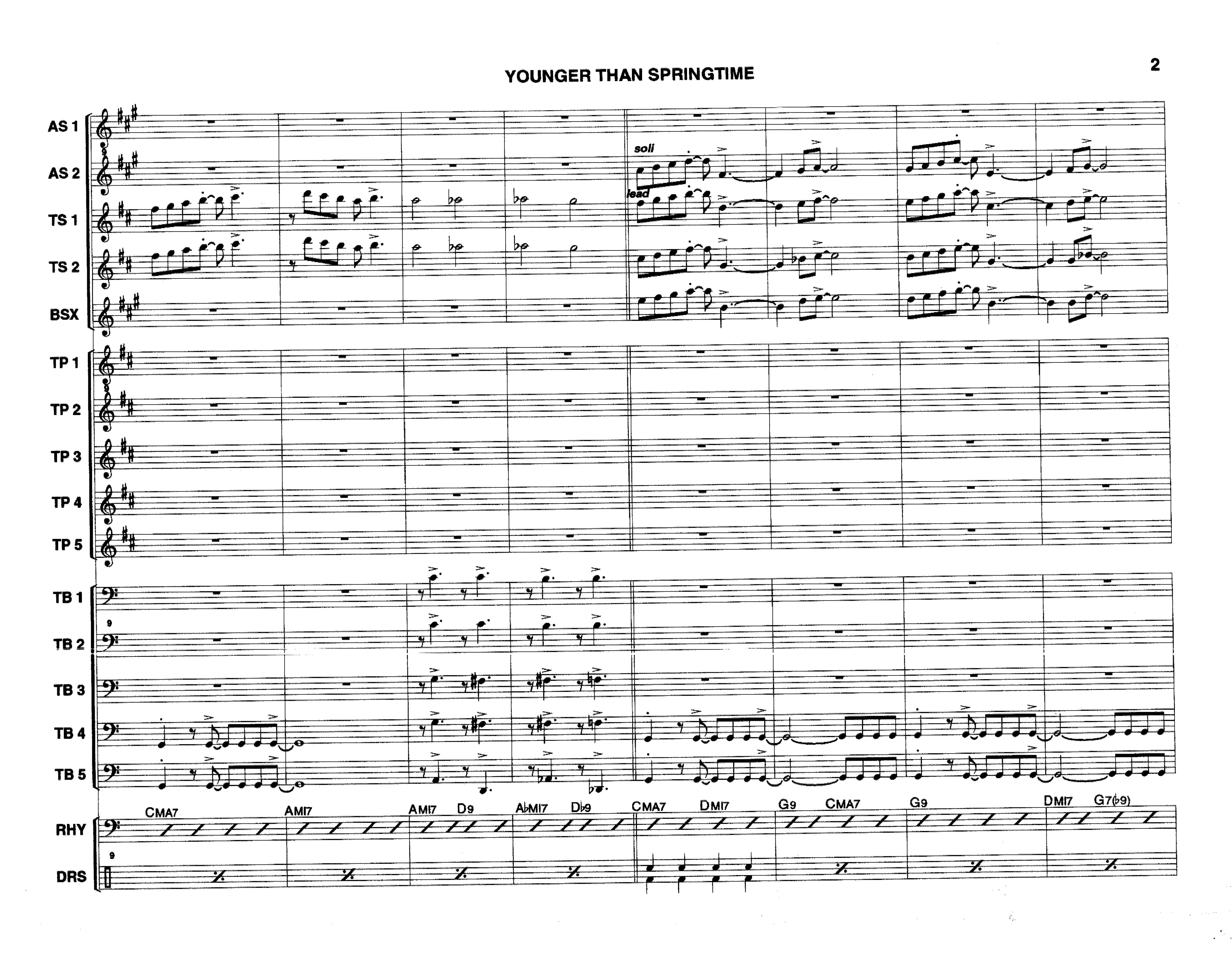
Younger Than Springtime (L.Niehaus)
Composed by Richard Rodgers
Arranged by Lennie Niehaus
- Ensemble: Big Band
- Pages: 43
- Instruments (19): 1st Alto Saxophone, 2nd Alto Saxophone, 1st Tenor Saxophone, 2nd Tenor Saxophone, Baritone Saxophone, 1st Trumpet, 2nd Trumpet, 3rd Trumpet, 4th Trumpet, 5th Trumpet, 1st Trombone, 2nd Trombone, 3rd Trombone, 4th Trombone, 5th Trombone (Bass), Piano, Guitar, Bass, Drums
- Difficulty: medium
- Content: Individual Parts
- Format: PDF Download (Instant)
- Price: $24.99
Richard Rodgers and Oscar Hammerstein II originally introduced "Younger Than Springtime" in their landmark 1949 Broadway musical *South Pacific*, where it quickly transcended its theatrical origins to become a cherished vehicle for jazz improvisation. The melody's lush, ascending lines and sophisticated harmonic framework naturally invited the attention of jazz luminaries during the cool and hard bop eras, with definitive interpretations recorded by giants such as Sonny Rollins, Bill Evans, and Chet Baker. This enduring standard bridges the gap between classic American musical theater and mid-century modern jazz, offering a rich melodic canvas that rewards nuanced phrasing and harmonic exploration. Lennie Niehaus—a seminal figure in West Coast jazz renowned for his work with the Stan Kenton Orchestra and his prolific writing for both small groups and big bands—approaches this chart with his signature West Coast sensibility. Eschewing dense, bombastic orchestration in favor of transparent counterpoint, linear clarity, and sophisticated, airy voicings, Niehaus transforms the Broadway ballad into a sublime, medium-tempo swing vehicle. The arrangement balances buoyant optimism with a relaxed, sophisticated groove, driven by an understated rhythm section feel that allows the rich harmonic inner voices of the saxophone and brass sections to shimmer. The structural architecture of the chart showcases Niehaus's mastery of ensemble color. The full 17-piece big band is utilized not merely for volume, but for dynamic contrast, featuring tightly interwoven sax solis and warm, harmonically rich brass backgrounds. The melody is initially introduced by the lead alto saxophone supported by subtle reed pads, gradually building in textural density before opening up into dedicated solo space. Technical demands center primarily on precision, intonation, and stylistic uniformity within sections rather than extreme velocity. Players must navigate flowing eighth-note lines with a relaxed, light-tongued swing articulation characteristic of the West Coast school, making clean execution essential to capturing the chart's effortless charm. Advanced high school ensembles, collegiate jazz orchestras, and professional repertory bands will find this arrangement an exceptional vehicle for developing stylistic versatility and ensemble blend. Because the challenges lie in stylistic execution, balance, and phrasing rather than brute technical endurance, it serves as an ideal masterclass in cool-school aesthetics. Musicians and audiences alike will appreciate the sophisticated harmonic turns and the seamless integration of classic Rodgers lyricism with quintessential West Coast jazz arranging. Achieving the authentic West Coast cool aesthetic in this arrangement requires meticulous attention to articulation and dynamic restraint. The tempo should settle comfortably into a relaxed medium swing—avoid rushing the groove, as the momentum comes from the forward placement of the eighth notes rather than sheer speed. The rhythm section must lay back, with the drummer utilizing a feather-light bass drum and a crisp, sustained ride cymbal pattern that breathes. Horn players should focus on a dry, linear articulation style, keeping accents controlled and avoiding heavy, aggressive brass bites. During the sax soli sections, intonation and balance are paramount; players must lock their vibrato and match the lead alto's phrasing precisely. Rehearsal time should be heavily invested in achieving a transparent ensemble blend, ensuring that inner-voice harmonies remain audible beneath the lead lines. Pay close attention to dynamic markings, as the emotional impact of Niehaus’s writing relies heavily on sudden, seamless shifts from whispered subtones to rich, warm crescendos. Q: What instrumentation and parts are included in this publication? A: This 43-page big band publication includes a full conductor score alongside standard 17-instrument jazz ensemble parts: 5 saxophones (Alto 1-2, Tenor 1-2, Baritone), 4 trumpets, 4 trombones, and a standard four-piece rhythm section (piano, bass, drums, guitar). Q: What is the difficulty level of this Lennie Niehaus arrangement? A: This chart is best suited for advanced high school, collegiate, and professional big bands. While it does not feature extreme technical demands or ultra-fast tempos, it requires mature stylistic control, excellent intonation, and a sophisticated grasp of West Coast swing phrasing. Q: What is the musical style and historical context of this piece? A: Originating as a timeless Richard Rodgers Broadway tune from *South Pacific*, this arrangement reimagines the standard through the lens of West Coast cool jazz, utilizing sophisticated, linear-driven harmonies popularized during the 1950s. Q: What makes this specific arrangement by Lennie Niehaus unique? A: Niehaus avoids heavy, bombastic big band clichés, instead utilizing transparent voicings, intricate counterpoint, and airy textures that give the classic melody a fresh, sophisticated, and deeply swinging modern jazz identity. Q: What is the approximate performance duration and tempo feel? A: The arrangement is written with a relaxed medium-swing feel (around 120-126 BPM) and typically runs between 3.5 and 4.5 minutes, depending on the length of the improvised solos and the conductor's preferred pacing.
Questions and answers
- What is included in the Younger Than Springtime (L.Niehaus) PDF?
- The verified current file contains a conductor score and individual parts across 43 pages.
- How many instruments or parts are listed for Younger Than Springtime (L.Niehaus)?
- The verified instrumentation list contains 19 entries for this Big Band arrangement.
- Who is credited for Younger Than Springtime (L.Niehaus)?
- Composer: Richard Rodgers. Arranger: Lennie Niehaus.
- What difficulty is listed for Younger Than Springtime (L.Niehaus)?
- The verified difficulty level is medium.
- Can I preview Younger Than Springtime (L.Niehaus) before buying?
- Yes. The product page provides a preview generated from the current PDF file.
- How is Younger Than Springtime (L.Niehaus) delivered?
- After successful payment, the digital PDF is made available for download. The displayed price is $24.99.
Musicians Also Search For
Younger Than Springtime Lennie Niehaus PDF • Younger Than Springtime Lennie Niehaus sheet music • Younger Than Springtime arranged by Lennie Niehaus • Lennie Niehaus big band charts • Lennie Niehaus jazz arrangements PDF • Younger Than Springtime Richard Rodgers sheet music • Younger Than Springtime Richard Rodgers big band arrangements • Richard Rodgers big band charts • Younger Than Springtime big band arrangements • Younger Than Springtime big band PDF download • Younger Than Springtime jazz sheet music • big band sheet music download • Younger Than Springtime conductor score PDF • Younger Than Springtime individual parts download • Younger Than Springtime sheet music PDF • buy Younger Than Springtime sheet music • download Younger Than Springtime PDF • Younger Than Springtime jazz charts • best Lennie Niehaus big band arrangements • Richard Rodgers arranged by Lennie Niehaus • Younger Than Springtime printable sheet music • big band repertoire PDF