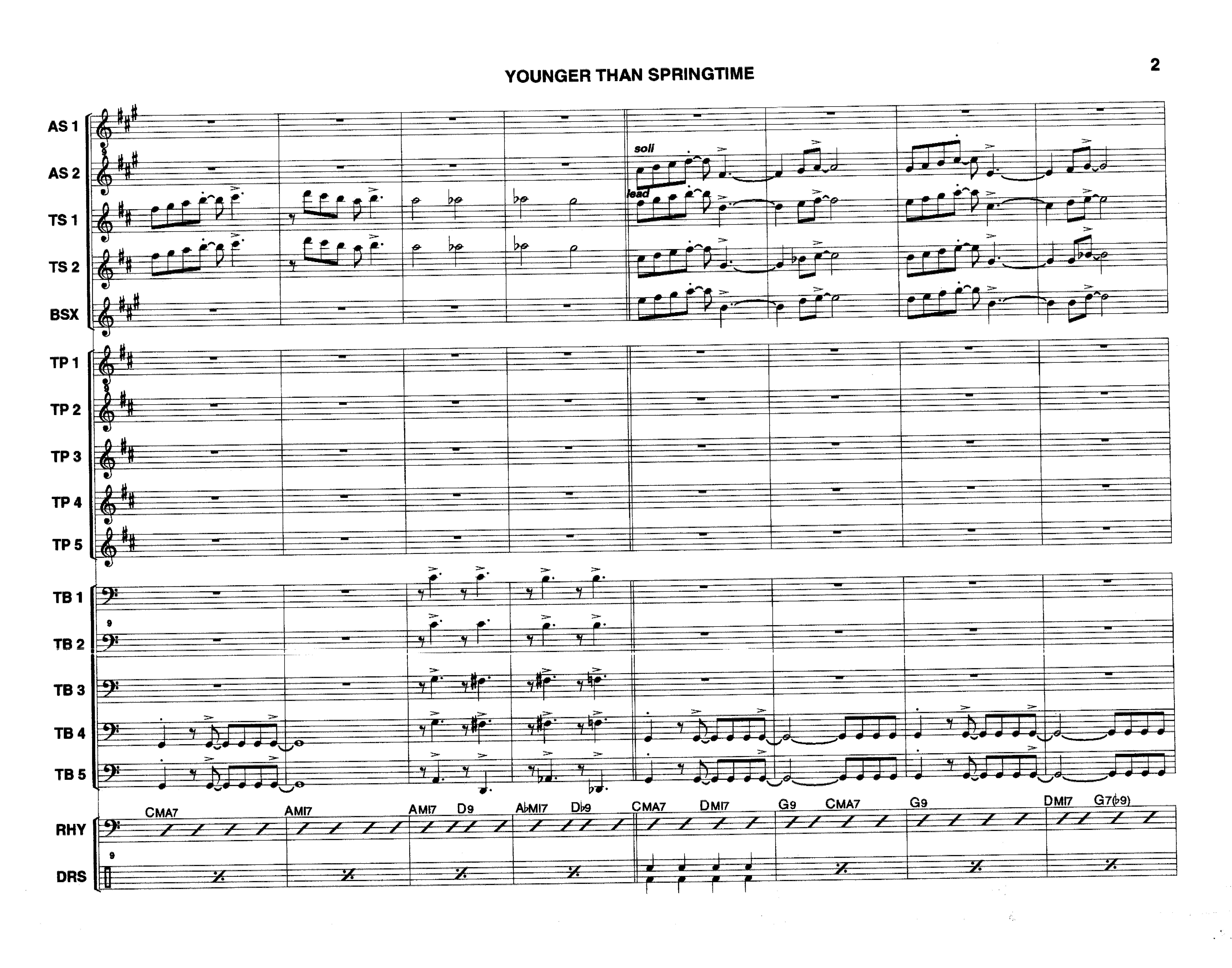
Younger Than Springtime (L.Niehaus) sheet music preview

Younger Than Springtime (L.Niehaus)

Composed by Richard Rodgers

Arranged by Lennie Niehaus

  • Ensemble: Big Band
  • Pages: 43
  • Instruments (19): 1st Alto Saxophone, 2nd Alto Saxophone, 1st Tenor Saxophone, 2nd Tenor Saxophone, Baritone Saxophone, 1st Trumpet, 2nd Trumpet, 3rd Trumpet, 4th Trumpet, 5th Trumpet, 1st Trombone, 2nd Trombone, 3rd Trombone, 4th Trombone, 5th Trombone (Bass), Piano, Guitar, Bass, Drums
  • Difficulty: medium
  • Content: Individual Parts
  • Format: PDF Download (Instant)
  • Price: $24.99

Richard Rodgers and Oscar Hammerstein II originally introduced "Younger Than Springtime" in their landmark 1949 Broadway musical *South Pacific*, where it quickly transcended its theatrical origins to become a cornerstone of the Great American Songbook. Over the decades, jazz luminaries from the modal explorations of Bill Evans to the swinging interpretations of Sonny Rollins and Wynton Kelly have embraced its soaring, optimistic melody and sophisticated harmonic architecture. It represents the pinnacle of mid-century American songwriting, offering jazz improvisers a rich harmonic playground characterized by lyrical modal shifts and lush, romantic progression. Lennie Niehaus approaches this timeless standard through a distinctly West Coast jazz lens, shaping it into a sophisticated, highly accessible chart tailored for a flexible 8-instrument big band instrumentation (Alto Sax, Tenor Sax, Baritone Sax, Trumpet, Trombone, plus rhythm section). The arrangement unfolds at a comfortable, buoyant medium-swing tempo in 4/4 time, prioritizing crisp articulation, horizontal linear development, and pristine harmonic balance over sheer volume. Niehaus avoids dense, wall-of-sound orchestration in favor of transparent, West Coast-style counterpoint and airy, open-voiced horn blendings that allow every single voice to shine clearly within the ensemble texture. The arrangement opens with a suggestive, lyrical intro that establishes the relaxed yet driving swing feel before handing the primary melody over to the saxophone section, with the trumpet and trombone offering subtle, harmonically rich background counter-lines. Niehaus constructs brilliant, conversational soli sections that highlight the interplay between the reed and brass voices, utilizing clever interval stacking and bebop-infused passing tones. While maintaining an approachable technical threshold, the chart includes a designated open solo section—ideal for showcasing a fluent tenor saxophone or trumpet soloist—backed by clean, rhythmic comping figures. The ensemble writing builds toward a tasteful, dynamically nuanced shout chorus that reinterprets the core motif with rhythmic vitality before tapering down to a warm, satisfying chordal resolution. Advanced high school ensembles, collegiate jazz labs, and professional community big bands will find this arrangement an exceptionally rewarding addition to their repertoire. Because it is scored specifically for an 8-instrument frontline plus rhythm section, it provides a full, professional big-band aesthetic without requiring a massive, full-instrumentation roster. It serves as an ideal vehicle for teaching stylistic consistency, jazz phrasing, lighter swing dynamics, and nuanced ensemble breathing, making it equally effective as a sophisticated concert opener or a featured contrast piece within a festival setlist. Achieving the authentic West Coast jazz sound in this arrangement requires strict attention to light, crisp articulation and balanced section dynamics. The tempo should remain a steady, unhurried medium swing; avoid rushing the quarter-note pulse, as the rhythmic charm relies on a relaxed, behind-the-beat feel. Horn players must execute eighth notes with a traditional jazz swing articulation—tonguing the upbeats lightly while keeping downbeats detached but sustained, avoiding heavy, bombastic accents. Rhythm section players should anchor the groove with a walking bass line that emphasizes steady quarter-note momentum, while the drummer maintains a traditional ride-cymbal "ding-da-ding" pattern with feathering on the bass drum and a crisp hi-hat chop on beats two and four. Ensure that background figures played behind the soloists remain at a subservient dynamic level (around mp) so the featured improviser's melodic line cuts through effortlessly. No special mute effects are required, allowing the natural, warm acoustic blend of the horns to carry the emotional narrative of the performance. Q: What instruments and parts are included in this arrangement? A: The chart is scored for an 8-instrument ensemble featuring Alto Saxophone, Tenor Saxophone, Baritone Saxophone, Trumpet, and Trombone, alongside a full rhythm section (piano, bass, and drums). Q: What is the difficulty level of this Lennie Niehaus arrangement? A: It is graded as medium difficulty, making it exceptionally well-suited for advanced high school bands, collegiate jazz ensembles, and professional community groups looking for sophisticated writing that doesn't demand massive full-instrumentation forces. Q: What is the musical style and historical background of the piece? A: Composed by Richard Rodgers for the 1949 stage musical *South Pacific*, this arrangement frames the classic melody in a sophisticated, relaxed West Coast medium-swing style characteristic of arranger Lennie Niehaus. Q: What makes this specific arrangement unique? A: Niehaus utilizes transparent, open-voiced horn textures, linear counterpoint, and clever soli writing tailored specifically for a compact 8-instrument line-up, capturing a lush, West Coast cool-jazz aesthetic. Q: What is the performance duration and recommended tempo? A: The arrangement runs approximately 3 to 4 minutes in length and is designed to be performed at a comfortable, driving medium-swing tempo around 120–126 BPM.

Questions and answers

What is included in the Younger Than Springtime (L.Niehaus) PDF?
The verified current file contains a conductor score and individual parts across 43 pages.
How many instruments or parts are listed for Younger Than Springtime (L.Niehaus)?
The verified instrumentation list contains 19 entries for this Big Band arrangement.
Who is credited for Younger Than Springtime (L.Niehaus)?
Composer: Richard Rodgers. Arranger: Lennie Niehaus.
What difficulty is listed for Younger Than Springtime (L.Niehaus)?
The verified difficulty level is medium.
Can I preview Younger Than Springtime (L.Niehaus) before buying?
Yes. The product page provides a preview generated from the current PDF file.
How is Younger Than Springtime (L.Niehaus) delivered?
After successful payment, the digital PDF is made available for download. The displayed price is $24.99.

Musicians Also Search For

Younger Than Springtime Lennie Niehaus PDFYounger Than Springtime Lennie Niehaus sheet musicYounger Than Springtime arranged by Lennie NiehausLennie Niehaus big band chartsLennie Niehaus jazz arrangements PDFYounger Than Springtime Richard Rodgers sheet musicYounger Than Springtime Richard Rodgers big band arrangementsRichard Rodgers big band chartsYounger Than Springtime big band arrangementsYounger Than Springtime big band PDF downloadYounger Than Springtime jazz sheet musicbig band sheet music downloadYounger Than Springtime conductor score PDFYounger Than Springtime individual parts downloadYounger Than Springtime sheet music PDFbuy Younger Than Springtime sheet musicdownload Younger Than Springtime PDFYounger Than Springtime jazz chartsbest Lennie Niehaus big band arrangementsRichard Rodgers arranged by Lennie NiehausYounger Than Springtime printable sheet musicbig band repertoire PDF

All arrangements by Lennie Niehaus All Richard Rodgers sheet music