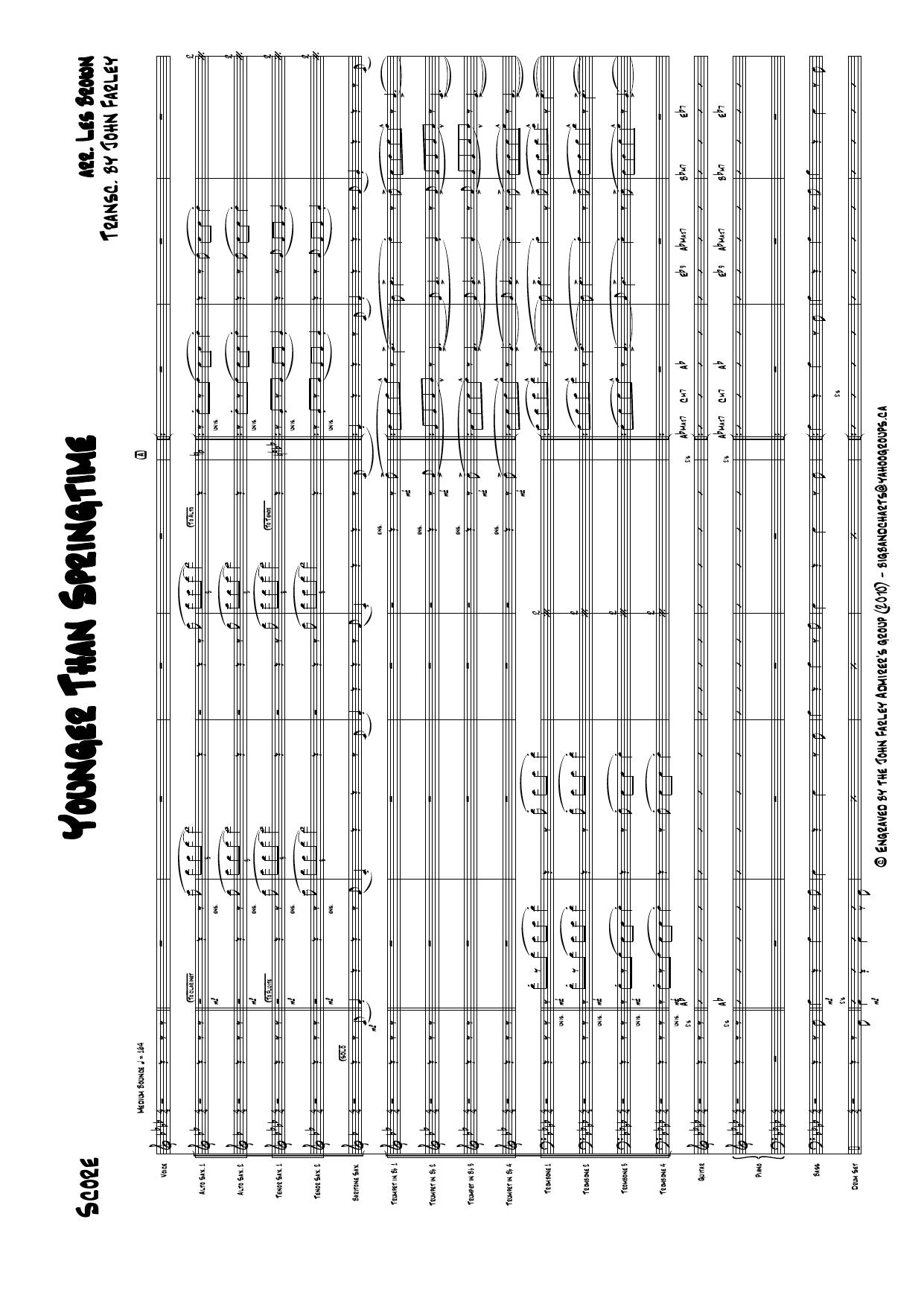
Younger Than Springtime (J.Farley)
Composed by Walter Donaldson
Arranged by John Farley
- Ensemble: Big Band
- Pages: 28
- Instruments (18): Voice, Alto Sax. 1, Alto Sax. 2, Tenor Sax. 1, Tenor Sax. 2, Baritone Sax., Trumpet in Bb 1, Trumpet in Bb 2, Trumpet in Bb 3, Trumpet in Bb 4, Trombone 1, Trombone 2, Trombone 3, Trombone 4, Guitar, Piano, Bass, Drum Set
- Difficulty: medium
- Content: Individual Parts
- Format: PDF Download (Instant)
- Price: $24.99
Originating from Rodgers and Hammerstein’s landmark 1949 Broadway masterpiece *South Pacific*, "Younger Than Springtime" quickly transcended its theatrical roots to become a beloved vehicle for jazz interpreters, championed by legendary vocalists and instrumentalists alike. Richard Rodgers’ enduring melody, characterized by its graceful, arching intervals and innate harmonic warmth, provides an ideal canvas for jazz composition. Rooted in the Great American Songbook tradition, the composition bridges lush lyricism with sophisticated chord changes, making it a natural choice for jazz arrangers seeking to balance sentimental beauty with dynamic swing potential. John Farley’s sophisticated big band interpretation transforms the familiar show tune into an expressive medium-swing ballad featuring a lush, cinematic texture and rich harmonic depth. Set comfortably in a flowing 4/4 medium-tempo groove, the arrangement evokes a mood of reflective optimism and gentle romance, alternating between tender, breath-inflected passages and soaring, brass-led climaxes. Farley avoids predictable tropes, utilizing contemporary extended harmonies—such as major-seventh alterations, suspended voicings, and subtle chromatic slide movements—to give the classic changes a fresh, modern-jazz edge while preserving the core melodic integrity that audiences recognize instantly. The chart opens with an atmospheric, rubato-leaning introduction before settling into a steady, conversational swing feel carried by a subtle rhythm section pulse. The vocal lead takes center stage, supported by sophisticated saxophone solis and interlocking brass countermelodies that weave seamlessly around the voice. Farley constructs a masterful arrangement where the woodwinds and muted trumpets share primary transitional duties, building emotional momentum toward a dynamic, tasteful shout chorus. This climactic section expands the dynamic range without overpowering the vocalist, showcasing rich stack voicings in the saxes and punchy, controlled brass stabs. Advanced high school, collegiate, and professional jazz ensembles will find this 28-page chart exceptionally rewarding. While the technical demands on individual players are moderate, the arrangement places a premium on ensemble blend, intonation, and stylistic nuance. The rhythm section must maintain an elastic, supportive pocket, and the horn sections must execute dynamic shading with precision. Providing ample opportunity to showcase a featured vocalist alongside capable instrumental soloists, this arrangement serves as a sophisticated centerpiece for any serious concert or festival program. The primary technical challenge in this arrangement lies in maintaining a consistent, relaxed medium-swing feel without rushing the tempo. Conductors should emphasize horizontal line phrasing over vertical point-to-point reading, ensuring that eighth notes maintain an authentic jazz triplet feel even during softer dynamic levels. For the rhythm section, the pianist and guitarist should utilize sparse, open voicings that lean on upper-structure extensions rather than heavy block chords, leaving ample room for the vocal soloist and horn lines. The bass player should anchor the ensemble with a steady, walking quarter-note line that articulates subtle chromatic approaches into key change centers. Horns should pay close attention to balance during the interwoven countermelodies behind the vocal; dynamic markers must be strictly observed, keeping background figures at a soft-to-medium level (mp to mf). When executing muted passages in the trumpets and trombones, ensure a uniform timbre across the section by matching cup or harmon mute types where specified. Rehearsals should initially focus on section intonation during the harmonically dense transitional interludes before integrating the vocal lead. Q: What instruments and parts are included in this arrangement? A: The chart is scored for a full 18-instrument big band lineup, featuring a vocal lead, two alto saxophones, two tenor saxophones, a baritone saxophone, four trumpets, four trombones, and a standard four-piece rhythm section (piano, guitar, bass, and drums), backed by a comprehensive conductor score across 28 pages. Q: What is the difficulty level of this chart? A: This arrangement is graded as advanced intermediate to advanced, making it ideal for college, community, and top-tier high school big bands that possess strong ensemble cohesion and a refined sense of swing style. Q: What is the historical and stylistic background of the piece? A: Based on Richard Rodgers and Oscar Hammerstein II's classic tune from the 1949 musical *South Pacific*, this arrangement reinterprets the timeless theater standard through a sophisticated medium-swing jazz lens. Q: What makes John Farley’s arrangement unique? A: Farley elevates the familiar melody by incorporating contemporary extended harmonies, intricate sax solis, and a carefully balanced shout chorus that frames the vocal soloist without ever masking the band's rich textures. Q: What is the performance duration and tempo feel? A: The arrangement runs approximately 4 to 5 minutes and is anchored by a relaxed, flowing medium-swing groove in 4/4 time.
Questions and answers
- What is included in the Younger Than Springtime (J.Farley) PDF?
- The verified current file contains a conductor score and individual parts across 28 pages.
- How many instruments or parts are listed for Younger Than Springtime (J.Farley)?
- The verified instrumentation list contains 18 entries for this Big Band arrangement.
- Who is credited for Younger Than Springtime (J.Farley)?
- Composer: Walter Donaldson. Arranger: John Farley.
- What difficulty is listed for Younger Than Springtime (J.Farley)?
- The verified difficulty level is medium.
- Can I preview Younger Than Springtime (J.Farley) before buying?
- Yes. The product page provides a preview generated from the current PDF file.
- How is Younger Than Springtime (J.Farley) delivered?
- After successful payment, the digital PDF is made available for download. The displayed price is $24.99.
Musicians Also Search For
Younger Than Springtime John Farley PDF • Younger Than Springtime John Farley sheet music • Younger Than Springtime arranged by John Farley • John Farley big band charts • John Farley jazz arrangements PDF • Younger Than Springtime Walter Donaldson sheet music • Younger Than Springtime Walter Donaldson big band arrangements • Walter Donaldson big band charts • Younger Than Springtime big band arrangements • Younger Than Springtime big band PDF download • Younger Than Springtime jazz sheet music • big band sheet music download • Younger Than Springtime conductor score PDF • Younger Than Springtime individual parts download • Younger Than Springtime sheet music PDF • buy Younger Than Springtime sheet music • download Younger Than Springtime PDF • Younger Than Springtime jazz charts • best John Farley big band arrangements • Walter Donaldson arranged by John Farley • Younger Than Springtime printable sheet music • big band repertoire PDF