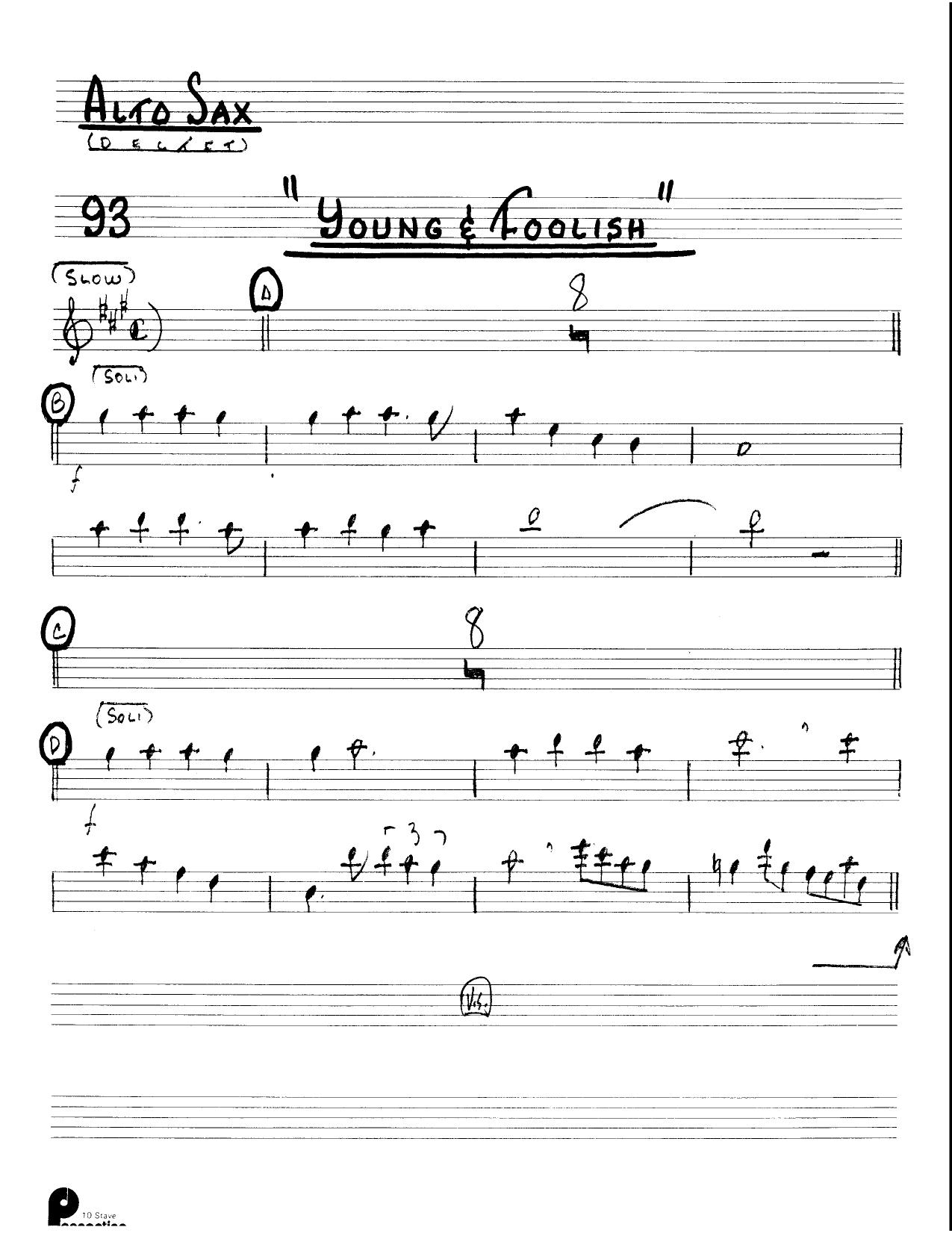
Young & Foolish (Kenton Dectet #093) sheet music preview

Young & Foolish (Kenton Dectet #093)

Composed by Albert Hague

Arranged by Kenton Dectet #093

  • Ensemble: Small Ensemble
  • Style: Ballad
  • Pages: 17
  • Instruments (9): Alto Sax, Tenor Sax, Baritone Sax, Trumpet 1, Trumpet 2, Trombone, Piano, Bass, Drums
  • Difficulty: easy
  • Content: Individual Parts
  • Format: PDF Download (Instant)
  • Price: $12.99

"Young & Foolish," a timeless ballad from the 1954 Broadway musical *Plain and Fancy*, stands as a testament to the enduring appeal of the Great American Songbook. Composed by Albert Hague with lyrics by Arnold B. Horwitt, this poignant melody quickly transcended its theatrical origins to become a beloved jazz standard. Its fame was cemented through iconic recordings by vocalists such as Tony Bennett and instrumentalists like Bill Evans, whose 1959 rendition on *Everybody Digs Bill Evans* is particularly celebrated for its introspective beauty. The song evokes a bittersweet nostalgia, reflecting on youthful innocence and the passage of time, making it a staple in the repertoires of countless jazz artists. Its harmonic structure, often centered around C major, features characteristic jazz progressions with secondary dominants and subtle chromaticism, offering rich improvisational possibilities while maintaining its lyrical simplicity. This Kenton Dectet #093 arrangement reimagines this classic ballad for a small ensemble, infusing it with the sophisticated harmonic language and nuanced voicings characteristic of the Stan Kenton tradition, adapted for a more intimate setting. While the original Stan Kenton Orchestra was known for its "progressive jazz" and larger-than-usual instrumentation, the Dectet series distills this complexity into a compact, powerful format. Expect lush, close-knit voicings in the horn sections, creating a rich tapestry of sound that supports the melody without overpowering it. The arranger skillfully employs extended harmonies and subtle countermelodies, enhancing the song's inherent emotional depth. Modulations are handled with elegance, providing harmonic interest and maintaining the ballad's reflective mood. The arrangement features the melody predominantly in the lead alto saxophone, with harmonized soli sections distributed among the other horns, offering each voice a moment to shine within the ensemble texture. A featured solo section is provided for tenor saxophone, allowing for expressive improvisation over the song's well-crafted chord changes. Technical challenges include precise control of dynamics and blend within the horn section, particularly in the sustained chords and intricate inner lines. The rewarding aspect of performing this arrangement lies in its ability to convey profound emotion through collective musicianship, demanding sensitivity and a deep understanding of the ballad style. Specific musical moments, such as the carefully crafted reharmonizations in the bridge and the subtle interplay between the brass and saxophone sections, are designed to captivate both performers and audience. This arrangement is ideally suited for college, community, and semi-professional jazz ensembles seeking to explore sophisticated ballad playing within a small ensemble context. The demands on intonation, blend, and musical maturity make it an excellent vehicle for developing expressive performance skills. Its manageable length of 17 pages ensures that it can be thoroughly rehearsed and polished, allowing the ensemble to fully embrace the nuanced beauty of this enduring jazz standard. To achieve the desired expressive quality, conductors should emphasize a consistent, unhurried slow ballad tempo throughout, ensuring ample space for phrases to breathe and resonate. A metronome marking around quarter note = 60-66 BPM is recommended, but ultimately, the feel should dictate the exact tempo. Intonation and blend within the horn section are paramount, particularly in sustained chords; encourage musicians to listen across the ensemble, not just to their immediate neighbors. The lead alto saxophone carries the primary melodic statements, requiring a warm, lyrical tone and precise articulation. The tenor saxophone solo should be encouraged to be melodic and expressive, utilizing the rich harmonic backdrop provided by the ensemble. Rehearsal tips include isolating challenging soli passages to perfect balance and attack, and focusing on dynamic shaping to build and release tension effectively, especially during the modulations. No special techniques like plunger mutes or falls are explicitly required, allowing the focus to remain on pure tone and musicality. Q: What instruments are included in this Kenton Dectet #093 arrangement? A: This arrangement is scored for a small ensemble, typically featuring a standard jazz dectet instrumentation. It includes parts for lead alto saxophone, tenor saxophone, baritone saxophone, two trumpets, trombone, piano, bass, and drums. Q: What is the difficulty level of this arrangement? A: This arrangement is rated as intermediate to advanced. It requires solid instrumental technique, strong intonation, and a mature understanding of jazz ballad interpretation, making it suitable for college, community, and semi-professional groups. Q: What is the musical style and historical context of "Young & Foolish"? A: "Young & Foolish" is a classic jazz ballad originating from the 1954 Broadway musical *Plain and Fancy*. It represents the mid-20th century era of popular song that became foundational to the jazz repertoire, known for its lyrical melodies and sophisticated harmonies. Q: What makes this specific Kenton Dectet #093 arrangement unique? A: This arrangement stands out for its sophisticated voicings and harmonic depth, characteristic of the Stan Kenton style adapted for a smaller ensemble. It features lush soli sections, carefully crafted reharmonizations, and a dedicated tenor saxophone solo, offering a rich and nuanced interpretation of the standard. Q: What is the approximate performance duration of this piece? A: Given its slow ballad tempo and the inclusion of a featured solo, the approximate performance duration for this arrangement of "Young & Foolish" is between 4 to 5 minutes.

Questions and answers

What is included in the Young & Foolish (Kenton Dectet #093) PDF?
The verified current file contains individual parts across 17 pages.
How many instruments or parts are listed for Young & Foolish (Kenton Dectet #093)?
The verified instrumentation list contains 9 entries for this Small Ensemble arrangement.
Who is credited for Young & Foolish (Kenton Dectet #093)?
Composer: Albert Hague. Arranger: Kenton Dectet #093.
What difficulty is listed for Young & Foolish (Kenton Dectet #093)?
The verified difficulty level is easy.
What style is listed for Young & Foolish (Kenton Dectet #093)?
The catalog lists the style as Ballad.
Can I preview Young & Foolish (Kenton Dectet #093) before buying?
Yes. The product page provides a preview generated from the current PDF file.
How is Young & Foolish (Kenton Dectet #093) delivered?
After successful payment, the digital PDF is made available for download. The displayed price is $12.99.

Musicians Also Search For

Young & Foolish Kenton Dectet #093 PDFYoung & Foolish Kenton Dectet #093 sheet musicYoung & Foolish arranged by Kenton Dectet #093Kenton Dectet #093 small ensemble chartsKenton Dectet #093 jazz arrangements PDFYoung & Foolish Albert Hague sheet musicYoung & Foolish Albert Hague small ensemble arrangementsAlbert Hague small ensemble chartsYoung & Foolish small ensemble arrangementsYoung & Foolish small ensemble PDF downloadYoung & Foolish jazz sheet musicsmall ensemble sheet music downloadYoung & Foolish individual parts downloadYoung & Foolish sheet music PDFYoung & Foolish Ballad chartsBallad small ensemble arrangementsbuy Young & Foolish sheet musicdownload Young & Foolish PDFYoung & Foolish jazz chartsbest Kenton Dectet #093 small ensemble arrangementsAlbert Hague arranged by Kenton Dectet #093Young & Foolish printable sheet musicsmall ensemble repertoire PDF

All arrangements by Kenton Dectet #093 All Albert Hague sheet music