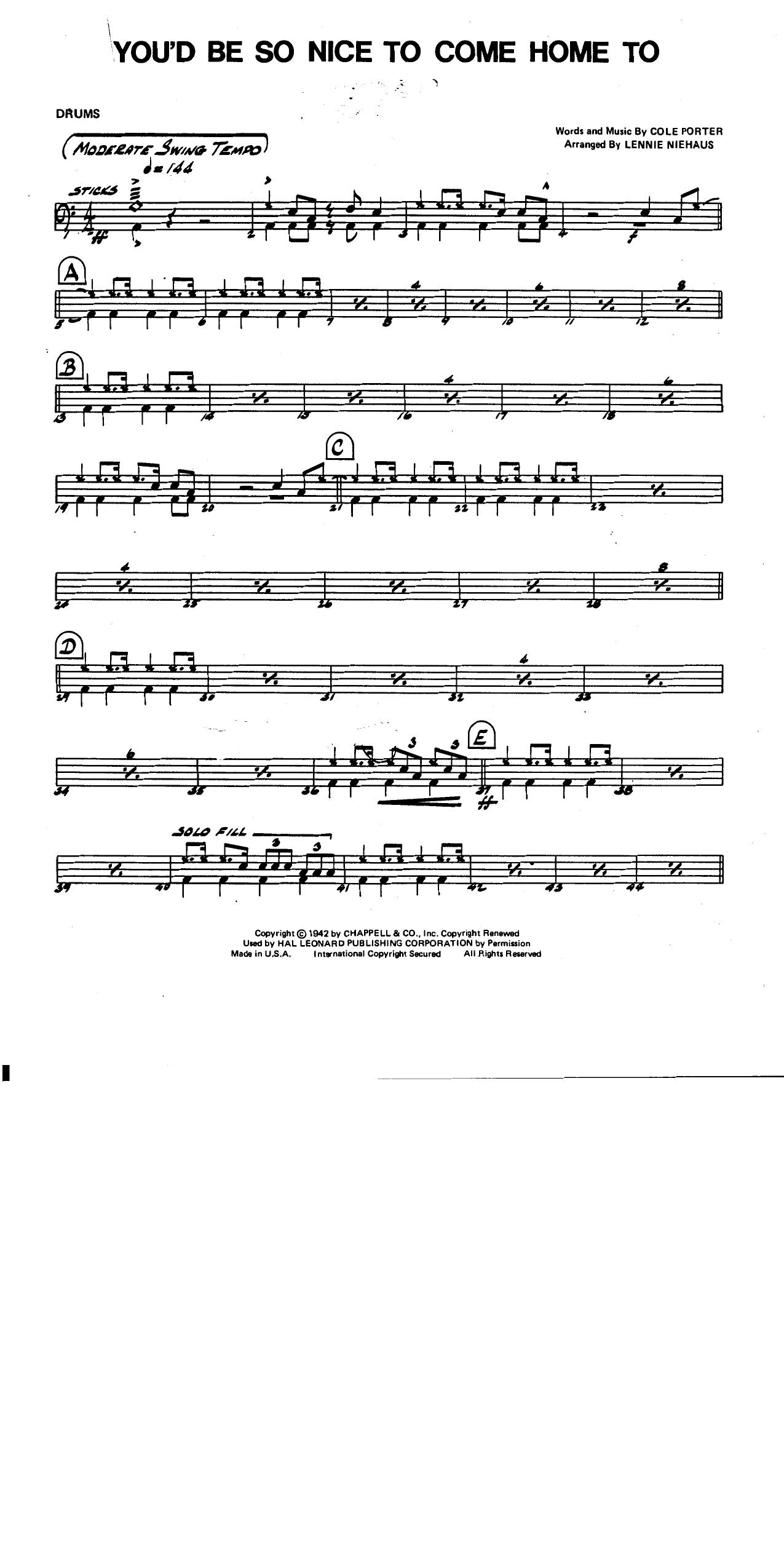
You'd Be So Nice To Come Home To (L.Niehaus)
Composed by Cole Porter
Arranged by Lennie Niehaus
- Ensemble: Big Band
- Pages: 36
- Instruments (17): Drums, Bass, Guitar (opt.), Piano, 1st Trombone, 2nd Trombone, 3rd Trombone, 4th Trombone (opt.), 1st Bb Trumpet, 2nd Bb Trumpet, 3rd Bb Trumpet, 4th Bb Trumpet (opt.), 1st Eb Alto Saxophone, 2nd Eb Alto Saxophone, 1st Bb Tenor Saxophone, 2nd Bb Tenor Saxophone (opt.), Eb Baritone Saxophone
- Difficulty: medium
- Content: Individual Parts
- Format: PDF Download (Instant)
- Price: $24.99
Cole Porter penned "You’d Be So Nice to Come Home To" for the 1943 musical film *Something to Shout About*, where it was originally introduced by Dinah Shore and Don Ameche. Within a remarkably short time, the composition transitioned from Hollywood cinema into the bedrock of the jazz canon, earning definitive treatments from icons like Chet Baker, Art Pepper, and Helen Merrill. Its sophisticated minor-mode verses and harmonically rich major-mode refrains present a masterclass in dynamic contrast, establishing it as one of the most enduring standards of the Great American Songbook. Lennie Niehaus’s masterful big band adaptation reimagines Porter’s classic through a polished West Coast jazz lens, driving forward with an infectious, buoyant medium-up swing feel in 4/4 time. The mood balances breezy sophistication with an underlying rhythmic urgency, evoking the quintessential cool-school aesthetic associated with Niehaus’s historic work alongside Stan Kenton. The arrangement shimmers with clever counterpoint, crisp dynamic shifts, and an overall sense of effortless cool that engages both the ensemble and the listener from the initial downbeat. Renowned for his economical yet strikingly effective writing, Niehaus builds the arrangement around rich, harmonically sophisticated sax soli sections and tightly knit brass voicings that avoid overcrowding the sonic space. The chart relies on transparent, linear writing where every voice has a distinct melodic or counter-melodic purpose. Rather than employing bombastic, brass-heavy shout choruses, Niehaus utilizes clever sectional interplay, shifting the thematic weight seamlessly between the reed and brass families while maintaining a driving, pulsating rhythm section foundation. The melody is introduced cleanly by the saxophone section before the arrangement opens up into designated solo spaces, giving featured improvisers room to stretch over standard chord changes. Technical challenges primarily lie in maintaining crisp articulation, precise swing eighth-note subdivision at a brisk tempo, and balanced intonation within Niehaus’s tight, harmonically advanced voicings. Advanced high school jazz ensembles with strong section leaders, as well as collegiate and professional big bands, will find this chart deeply rewarding due to its refined phrasing demands and timeless West Coast sensibility. Navigating this Lennie Niehaus chart successfully requires absolute precision with swing eighth-note phrasing at a brisk, driving medium-up tempo. The rhythm section acts as the primary engine; the drummer should maintain a light, feathered bass drum pulse and a crisp ride cymbal pattern that avoids heavy downbeat crushing, capturing the authentic West Coast cool style. Horn players must focus heavily on dynamic balance during the intricate sax soli passages, ensuring that inner-voice harmonies do not obscure the lead alto line. Articulations should be clean and detached rather than overly heavy or legato, matching Niehaus's signature linear writing style. Pay close attention to subtle dynamic markings—the contrast between the hushed background figures and the brighter tutti moments provides the chart with its forward momentum and structural shape. No specialized effects like plunger mutes or exaggerated falls are required; the focus remains squarely on pristine tone quality, intonation, and rhythmic cohesion across the entire ensemble. Q: What instruments and parts are included in this arrangement? A: The chart is scored for a standard 16-instrument big band instrumentation, featuring 5 saxophones (Alto Sax 1, Alto Sax 2, Tenor Sax 1, Tenor Sax 2, Baritone Sax), 8 brass (typically 4 trumpets and 4 trombones), and a 3-piece rhythm section (piano, bass, and drums), backed by a comprehensive 36-page score and part set. Q: What is the difficulty level of this chart? A: This arrangement is graded as advanced intermediate to advanced, making it ideal for skilled high school jazz bands, collegiate ensembles, and professional community big bands that possess strong section reading capabilities. Q: What is the musical style and historical context of this piece? A: Written by Cole Porter in 1943, the tune is arranged here in a classic West Coast cool jazz style by Lennie Niehaus, emphasizing transparent voicings, linear counterpoint, and a swinging 4/4 medium-up groove. Q: What makes this specific Lennie Niehaus arrangement unique? A: Unlike heavy, bombastic East Coast big band charts, Niehaus utilizes sophisticated sax solis, subtle harmonic shifts, and conversational interplay between sections rather than relying on an overpowering, high-register shout chorus. Q: What is the approximate performance duration and tempo? A: While performance time can vary slightly based on the number of improvised choruses taken, the chart operates at a lively medium-up swing tempo designed to keep both the ensemble and audience fully engaged from start to finish.
Questions and answers
- What is included in the You'd Be So Nice To Come Home To (L.Niehaus) PDF?
- The verified current file contains individual parts across 36 pages.
- How many instruments or parts are listed for You'd Be So Nice To Come Home To (L.Niehaus)?
- The verified instrumentation list contains 17 entries for this Big Band arrangement.
- Who is credited for You'd Be So Nice To Come Home To (L.Niehaus)?
- Composer: Cole Porter. Arranger: Lennie Niehaus.
- What difficulty is listed for You'd Be So Nice To Come Home To (L.Niehaus)?
- The verified difficulty level is medium.
- Can I preview You'd Be So Nice To Come Home To (L.Niehaus) before buying?
- Yes. The product page provides a preview generated from the current PDF file.
- How is You'd Be So Nice To Come Home To (L.Niehaus) delivered?
- After successful payment, the digital PDF is made available for download. The displayed price is $24.99.
Musicians Also Search For
You'd Be So Nice To Come Home To Lennie Niehaus PDF • You'd Be So Nice To Come Home To Lennie Niehaus sheet music • You'd Be So Nice To Come Home To arranged by Lennie Niehaus • Lennie Niehaus big band charts • Lennie Niehaus jazz arrangements PDF • You'd Be So Nice To Come Home To Cole Porter sheet music • You'd Be So Nice To Come Home To Cole Porter big band arrangements • Cole Porter big band charts • You'd Be So Nice To Come Home To big band arrangements • You'd Be So Nice To Come Home To big band PDF download • You'd Be So Nice To Come Home To jazz sheet music • big band sheet music download • You'd Be So Nice To Come Home To individual parts download • You'd Be So Nice To Come Home To sheet music PDF • buy You'd Be So Nice To Come Home To sheet music • download You'd Be So Nice To Come Home To PDF • You'd Be So Nice To Come Home To jazz charts • best Lennie Niehaus big band arrangements • Cole Porter arranged by Lennie Niehaus • You'd Be So Nice To Come Home To printable sheet music • big band repertoire PDF