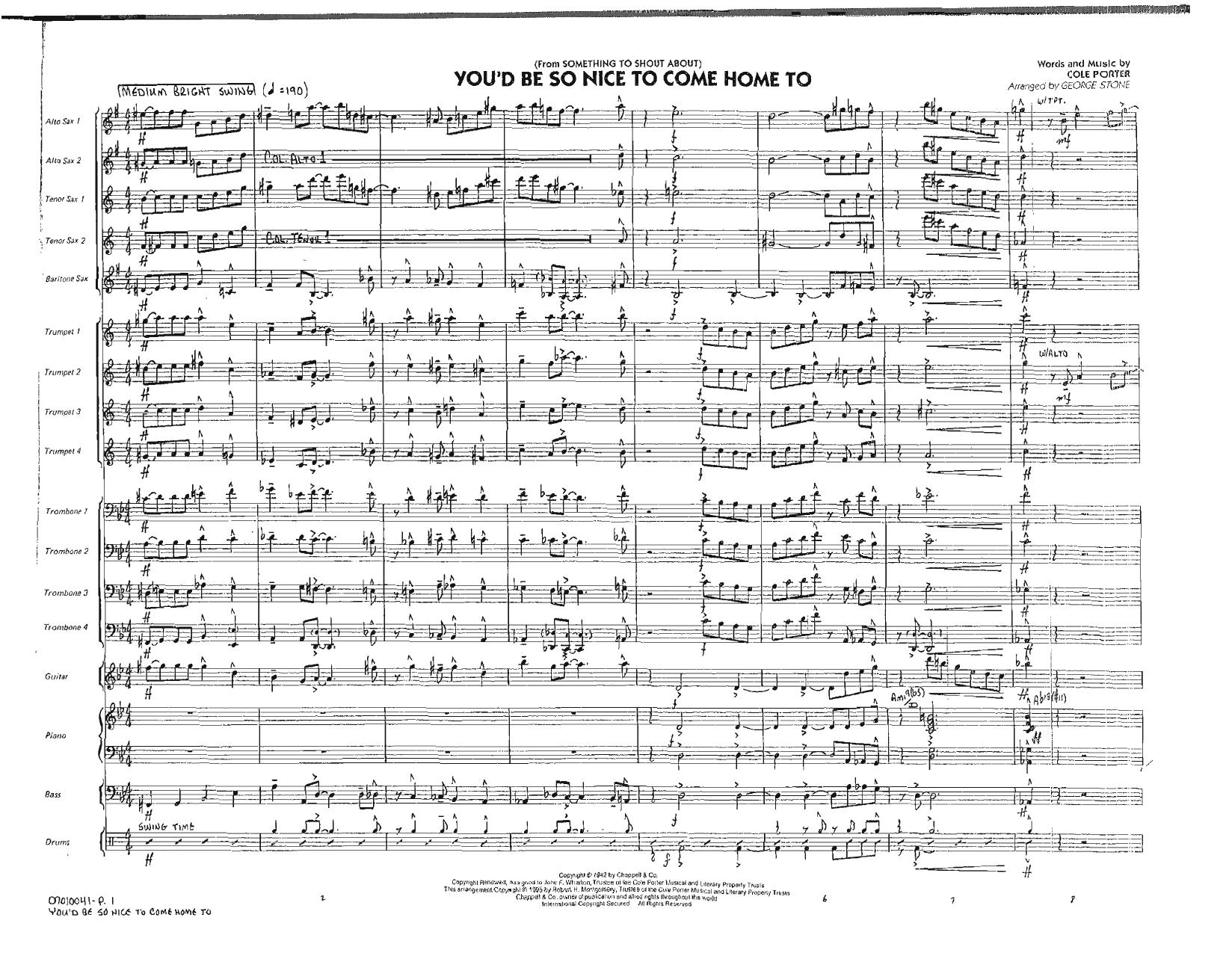
You'd Be So Nice To Come Home To (G.Stone)
Composed by Cole Porter
Arranged by George Stone
- Ensemble: Big Band
- Pages: 52
- Instruments (17): Alto Sax 1, Alto Sax 2, Tenor Sax 1, Tenor Sax 2, Baritone Sax, Trumpet 1, Trumpet 2, Trumpet 3, Trumpet 4, Trombone 1, Trombone 2, Trombone 3, Trombone 4, Guitar, Piano, Bass, Drums
- Difficulty: advanced
- Content: Individual Parts
- Format: PDF Download (Instant)
- Price: $24.99
Cole Porter introduced "You'd Be So Nice to Come Home To" in the 1943 musical film *Something to Shout About*, where it was originally performed by Dinah Shore and later nominated for an Academy Award. The composition rapidly ascended to the upper echelon of the Great American Songbook, prized for its sophisticated minor-major harmonic shifts, striking AABA form, and a memorable melodic contour that bridges lush romanticism with rhythmic drive. Over the decades, it became a mandatory rite of passage for jazz instrumentalists, cemented in jazz lore by legendary instrumental interpretations such as Art Pepper’s blistering 1957 rendition on *Art Pepper Meets the Rhythm Section* and countless vocal recordings by Ella Fitzgerald and Chet Baker. George Stone’s masterful big band adaptation reimagines Porter’s classic through a lens of modern harmonic sophistication while maintaining an undeniable, hard-driving swing momentum. Set at a brisk, propelling medium-up tempo, the arrangement opens with an atmospheric, tension-building intro that utilizes lush contemporary voicings in the brass before dropping into a infectious, straight-ahead groove. Stone expertly balances intricate, contrapuntal horn lines with rich chordal pads, creating an expansive sonic landscape that evokes both the sophistication of West Coast cool jazz and the sheer adrenaline of a modern contemporary big band workout. The mood shifts effortlessly between sultry, understated cool and explosive, high-octane ensemble power. The structural architecture of the chart showcases Stone's trademark ear for color and texture, featuring a meticulously crafted sax soli that reinterprets the core melody with ingenious chromatic passing tones and lush upper-structure extensions. Brass sections trade crisp, articulated punch lines with fluid woodwind lines, culminating in a towering shout chorus that reworks Porter's changes into a breathtaking display of modern big band polyphony. Featured solo space is thoughtfully integrated into the arrangement, allowing ample room for both a primary horn soloist and a secondary conversational voice within the rhythm section framework, keeping the improvisational energy high and engaging for both players and listeners alike. Tailored specifically for advanced collegiate, community, and professional big band ensembles, this 52-page masterwork demands precision, rhythmic crispness, and a high degree of section blending. While the technical demands on the rhythm section and lead trumpet are significant—particularly regarding range and endurance—the payoff is an exceptionally rewarding concert or festival centerpiece. Directors looking to challenge their musicians with sophisticated contemporary arranging techniques applied to a timeless, universally recognized jazz standard will find George Stone’s treatment an essential, show-stopping addition to their repertoire library. Navigating George Stone’s sophisticated chart requires meticulous attention to dynamic balance and articulation clarity, particularly when the ensemble is executing dense, modern extended tertian harmonies. The conductor should ensure that the rhythm section maintains a driving, relaxed medium-up swing feel without rushing, anchoring the complex metric shifts and syncopated brass stabs. Horn players must approach the secondary lines with a chamber-music-like sensitivity, allowing the designated soloists and lead voices to project effortlessly through the rich background textures. Pay close attention to the dynamic markings leading into the shout chorus; pulling back slightly on the sub-ito dynamics will maximize the explosive impact of the final climax. Standard big band articulations apply, with short, clipped accents on off-beat figures and full, sustained portamento on the sweeping harmonic pads. Rehearsals should initially isolate the sax soli at a reduced tempo to lock in the intricate intonation and uniform articulation required before integrating it back into the full-band context. Q: What instruments and parts are included in this arrangement? A: The instrumentation comprises a standard 17-piece big band layout: 5 saxophones (Alto 1, Alto 2, Tenor 1, Tenor 2, Baritone), 4 trumpets, 4 trombones, and a 4-piece rhythm section (piano, guitar, bass, drums), complete with a full conductor score across its 52 pages. Q: What is the difficulty level of this chart? A: This arrangement is graded as advanced, making it best suited for collegiate, advanced high school, community, and professional big band ensembles capable of handling modern harmonic voicings and demanding rhythmic syncopation. Q: What is the musical style and historical background of the piece? A: Originally composed by Cole Porter for the 1943 film *Something to Shout About*, this piece is an iconic jazz standard interpreted here as a modern, hard-swinging big band chart that honors the traditions of the Great American Songbook while pushing contemporary harmonic boundaries. Q: What makes George Stone's arrangement unique? A: Stone sets himself apart through his signature use of lush upper-structure chord extensions, inventive counterpoint, a meticulously crafted saxophone soli, and a towering, harmonically rich shout chorus that reimagines familiar changes in a fresh, modern context. Q: What is the performance duration and recommended tempo? A: The arrangement is set at a brisk, propelling medium-up swing tempo (approximately quarter note = 180–192 BPM) and runs for roughly 4 to 5 minutes depending on the length of the improvised solos.
Questions and answers
- What is included in the You'd Be So Nice To Come Home To (G.Stone) PDF?
- The verified current file contains a conductor score and individual parts across 52 pages.
- How many instruments or parts are listed for You'd Be So Nice To Come Home To (G.Stone)?
- The verified instrumentation list contains 17 entries for this Big Band arrangement.
- Who is credited for You'd Be So Nice To Come Home To (G.Stone)?
- Composer: Cole Porter. Arranger: George Stone.
- What difficulty is listed for You'd Be So Nice To Come Home To (G.Stone)?
- The verified difficulty level is advanced.
- Can I preview You'd Be So Nice To Come Home To (G.Stone) before buying?
- Yes. The product page provides a preview generated from the current PDF file.
- How is You'd Be So Nice To Come Home To (G.Stone) delivered?
- After successful payment, the digital PDF is made available for download. The displayed price is $24.99.
Musicians Also Search For
You'd Be So Nice To Come Home To George Stone PDF • You'd Be So Nice To Come Home To George Stone sheet music • You'd Be So Nice To Come Home To arranged by George Stone • George Stone big band charts • George Stone jazz arrangements PDF • You'd Be So Nice To Come Home To Cole Porter sheet music • You'd Be So Nice To Come Home To Cole Porter big band arrangements • Cole Porter big band charts • You'd Be So Nice To Come Home To big band arrangements • You'd Be So Nice To Come Home To big band PDF download • You'd Be So Nice To Come Home To jazz sheet music • big band sheet music download • You'd Be So Nice To Come Home To conductor score PDF • You'd Be So Nice To Come Home To individual parts download • You'd Be So Nice To Come Home To sheet music PDF • buy You'd Be So Nice To Come Home To sheet music • download You'd Be So Nice To Come Home To PDF • You'd Be So Nice To Come Home To jazz charts • best George Stone big band arrangements • Cole Porter arranged by George Stone • You'd Be So Nice To Come Home To printable sheet music • big band repertoire PDF