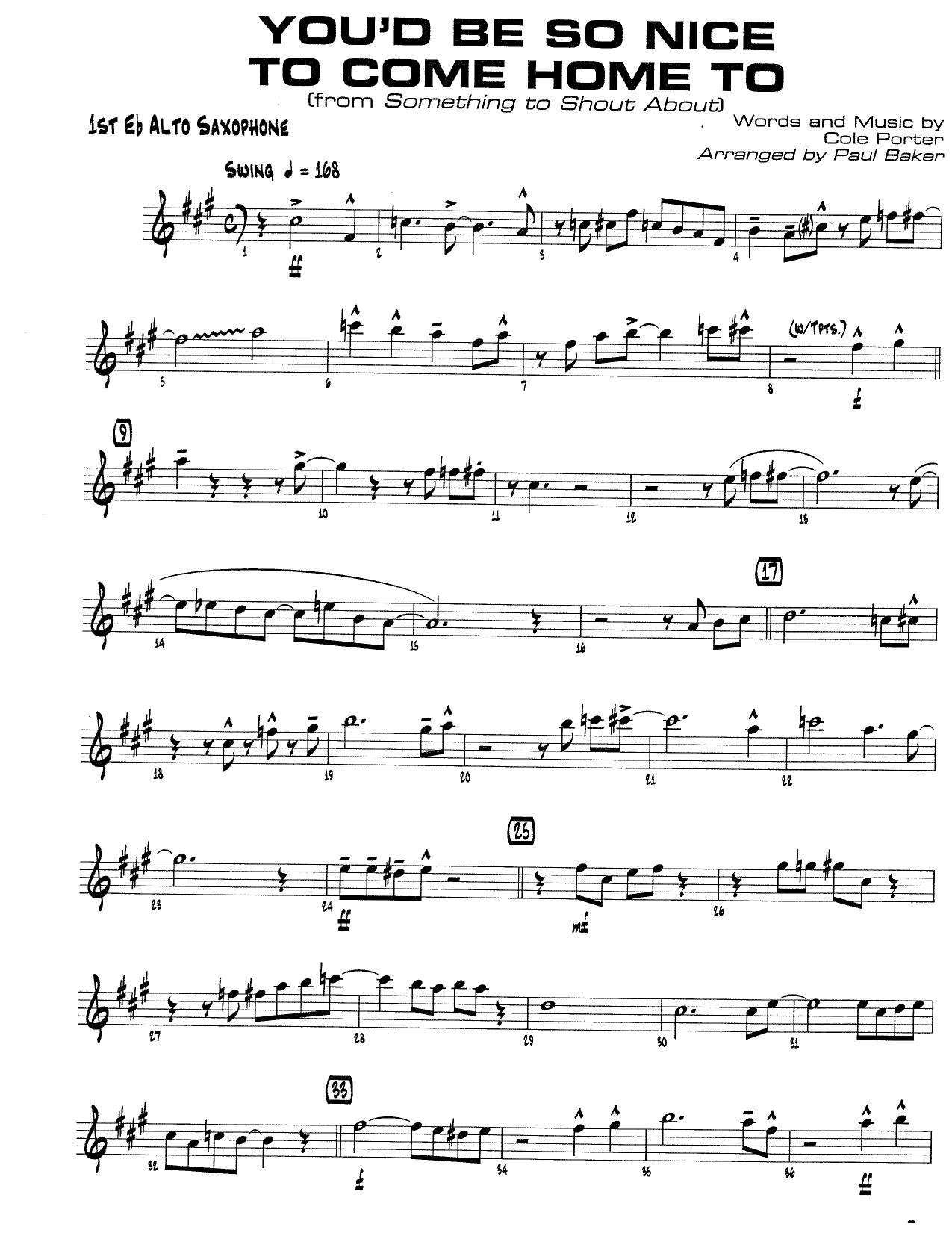
You'd Be So Nice To Come Home To (P.Baker)
Composed by Cole Porter
Arranged by P.Baker
- Ensemble: Big Band
- Style: Jazz Standard
- Pages: 48
- Instruments (18): 1st Eb Alto Saxophone, 2nd Eb Alto Saxophone, 1st Bb Tenor Saxophone, 2nd Bb Tenor Saxophone, Eb Baritone Saxophone, 1st Bb Trumpet, 2nd Bb Trumpet, 3rd Bb Trumpet, 4th Bb Trumpet, 1st Trombone, 2nd Trombone, 3rd Trombone, 4th Trombone, Bass, Drums, Guitar, Piano, Vibraphone
- Difficulty: medium
- Content: Individual Parts
- Format: PDF Download (Instant)
- Price: $24.99
Cole Porter introduced "You'd Be So Nice to Come Home To" in the 1943 musical film *Something to Shout About*, where it was originally introduced by Dinah Shore and later nominated for an Academy Award. The composition swiftly transcended its cinematic origins to become an essential vehicle in the Great American Songbook, embraced by bebop innovators, cool jazz pioneers, and vocalists alike. Its enduring appeal lies in its sophisticated 32-bar AABA form, shifting minor-to-major tonalities, and a bittersweet harmonic architecture that naturally lends itself to creative jazz interpretation. Over the decades, definitive treatments by artists like Art Pepper, Chet Baker, and Helen Merrill cemented its status as a timeless canvas for ensemble arrangement. In this sophisticated big band adaptation by P.Baker, the tune receives a vibrant, dynamic reimagining tailored for a standard 18-piece instrumentation. The arrangement opens with a seductive, understated medium-swing groove anchored by the rhythm section, before introducing the primary melody through a lush, harmonically rich saxophone soli. P.Baker utilizes contemporary extended tertian harmonies, infusing traditional chord changes with subtle chromatic alterations that elevate the emotional tension without sacrificing the swinging momentum. The mood oscillates between sultry introspection and high-energy release, culminating in a powerhouse shout chorus that showcases the full dynamic range of the brass section against driving, syncopated rhythm figures. Designed with advanced ensembles in mind, this 48-page chart demands precision, stylistic versatility, and strong sectional independence from collegiate, community, and professional big bands. The arrangement features designated solo spaces for both alto saxophone and trumpet, allowing featured improvisers to stretch out over standard blowing changes while the ensemble lays down a sophisticated background bed. Technical challenges include maintaining an even, relaxed eighth-note feel at a moderate tempo, executing crisp dynamic contrasts, and balancing dense reed voicings in the lower registers. Conductors will find that the chart rewards meticulous attention to articulation and phrasing, particularly in the delicate interplay between the brass and saxophones during transitional interludes. P.Baker’s expert pacing ensures that the build-up from the quiet, moody exposition to the explosive brass climaxes feels organic and exhilarating. For advanced high school groups looking to step up their harmonic vocabulary or college bands seeking a reliable festival chart that balances artistic depth with audience appeal, this arrangement delivers an unforgettable concert experience. Navigating P.Baker’s arrangement requires a disciplined approach to the medium-swing tempo (suggested around quarter note = 120–126). The rhythm section must establish an unhurried, driving pocket where the ride cymbal dictates the forward momentum without rushing the backbeat. Horn players should focus on uniform articulation, ensuring that dotted eighth-sixteenth figures remain light and bouncy rather than heavy or squared-off. Pay close attention to the dynamic markings during the muted trumpet and soft saxophone soli sections; the ensemble must pull back significantly to let the solo voices breathe through the texture. In the shout chorus, brass players should utilize controlled, resonant tones rather than forced volume, allowing the high-register extensions to blend cleanly with the trombones. Rehearsals should initially isolate the rhythm section to lock in the comping voicings before layering in the horns section by section to balance the complex internal harmony. Q: What instruments and parts are included in this big band arrangement? A: The 48-page set is scored for a standard 18-piece big band, comprising Alto Saxophone 1, Alto Saxophone 2, Tenor Saxophone 1, Tenor Saxophone 2, Baritone Saxophone, four trumpets, four trombones, bass trombone, guitar, piano, bass, and drums. Q: What is the difficulty level of this P.Baker arrangement? A: This chart is graded as advanced, making it best suited for collegiate, advanced high school, community, and professional big bands that possess strong sectional reading skills and experienced soloists. Q: What style and historical context does this arrangement draw from? A: It is rooted in the jazz standard tradition established by Cole Porter in 1943, reinterpreted through a contemporary big band lens that blends traditional swing feel with modern harmonic voicings. Q: What makes this specific arrangement by P.Baker unique? A: It stands out due to its lush saxophone solis, sophisticated chromatic reharmonizations, and a masterfully paced shout chorus that seamlessly bridges classic swing aesthetics with modern compositional flair. Q: What is the performance duration and recommended tempo for this piece? A: The arrangement runs approximately 4 to 5 minutes depending on the length of the improvised solos, and is best performed at a comfortable medium-swing tempo around quarter note = 120–126.
Questions and answers
- What is included in the You'd Be So Nice To Come Home To (P.Baker) PDF?
- The verified current file contains individual parts across 48 pages.
- How many instruments or parts are listed for You'd Be So Nice To Come Home To (P.Baker)?
- The verified instrumentation list contains 18 entries for this Big Band arrangement.
- Who is credited for You'd Be So Nice To Come Home To (P.Baker)?
- Composer: Cole Porter. Arranger: P.Baker.
- What difficulty is listed for You'd Be So Nice To Come Home To (P.Baker)?
- The verified difficulty level is medium.
- What style is listed for You'd Be So Nice To Come Home To (P.Baker)?
- The catalog lists the style as Jazz Standard.
- Can I preview You'd Be So Nice To Come Home To (P.Baker) before buying?
- Yes. The product page provides a preview generated from the current PDF file.
- How is You'd Be So Nice To Come Home To (P.Baker) delivered?
- After successful payment, the digital PDF is made available for download. The displayed price is $24.99.
Musicians Also Search For
You'd Be So Nice To Come Home To P.Baker PDF • You'd Be So Nice To Come Home To P.Baker sheet music • You'd Be So Nice To Come Home To arranged by P.Baker • P.Baker big band charts • P.Baker jazz arrangements PDF • You'd Be So Nice To Come Home To Cole Porter sheet music • You'd Be So Nice To Come Home To Cole Porter big band arrangements • Cole Porter big band charts • You'd Be So Nice To Come Home To big band arrangements • You'd Be So Nice To Come Home To big band PDF download • You'd Be So Nice To Come Home To jazz sheet music • big band sheet music download • You'd Be So Nice To Come Home To individual parts download • You'd Be So Nice To Come Home To sheet music PDF • You'd Be So Nice To Come Home To Jazz Standard charts • Jazz Standard big band arrangements • buy You'd Be So Nice To Come Home To sheet music • download You'd Be So Nice To Come Home To PDF • You'd Be So Nice To Come Home To jazz charts • best P.Baker big band arrangements • Cole Porter arranged by P.Baker • You'd Be So Nice To Come Home To printable sheet music • big band repertoire PDF