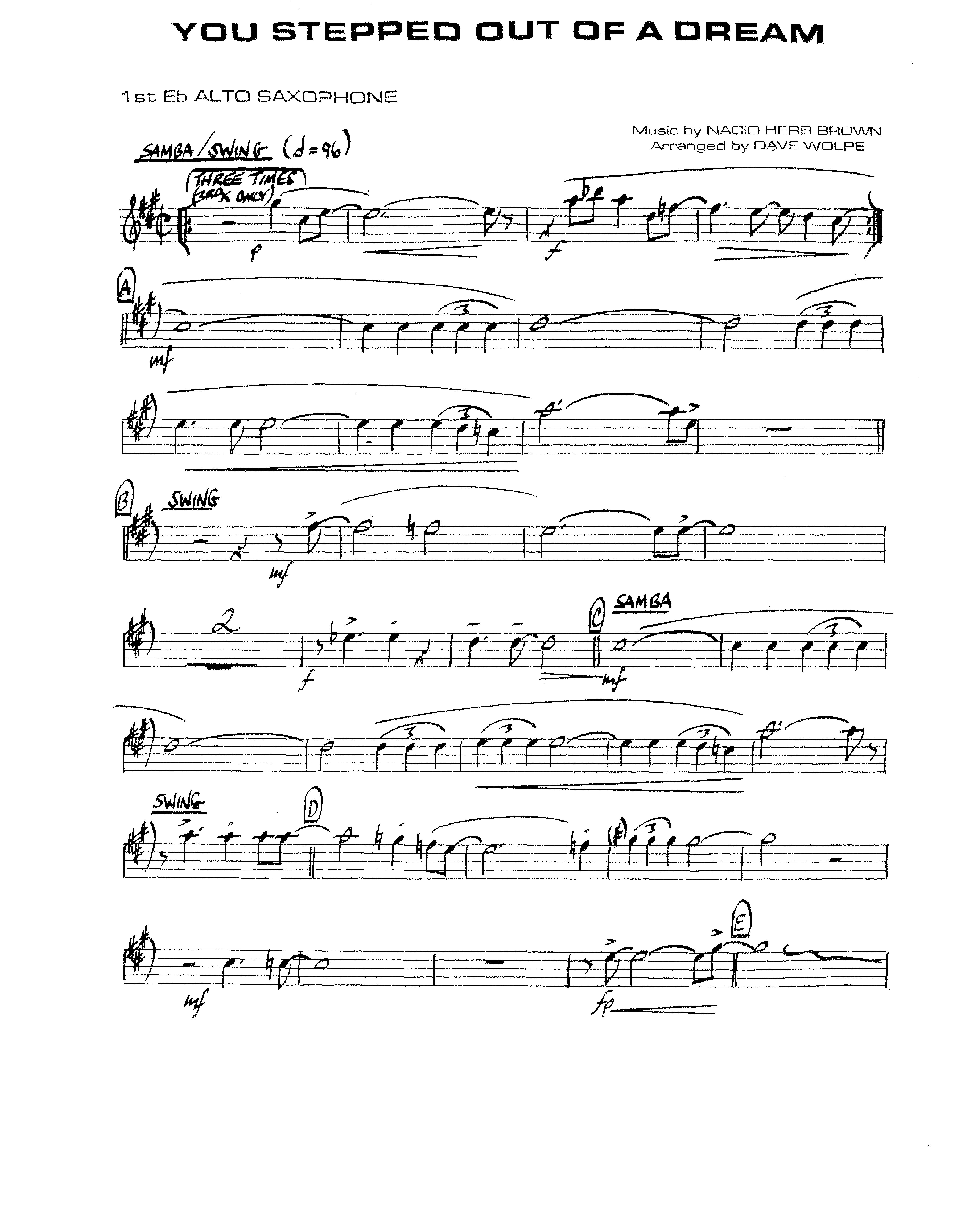
You Stepped Out Of A Dream (D.Wolpe)
Composed by Nacio Herb Brown
Arranged by Dave Wolpe
- Ensemble: Big Band
- Pages: 52
- Instruments (17): 1st Eb Alto Saxophone, 2nd Eb Alto Saxophone, 1st Bb Tenor Saxophone, 2nd Bb Tenor Saxophone, Eb Baritone Saxophone, 1st Bb Trumpet, 2nd Bb Trumpet, 3rd Bb Trumpet, 4th Bb Trumpet, 1st Trombone, 2nd Trombone, 3rd Trombone, Bass Trombone, Piano, Drums, Bass, Guitar
- Difficulty: advanced
- Content: Individual Parts
- Format: PDF Download (Instant)
- Price: $24.99
Originally introduced by orchestration masters in the 1940 film *Ziegfeld Girl* and subsequently popularized by legendary interpreters like Nat King Cole, Sarah Vaughan, and countless bebop innovators, Nacio Herb Brown’s "You Stepped Out Of A Dream" stands as one of the most structurally fascinating and harmonically rich standards of the Great American Songbook. Built upon a mesmerizing, descending cyclical chord progression and a flowing 32-bar AABA form, the composition seamlessly bridges the lush romanticism of the late swing era with the sophisticated harmonic explorations that birthed modern jazz. Its haunting, ethereal melody and distinct minor-to-major shifting tonal centers have made it an enduring vehicle for jazz improvisation across generations. Master arranger Dave Wolpe approaches this timeless classic with a brilliant blend of driving big band momentum and sophisticated, lush voicings tailored specifically for standard jazz orchestra instrumentation. Written in a swinging, forward-propelling medium-up tempo, the arrangement opens with an atmospheric, tension-building introduction before launching into a robust groove anchored by a crisp ride cymbal and walking bassline. Wolpe expertly balances transparent, shimmering brass backgrounds with rich, interwoven sax solis that highlight the sophisticated chromaticism of Brown’s original melody. The dynamic contour builds steadily through harmonically adventurous interludes, culminating in an electrifying shout chorus that pushes the ensemble to its full dynamic peak before resolving into a classy, understated final chord. Throughout the chart, the melodic weight shifts fluidly between sections, showcasing the woodwinds on lush, articulated statements while giving the brass powerful punch-accents that punctuate the arrangement's forward drive. Improvisational space is thoughtfully integrated, providing featured soloists a comfortable yet challenging harmonic framework to stretch out over standard changes. Technical demands center primarily on precision in the rhythm section, clean articulation in fast-moving ensemble lines, and dynamic control during the transition from whispering muted passages to roaring full-ensemble tuttis. The saxophones will find the scalar passages both rewarding and finger-busters if not practiced with strict metronomic discipline, while the brass section benefits immensely from a mature sense of swing phrasing and breath support. Advanced high school, collegiate, and professional community big bands will find this chart an ideal centerpiece for festival programs, formal concerts, or club dates. It strikes a rare pedagogical and artistic balance: accessible enough for strong developing players to master with focused rehearsal, yet sophisticated enough in its harmonic palette and rhythmic interplay to deeply satisfy professional musicians. The arrangement’s brilliant pacing ensures that audience and ensemble engagement remains electric from the first downbeat to the final cutoff. Success with this arrangement hinges on maintaining a relentless, driving medium-swing feel without letting the tempo rush. The rhythm section is the engine; the drummer should keep a steady, feather-light pulsation on the hi-hat on beats two and four, while the bassist locks in with a half-note or quarter-note walking pattern that emphasizes the descending root movements of the harmony. Technically, the primary challenge lies in the tight ensemble integration between the saxes and brass during fast eighth-note unison passages. Conductors should rehearse these sections initially at a slower tempo, ensuring uniform articulation—specifically standard jazz articulation where upbeats are accented and sustained notes receive appropriate tapering. Pay close attention to dynamic markings: when the chart calls for whispered backgrounds under a soloist, the accompanying sections must drop their volume dynamically to a true piano to maintain textural clarity. Brass players should utilize cup or straight mutes where indicated to achieve the authentic period color, ensuring smooth intonation across shifting chord clusters. Q: What instrumentation and parts are included in this big band arrangement? A: This chart is scored for a standard 17-piece big band featuring 5 saxophones (Alto 1, Alto 2, Tenor 1, Tenor 2, Baritone), 4 trumpets, 4 trombones, and a full rhythm section including piano, guitar, bass, and drums. A full set of transposed instrumental parts and the 52-page full conductor score are included. Q: What is the difficulty level of this Dave Wolpe arrangement? A: This arrangement is graded as medium-advanced, making it ideally suited for high school jazz ensembles with strong section leaders, collegiate bands, and professional community big bands looking for rewarding contest or concert repertoire. Q: What is the historical style and feel of this piece? A: It is arranged in a classic mid-century jazz big band style, utilizing a driving medium swing feel that honors the song's origins in the 1940s while incorporating modern harmonic coloring typical of Dave Wolpe's writing. Q: What makes this specific arrangement by Dave Wolpe unique? A: Wolpe’s chart stands out for its clever integration of Nacio Herb Brown’s descending chord cycles, blending lush, Ellingtonian saxophone voicings with crisp, punchy modern brass counterlines and a high-energy shout chorus. Q: What is the estimated performance duration and tempo guideline? A: While performance time can vary slightly based on the length of improvised solos, the arrangement typically runs around 3 to 4 minutes when performed at the recommended medium-up swing tempo.
Questions and answers
- What is included in the You Stepped Out Of A Dream (D.Wolpe) PDF?
- The verified current file contains individual parts across 52 pages.
- How many instruments or parts are listed for You Stepped Out Of A Dream (D.Wolpe)?
- The verified instrumentation list contains 17 entries for this Big Band arrangement.
- Who is credited for You Stepped Out Of A Dream (D.Wolpe)?
- Composer: Nacio Herb Brown. Arranger: Dave Wolpe.
- What difficulty is listed for You Stepped Out Of A Dream (D.Wolpe)?
- The verified difficulty level is advanced.
- Can I preview You Stepped Out Of A Dream (D.Wolpe) before buying?
- Yes. The product page provides a preview generated from the current PDF file.
- How is You Stepped Out Of A Dream (D.Wolpe) delivered?
- After successful payment, the digital PDF is made available for download. The displayed price is $24.99.
Musicians Also Search For
You Stepped Out Of A Dream Dave Wolpe PDF • You Stepped Out Of A Dream Dave Wolpe sheet music • You Stepped Out Of A Dream arranged by Dave Wolpe • Dave Wolpe big band charts • Dave Wolpe jazz arrangements PDF • You Stepped Out Of A Dream Nacio Herb Brown sheet music • You Stepped Out Of A Dream Nacio Herb Brown big band arrangements • Nacio Herb Brown big band charts • You Stepped Out Of A Dream big band arrangements • You Stepped Out Of A Dream big band PDF download • You Stepped Out Of A Dream jazz sheet music • big band sheet music download • You Stepped Out Of A Dream individual parts download • You Stepped Out Of A Dream sheet music PDF • buy You Stepped Out Of A Dream sheet music • download You Stepped Out Of A Dream PDF • You Stepped Out Of A Dream jazz charts • best Dave Wolpe big band arrangements • Nacio Herb Brown arranged by Dave Wolpe • You Stepped Out Of A Dream printable sheet music • big band repertoire PDF