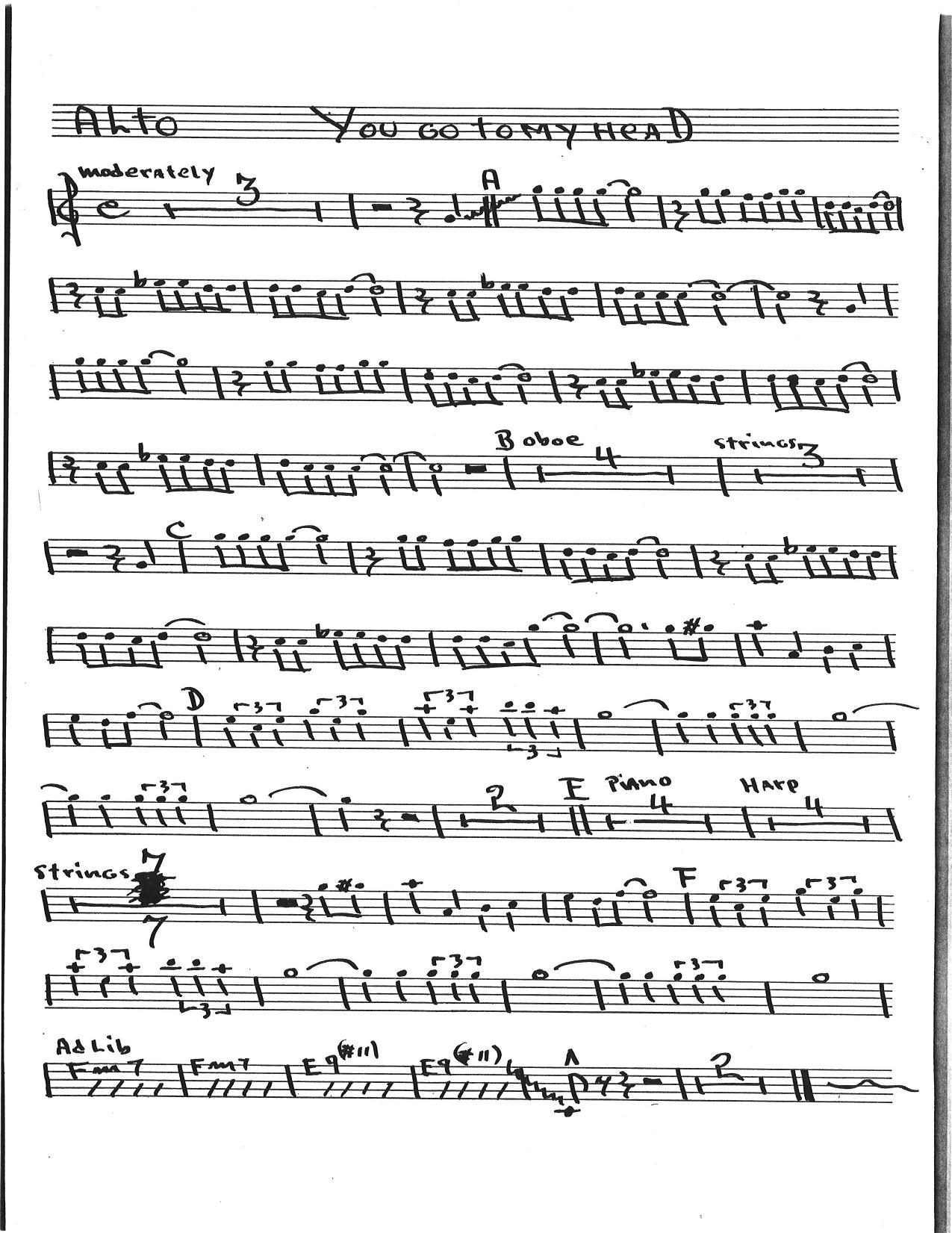
You Go To My Head (C.Parker with Strings) sheet music preview

You Go To My Head (C.Parker with Strings)

Composed by J. Fred Coots

Arranged by Ch.Parker-String

  • Ensemble: Big Band
  • Pages: 19
  • Instruments (11): Alto, 1st Violin, 2nd Violin, 3rd Violin, Viola, Cello, Bass, Harp, Drums, Oboe, Piano
  • Difficulty: easy
  • Content: Individual Parts
  • Format: PDF Download (Instant)
  • Price: $24.99

Composed in 1938 by J. Fred Coots with lyrics by Haven Gillespie, "You Go To My Head" swiftly transitioned from a popular song into an essential jazz standard, immortalized by legendary interpreters such as Billie Holiday, Frank Sinatra, and most notably, Charlie Parker. The association of Parker with lush, cinematic string sections—cemented by his landmark 1949 and 1950 Verve recordings—represents a fascinating pinnacle of mid-century jazz history where bebop harmonic sophistication met the opulent textures of European art music. This specific arrangement captures that rare, transcendent intersection, filtering the poignant lyricism of Coots's melody through an advanced harmonic lens while maintaining the deeply expressive, blues-infused introspection that defined Parker's ballad playing. Evoking a lingering, twilight atmosphere, this arrangement unfolds as a gorgeous, slow-tempo ballad driven by a rubato-leaning rhythmic pulse and lush, sophisticated chord extensions. The mood is simultaneously melancholic and romantic, characterized by a fragile beauty that demands immense emotional maturity from the ensemble. Rather than relying on high-energy swing or aggressive bebop shout choruses, the sonic landscape is painted with rich, luminous voicings, suspended chords, and chromatic passing tones that create a profound sense of harmonic suspense. The integration of classical string textures with a jazz rhythm section generates a warm, enveloping resonance, evoking the sophisticated supper-club elegance of the late 1940s New York jazz scene. The arranger masterfully balances the tension between the soloist and the surrounding ensemble, weaving the 8-instrument instrumentation—featuring Alto Saxophone alongside a classical core of Violin, Viola, Cello, and Harp—into a cohesive, chamber-jazz tapestry. The Alto Saxophone part carries the weight of the primary melodic narrative, echoing Charlie Parker’s iconic phrasing, vocal inflection, and micro-tonal bends, while the strings provide undulating counter-melodies, sustained pad textures, and rich harmonic counterpoint. The inclusion of the harp adds an ethereal, impressionistic quality rarely found in standard big band charts, doubling or embellishing key harmonic shifts with shimmering glissandos and delicate arpeggiations. Technical demands lie primarily in intonation, breath control, and stylistic unity, as players must seamlessly blend classical precision with the expressive micro-inflections of jazz phrasing. Advanced high school ensembles, collegiate studio orchestras, and professional chamber-jazz groups will find this arrangement an exquisite vehicle for showcasing a mature lead soloist and a refined rhythm section. Because the chart relies heavily on rubato pacing, subtle dynamic shading, and delicate ensemble balance rather than sheer volume, it offers a refreshing departure from traditional heavy-brass big band literature. Performing this piece challenges musicians to listen deeply across instrumental families, making it a profoundly rewarding centerpiece for formal concert programs, festival adjudication, or intimate club settings where nuance and tonal beauty take center stage. Success with this arrangement hinges on establishing a deeply collaborative relationship between the jazz rhythm section and the classical string voices. The tempo should be treated flexibly; approach the ballad feel with a relaxed, breathing pulse rather than a rigid metronomic grid, allowing the lead Alto Saxophone ample room to stretch phrasing naturally. Intonation is a primary technical challenge, particularly when the strings double or harmonize with the altered dominants and extended voicings inherent in Parker's harmonic language. Conductors must ensure that the harp and piano (if utilized in the rhythm section) do not clash registerally; clear delineation of space is vital to maintain transparency. Encourage the string players to study recordings of Charlie Parker with strings to absorb the specific vibrato width and slide techniques required to bridge the gap between classical execution and jazz idiom. Rehearsals should initially isolate the rubato transitions, ensuring the ensemble breathes as one unit before layering in the soloist's expressive cadenzas and ornaments. Q: What instruments and parts are included in this arrangement? A: This arrangement is scored for an 8-instrument ensemble consisting of a featured Alto Saxophone, a classical string section (Violin, Viola, Cello), Harp, and rhythm section support spanning 19 detailed pages of score and parts. Q: What is the difficulty level of this chart? A: It is best suited for advanced high school, collegiate, and professional ensembles due to its sophisticated harmonic language, intricate string-voicing integration, and the requirement for mature artistic expression and intonation control. Q: What is the historical style and context of this piece? A: The chart draws heavily from the historic 1949–1950 Charlie Parker with Strings recordings, blending 1930s standard ballad repertoire with lush bebop harmonies and impressionistic classical chamber textures. Q: What makes this specific arrangement unique? A: The integration of a classical harp and string trio (violin, viola, cello) with an alto saxophone soloist creates a rare chamber-jazz aesthetic that diverges from standard brass-heavy big band instrumentation. Q: What is the performance tempo and duration of the arrangement? A: Designed as a slow, expressive ballad, the piece features a flexible, rubato-influenced tempo feel that typically spans a duration of 4 to 5 minutes depending on the soloist's interpretive pacing.

Questions and answers

What is included in the You Go To My Head (C.Parker with Strings) PDF?
The verified current file contains individual parts across 19 pages.
How many instruments or parts are listed for You Go To My Head (C.Parker with Strings)?
The verified instrumentation list contains 11 entries for this Big Band arrangement.
Who is credited for You Go To My Head (C.Parker with Strings)?
Composer: J. Fred Coots. Arranger: Ch.Parker-String.
What difficulty is listed for You Go To My Head (C.Parker with Strings)?
The verified difficulty level is easy.
Can I preview You Go To My Head (C.Parker with Strings) before buying?
Yes. The product page provides a preview generated from the current PDF file.
How is You Go To My Head (C.Parker with Strings) delivered?
After successful payment, the digital PDF is made available for download. The displayed price is $24.99.

Musicians Also Search For

You Go To My Head Ch.Parker-String PDFYou Go To My Head Ch.Parker-String sheet musicYou Go To My Head arranged by Ch.Parker-StringCh.Parker-String big band chartsCh.Parker-String jazz arrangements PDFYou Go To My Head J. Fred Coots sheet musicYou Go To My Head J. Fred Coots big band arrangementsJ. Fred Coots big band chartsYou Go To My Head big band arrangementsYou Go To My Head big band PDF downloadYou Go To My Head jazz sheet musicbig band sheet music downloadYou Go To My Head individual parts downloadYou Go To My Head sheet music PDFbuy You Go To My Head sheet musicdownload You Go To My Head PDFYou Go To My Head jazz chartsbest Ch.Parker-String big band arrangementsJ. Fred Coots arranged by Ch.Parker-StringYou Go To My Head printable sheet musicbig band repertoire PDF

All arrangements by Ch.Parker-String All J. Fred Coots sheet music