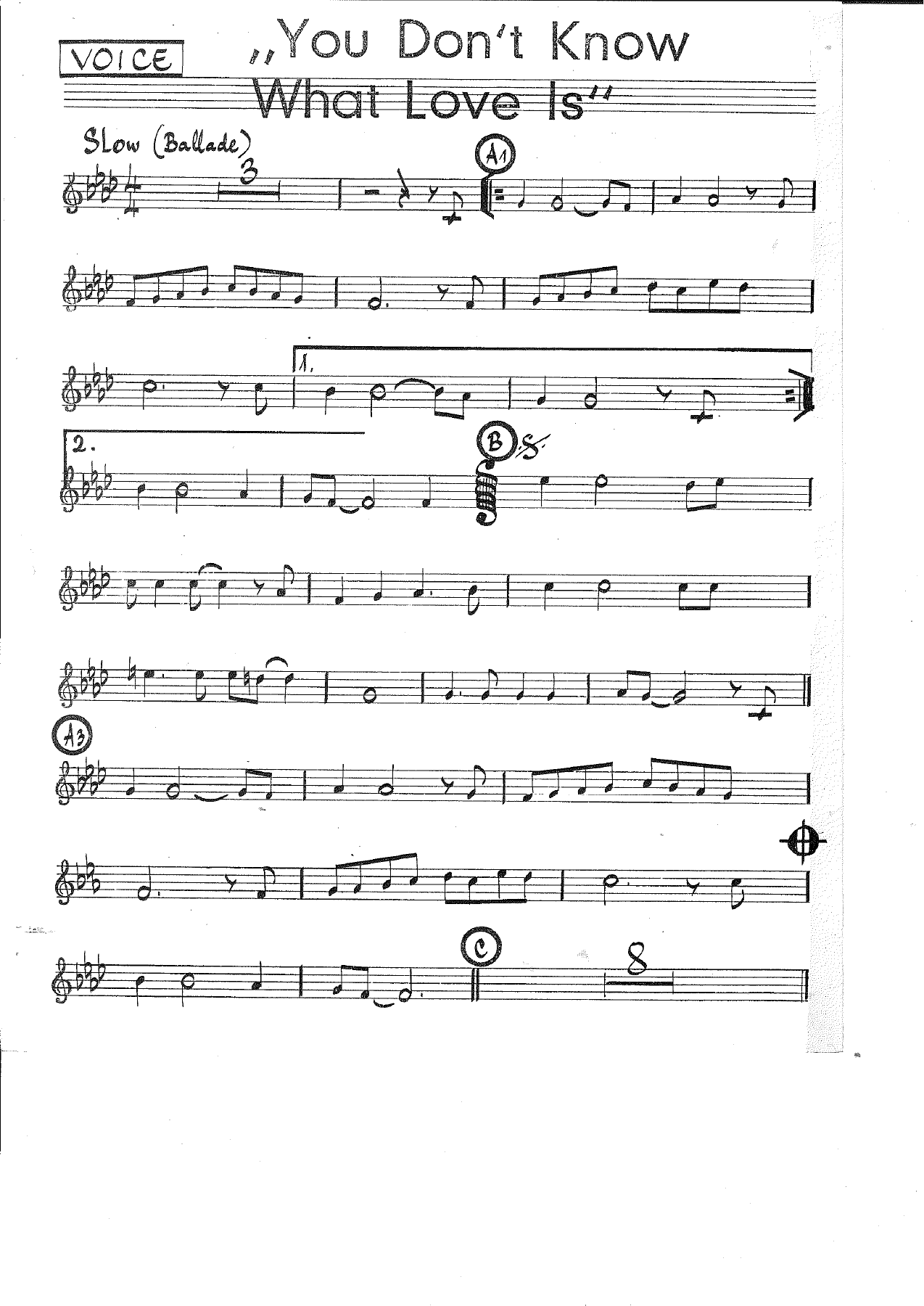
You don't know what love is Soloist (comp. Gene de Paul)
Composed by Gene de Paul
Arranged by Unknown Arranger
- Ensemble: Big Band Vocal
- Style: Ballad
- Pages: 34
- Instruments (19): Voice, Bb Soloist, Trumpet Solo, 1st Alto Saxophone, 2nd Alto Saxophone, 1st Tenor Saxophone, 2nd Tenor Saxophone, Baritone Saxophone, 1st Trombone, 2nd Trombone, 3rd Trombone, 4th Trombone, 1st Trumpet, 2nd Trumpet, 3rd Trumpet, Bass, Piano, Guitar, Drums
- Difficulty: medium
- Content: Individual Parts
- Format: PDF Download (Instant)
- Price: $24.99
"You Don't Know What Love Is," composed by Gene de Paul with lyrics by Don Raye, emerged in 1941, an era that saw the blossoming of American popular song and the transition from big band swing to more intimate vocal jazz. While initially introduced in the Abbott and Costello film *Keep 'Em Flying*, it quickly transcended its cinematic origins to become a quintessential jazz ballad, celebrated for its poignant melody and evocative lyrics exploring the depths of heartbreak. Its enduring appeal lies in its sophisticated harmonic structure and the emotional breadth it offers vocalists, making it a staple in the repertoires of legendary artists from Billie Holiday and Dinah Washington to Chet Baker and John Coltrane, cementing its status as a timeless jazz standard. This particular arrangement of "You Don't Know What Love Is" for big band and vocal soloist embraces the song's inherent melancholic beauty, presenting it as a slow, reflective ballad in 4/4 time. The key, likely a comfortable one for a female vocalist (e.g., F minor or G minor), allows the rich harmonies to unfold with a somber elegance. The mood is consistently introspective and tender, eschewing any overt swing feel in favor of a sustained, expressive rubato within the rhythmic framework. The arrangement emphasizes lush, dense voicings in the brass and saxophones, creating a warm, supportive bed for the vocalist, punctuated by delicate counter-melodies and sustained chords that evoke a sense of longing and introspection. Unknown Arranger's treatment of this classic is characterized by a sophisticated yet accessible approach. The arrangement opens with an atmospheric introduction, likely featuring sustained brass chords or a delicate piano/bass interplay, setting the reflective tone before the vocal enters. The melody is primarily carried by the vocal soloist, allowing for maximum expressive freedom, while the ensemble provides a masterclass in dynamic support and harmonic color. There are no extended soli sections or a traditional shout chorus; instead, the ensemble's role is to enhance the vocal performance through carefully sculpted background figures and rich harmonic pads. A notable feature might be a brief, lyrical instrumental interlude, perhaps featuring a tenor saxophone or trumpet, offering a moment of instrumental reflection before the vocal returns for a final, emotionally resonant chorus. The arrangement culminates in a tender, fading outro, leaving the listener with the song's lingering sentiment. Performance of this arrangement demands a high level of musical maturity and sensitivity from all ensemble members. The primary challenge lies in maintaining a cohesive, expressive slow tempo, ensuring precise intonation within the often-dense voicings, and executing subtle dynamic shifts that underscore the vocal narrative. For the vocalist, the reward is immense: an opportunity to interpret a classic with a rich, supportive orchestral backdrop. The band, in turn, benefits from developing ensemble blend, sustained tone, and the art of accompanying a soloist with nuance and restraint. This arrangement is ideally suited for advanced high school, college, community, and professional jazz ensembles seeking a refined, emotionally resonant ballad that showcases both their vocalist and their collective musicality. This arrangement of "You Don't Know What Love Is" requires a deeply expressive and unified approach. The tempo should be a very slow ballad, approximately quarter note = 50-60 bpm, with a strong emphasis on rubato within the phrasing, particularly from the vocalist. Conductors should encourage a sustained, legato sound from all sections, focusing on precise intonation within the often-close voicings. Brass players should prioritize a warm, dark tone, utilizing straight mutes only if explicitly marked for specific color. Saxophones need to blend seamlessly, creating a rich harmonic cushion. The rhythm section should provide a subtle, supportive foundation; the bassist's role is to lay down a steady, melodic line, while the drummer should use brushes or mallets for a soft, atmospheric texture. Rehearsal time should be dedicated to shaping phrases, balancing dynamics to ensure the vocalist is always paramount, and achieving a collective sense of emotional depth. Q: What instruments are included in this arrangement? A: This arrangement is scored for a standard big band instrumentation, typically including 5 saxophones (2 alto, 2 tenor, 1 baritone), 4 trumpets, 4 trombones, piano, bass, drums, and a dedicated vocal soloist part. Q: What is the difficulty level of this arrangement? A: This arrangement is considered advanced intermediate to advanced. While not technically demanding in terms of speed, it requires strong musicianship, excellent intonation, sophisticated ensemble blend, and a mature approach to ballad interpretation from all players and the vocalist. Q: What style and historical context does "You Don't Know What Love Is" represent? A: This piece is a classic jazz ballad from 1941, embodying the emotional depth and harmonic sophistication of the American Songbook era. It's a timeless jazz standard, celebrated for its poignant melody and lyrical exploration of heartbreak. Q: What makes this specific arrangement unique? A: This arrangement stands out for its focus on lush, dense voicings and a deeply expressive, slow ballad approach. It prioritizes supporting the vocal soloist with rich harmonic textures and subtle dynamic shifts, rather than featuring extended instrumental solos or traditional shout choruses. Q: What is the typical performance duration or tempo for this arrangement? A: Given its nature as a slow ballad, the performance duration is typically around 4-5 minutes, depending on the vocalist's interpretation and any optional instrumental interludes. The tempo should be a very slow, reflective quarter note = 50-60 bpm.
Questions and answers
- What is included in the You don't know what love is Soloist (comp. Gene de Paul) PDF?
- The verified current file contains individual parts across 34 pages.
- How many instruments or parts are listed for You don't know what love is Soloist (comp. Gene de Paul)?
- The verified instrumentation list contains 19 entries for this Big Band Vocal arrangement.
- Who is credited for You don't know what love is Soloist (comp. Gene de Paul)?
- Composer: Gene de Paul. Arranger: Unknown Arranger.
- What difficulty is listed for You don't know what love is Soloist (comp. Gene de Paul)?
- The verified difficulty level is medium.
- What style is listed for You don't know what love is Soloist (comp. Gene de Paul)?
- The catalog lists the style as Ballad.
- Can I preview You don't know what love is Soloist (comp. Gene de Paul) before buying?
- Yes. The product page provides a preview generated from the current PDF file.
- How is You don't know what love is Soloist (comp. Gene de Paul) delivered?
- After successful payment, the digital PDF is made available for download. The displayed price is $24.99.
Musicians Also Search For
You don't know what love is Soloist Unknown Arranger PDF • You don't know what love is Soloist Unknown Arranger sheet music • You don't know what love is Soloist arranged by Unknown Arranger • Unknown Arranger big band vocal charts • Unknown Arranger jazz arrangements PDF • You don't know what love is Soloist Gene de Paul sheet music • You don't know what love is Soloist Gene de Paul big band vocal arrangements • Gene de Paul big band vocal charts • You don't know what love is Soloist big band vocal arrangements • You don't know what love is Soloist big band vocal PDF download • You don't know what love is Soloist jazz sheet music • big band vocal sheet music download • You don't know what love is Soloist individual parts download • You don't know what love is Soloist sheet music PDF • You don't know what love is Soloist Ballad charts • Ballad big band vocal arrangements • buy You don't know what love is Soloist sheet music • download You don't know what love is Soloist PDF • You don't know what love is Soloist jazz charts • best Unknown Arranger big band vocal arrangements • Gene de Paul arranged by Unknown Arranger • You don't know what love is Soloist printable sheet music • big band vocal repertoire PDF