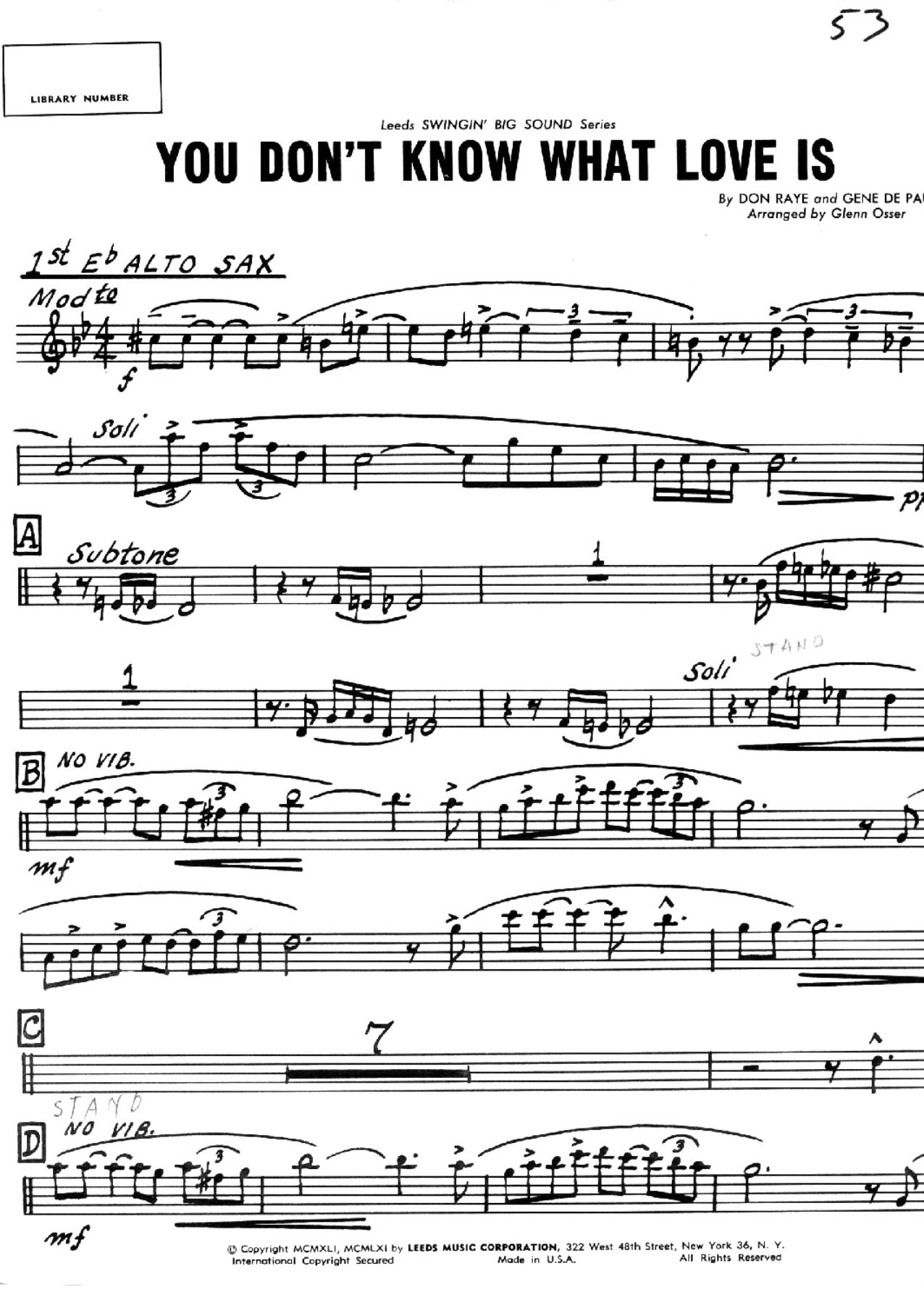
You Don't Know What Love Is (G.Osser) sheet music preview

You Don't Know What Love Is (G.Osser)

Composed by Gene De Paul

Arranged by Glenn Osser

  • Ensemble: Big Band
  • Pages: 32
  • Instruments (15): 1st Eb Alto Sax, 2nd Eb Alto Sax, 1st Bb Tenor Sax, 2nd Bb Tenor Sax, Eb Baritone Sax, 1st Trombone, 2nd Trombone, 3rd Trombone, 4th Trombone, 1st Bb Trumpet, 3rd Bb Trumpet, 4th Bb Trumpet, Guitar, Piano, String Bass
  • Difficulty: medium
  • Content: Individual Parts
  • Format: PDF Download (Instant)
  • Price: $24.99

Gene de Paul and Don Raye penned "You Don't Know What Love Is" for the 1942 Abbott and Costello film *Keep 'Em Flying*, though the song was famously cut from the movie before finding its true home in the pantheon of jazz standards. It achieved legendary status through definitive recordings by artists like Billie Holiday, Miles Davis, and John Coltrane, transforming into the quintessential minor-key torch ballad. Its haunting, downward-resolving melody and sophisticated harmonic framework have made it a mandatory rite of passage for jazz instrumentalists and vocalists across generations, capturing a deeply melancholic, introspective mood that defines the classic American songbook. Glenn Osser’s masterful big band treatment approaches this timeless vehicle as a lush, cinematic ballad steeped in mid-century arranging elegance. Set predominantly in a slow, expressive 4/4 meter, the arrangement relies on rich, extended chord voicings and dense harmonic textures rather than dense rhythmic complexity. The mood is brooding, sophisticated, and intensely dramatic, opening with evocative atmospheric writing that builds a palpable sense of longing. Osser utilizes classic sectional interplay, weaving warm saxophone solis against muted brass cushions to create a textured, shimmering backdrop that honors the inherent vulnerability of the melody. The structural architecture of this chart places a heavy emphasis on dynamic contrast and emotional pacing. The lead alto saxophone and muted trumpet sections frequently share melodic duties, carrying the fragile thematic material with restrained vibrato and careful attention to phrasing. While there is ample room for a featured instrumental soloist—typically a smoky tenor saxophone or melancholic trumpet—to stretch out over the minor changes, the true brilliance of Osser's writing lies in its ensemble-driven dialogue. The technical challenges here are less about fingerbuster velocity and more about intonation, balance, and breath control; maintaining a warm, unified sound during exposed chordal passages requires exceptional ensemble listening skills. Advanced high school, collegiate, and professional community jazz orchestras will find this arrangement an ideal vehicle for developing ballad-playing maturity. Unlike up-tempo burners that rely on adrenaline, this chart exposes a band's foundational musicianship, making it a stellar centerpiece for formal concert programs or festival adjudications. Performing Osser's arrangement rewards the ensemble with a masterclass in dynamic shading, phrasing nuance, and emotional storytelling, proving that a big band's power is often most potent when held at a whisper. Conductors should approach this arrangement with a strict focus on breath support, blend, and intonation, as the slow tempo exposes every subtle pitch discrepancy. The underlying pulse must feel organic and unhurried, avoiding any tendency to rush through the minor-key phrasing. Brass players should utilize harmon or straight mutes where indicated to achieve the signature mid-century cinematic warmth, ensuring that muted lines project without forcing the tone. Rehearsal time is best spent isolating the dense chordal voicings in the saxophones and trombones, ensuring that inner voices balance cleanly beneath the lead melody. Emphasize continuous line and forward motion across bar lines to prevent the ballad from feeling static, and work closely with the rhythm section to keep the accompaniment sparse, supportive, and elegantly understated. Q: What instruments and parts are included in this arrangement? A: This 32-page big band publication is scored for a 15-instrument standard ensemble, featuring two alto saxophones, two tenor saxophones, a baritone saxophone, a full brass and rhythm section complement. Q: What is the difficulty level of this Glenn Osser chart? A: This arrangement is best suited for advanced high school, collegiate, and professional community jazz orchestras due to its heavy demands on intonation, balance, and ballad phrasing. Q: What style and historical era does this piece represent? A: It represents the classic mid-century jazz ballad style, drawing on the rich harmonic tradition of the American songbook and the sophisticated arranging approaches of the 1950s big band era. Q: What makes this specific arrangement by Glenn Osser unique? A: Osser distinguishes his treatment through lush, cinematic voicings, sophisticated sectional interplay, and a moody, atmospheric approach that elevates a classic torch song into a masterclass in dynamic restraint. Q: What is the approximate performance duration and tempo feel? A: The arrangement is performed as a slow, expressive minor-key ballad in 4/4 time, with a typical duration of approximately 3 to 4 minutes depending on the length of the featured solo.

Questions and answers

What is included in the You Don't Know What Love Is (G.Osser) PDF?
The verified current file contains individual parts across 32 pages.
How many instruments or parts are listed for You Don't Know What Love Is (G.Osser)?
The verified instrumentation list contains 15 entries for this Big Band arrangement.
Who is credited for You Don't Know What Love Is (G.Osser)?
Composer: Gene De Paul. Arranger: Glenn Osser.
What difficulty is listed for You Don't Know What Love Is (G.Osser)?
The verified difficulty level is medium.
Can I preview You Don't Know What Love Is (G.Osser) before buying?
Yes. The product page provides a preview generated from the current PDF file.
How is You Don't Know What Love Is (G.Osser) delivered?
After successful payment, the digital PDF is made available for download. The displayed price is $24.99.

Musicians Also Search For

You Don't Know What Love Is Glenn Osser PDFYou Don't Know What Love Is Glenn Osser sheet musicYou Don't Know What Love Is arranged by Glenn OsserGlenn Osser big band chartsGlenn Osser jazz arrangements PDFYou Don't Know What Love Is Gene De Paul sheet musicYou Don't Know What Love Is Gene De Paul big band arrangementsGene De Paul big band chartsYou Don't Know What Love Is big band arrangementsYou Don't Know What Love Is big band PDF downloadYou Don't Know What Love Is jazz sheet musicbig band sheet music downloadYou Don't Know What Love Is individual parts downloadYou Don't Know What Love Is sheet music PDFbuy You Don't Know What Love Is sheet musicdownload You Don't Know What Love Is PDFYou Don't Know What Love Is jazz chartsbest Glenn Osser big band arrangementsGene De Paul arranged by Glenn OsserYou Don't Know What Love Is printable sheet musicbig band repertoire PDF

All arrangements by Glenn Osser All Gene De Paul sheet music