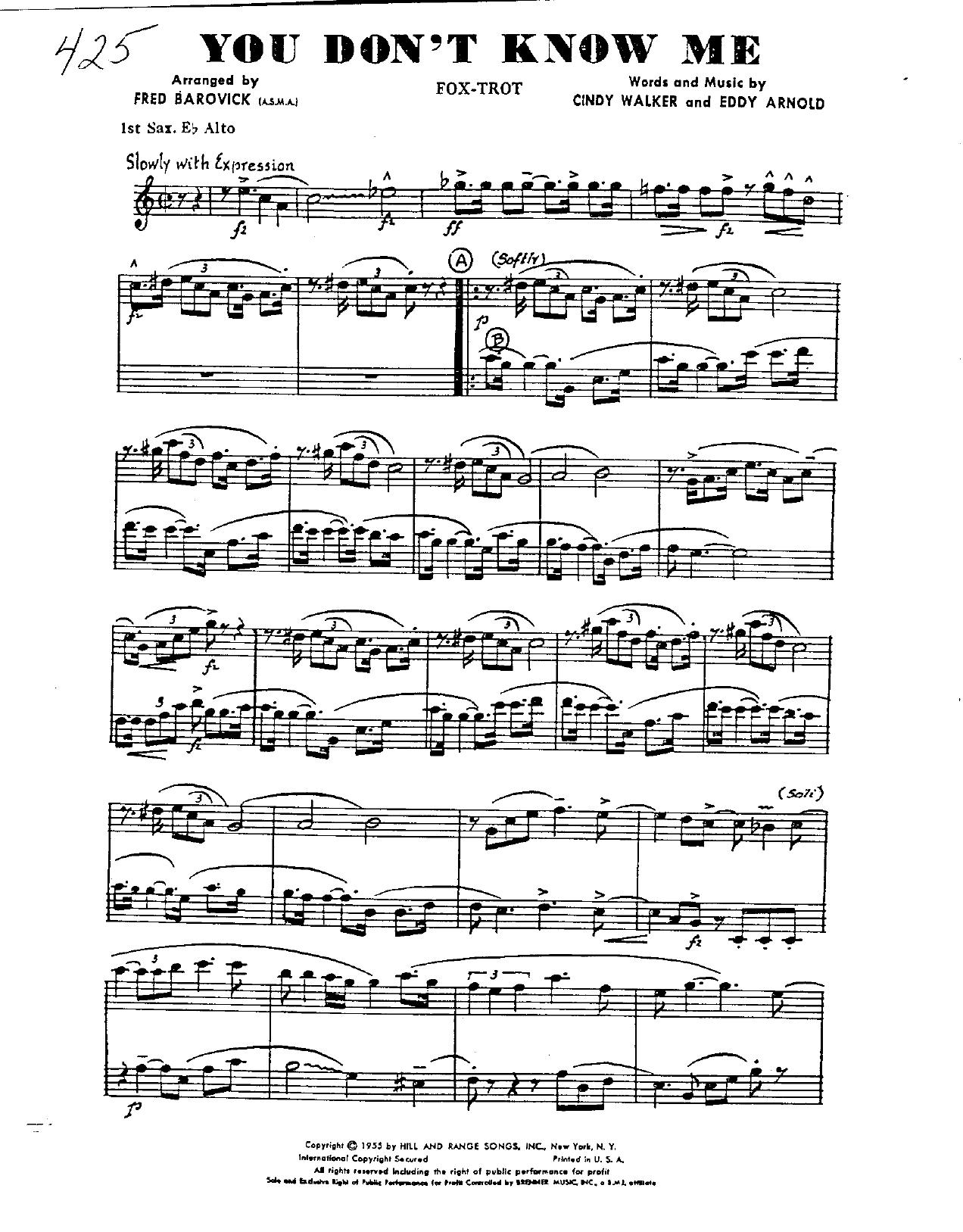
You Don't Know Me (F.Barovick) sheet music preview

You Don't Know Me (F.Barovick)

Composed by Cindy Walker

Arranged by Fred Barovick

  • Ensemble: Big Band
  • Pages: 31
  • Instruments (15): 1st Sax. Eb Alto, 3rd Sax. Eb Alto, 2nd Sax. Bb Tenor, 4th Sax. Bb Tenor, 5th Sax. Eb Baritone, 1st Bb Trumpet, 2nd Bb Trumpet, 3rd Bb Trumpet, 4th Bb Trumpet, 1st Trombone, 2nd Trombone, 3rd Trombone, 4th Trombone, Piano, Drums
  • Difficulty: medium
  • Content: Individual Parts
  • Format: PDF Download (Instant)
  • Price: $24.99

Cindy Walker’s timeless classic "You Don't Know Me," co-written with Eddy Arnold in 1955, occupies a revered space at the intersection of traditional countrypolitan songwriting and the Great American Songbook. While initially popularized by Arnold and later transformed into a monumental pop and soul masterpiece by Ray Charles on his landmark 1962 album *Modern Sounds in Country and Western Music*, the composition’s lush harmonic framework and aching, blues-infused melody have long invited sophisticated jazz interpretation. This enduring standard relies on a narrative of unrequited love, driven by a melancholic chord progression that transitions smoothly between major and minor tonalities, offering a rich canvas for jazz arrangers seeking deep emotional resonance. Fred Barovick’s masterful big band adaptation reimagines the tune as a smoldering, late-night ballad with a deeply expressive, relaxed swing feel. The arrangement opens with a delicate, atmospheric introduction that showcases Barovick’s signature lush saxophone voicings, utilizing close harmony across the 15-instrument line-up to evoke a smoky, intimate club ambiance. Throughout the chart, the dynamic interplay between the brass and reed sections creates a warm, cushion-like texture. Rather than relying on a high-energy, bombastic shout chorus, Barovick opts for a sophisticated, swelling development section that builds intensity through rich extended dominant chords and subtle counterpoint, ultimately resolving into a poignant, emotionally charged climax before fading into a whisper. The arrangement features prominent melodic statements carried primarily by the alto and tenor saxophones, balanced by warm, muted brass pads that provide rhythmic and harmonic stability. Solo opportunities are thoughtfully integrated, allowing a featured soloist—ideally on tenor saxophone or flugelhorn—to stretch out over the traditional AABA form, supported by subtle background figures from the ensemble. Technically, the chart demands exceptional breath control, precise intonation on sustained slow-tempo voicings, and a mature sense of rubato and phrasing. Rhythm section players must maintain a steady, unhurried pulse, treating the underlying groove with the utmost sensitivity to support the ensemble's collective rubato-esque phrasing. Advanced high school ensembles with strong section leaders, collegiate jazz orchestras, and professional community big bands will find this arrangement an exceptional vehicle for developing ballad-playing maturity. Because it eschews blazing tempos in favor of expressive nuance, it challenges musicians to listen closely across sections, balance complex chord structures at low volumes, and convey profound emotional storytelling. It stands out as a rewarding centerpiece for any concert program that aims to balance sophisticated harmonic writing with universal melodic appeal. Conductors should approach this chart with a primary focus on horizontal phrasing and dynamic control. Set the tempo as a relaxed, flowing slow swing (approximately quarter note = 66-72 BPM), ensuring the rhythm section avoids a stiff, mechanical triplet feel in favor of a smooth, buoyant pulse. The main technical challenge lies in maintaining pristine intonation during the dense, slow-moving saxophone soli sections and sustained brass chords. Players should utilize warm, centered tones with minimal vibrato in the ensemble passages to allow the complex harmonic voicings to bloom naturally. Muted brass sections should balance their projection carefully against the open reeds, ensuring that background figures never obscure the primary melody. Rehearsals should initially isolate the rubato transitions to ensure the entire ensemble breathes and moves together as a unified organism, paying close attention to dynamic crescendos and decrescendos that dictate the emotional arc of the performance. Q: What instrumentation and parts are included in this arrangement? A: This chart is scored for a 15-instrument standard big band ensemble, featuring specific parts for Alto Saxophone 1, Alto Saxophone 3, Tenor Saxophone 2, Tenor Saxophone 4, and Baritone Saxophone 5, alongside corresponding brass and rhythm sections. Q: What is the difficulty level of this Fred Barovick arrangement? A: It is ideally suited for advanced high school, collegiate, and professional community big bands that possess strong section playing capabilities and a mature sense of ballad interpretation. Q: What is the musical style and historical context of "You Don't Know Me" in this setting? A: Based on Cindy Walker's 1955 standard—famously reinterpreted during the jazz and soul crossover eras—this arrangement casts the tune as a sophisticated, late-night slow swing ballad rich in emotional depth. Q: What makes this specific arrangement by Fred Barovick unique? A: Barovick departs from typical high-energy big band formats by utilizing lush, close-interval saxophone voicings, subtle harmonic extensions, and an expressive, swelling development section instead of a traditional loud shout chorus. Q: What is the recommended tempo and performance duration for this piece? A: The arrangement is set to a relaxed slow swing feel at approximately quarter note = 66–72 BPM, resulting in a performance duration of roughly 4 to 5 minutes depending on solo expansiveness.

Questions and answers

What is included in the You Don't Know Me (F.Barovick) PDF?
The verified current file contains individual parts across 31 pages.
How many instruments or parts are listed for You Don't Know Me (F.Barovick)?
The verified instrumentation list contains 15 entries for this Big Band arrangement.
Who is credited for You Don't Know Me (F.Barovick)?
Composer: Cindy Walker. Arranger: Fred Barovick.
What difficulty is listed for You Don't Know Me (F.Barovick)?
The verified difficulty level is medium.
Can I preview You Don't Know Me (F.Barovick) before buying?
Yes. The product page provides a preview generated from the current PDF file.
How is You Don't Know Me (F.Barovick) delivered?
After successful payment, the digital PDF is made available for download. The displayed price is $24.99.

Musicians Also Search For

You Don't Know Me Fred Barovick PDFYou Don't Know Me Fred Barovick sheet musicYou Don't Know Me arranged by Fred BarovickFred Barovick big band chartsFred Barovick jazz arrangements PDFYou Don't Know Me Cindy Walker sheet musicYou Don't Know Me Cindy Walker big band arrangementsCindy Walker big band chartsYou Don't Know Me big band arrangementsYou Don't Know Me big band PDF downloadYou Don't Know Me jazz sheet musicbig band sheet music downloadYou Don't Know Me individual parts downloadYou Don't Know Me sheet music PDFbuy You Don't Know Me sheet musicdownload You Don't Know Me PDFYou Don't Know Me jazz chartsbest Fred Barovick big band arrangementsCindy Walker arranged by Fred BarovickYou Don't Know Me printable sheet musicbig band repertoire PDF

All arrangements by Fred Barovick All Cindy Walker sheet music