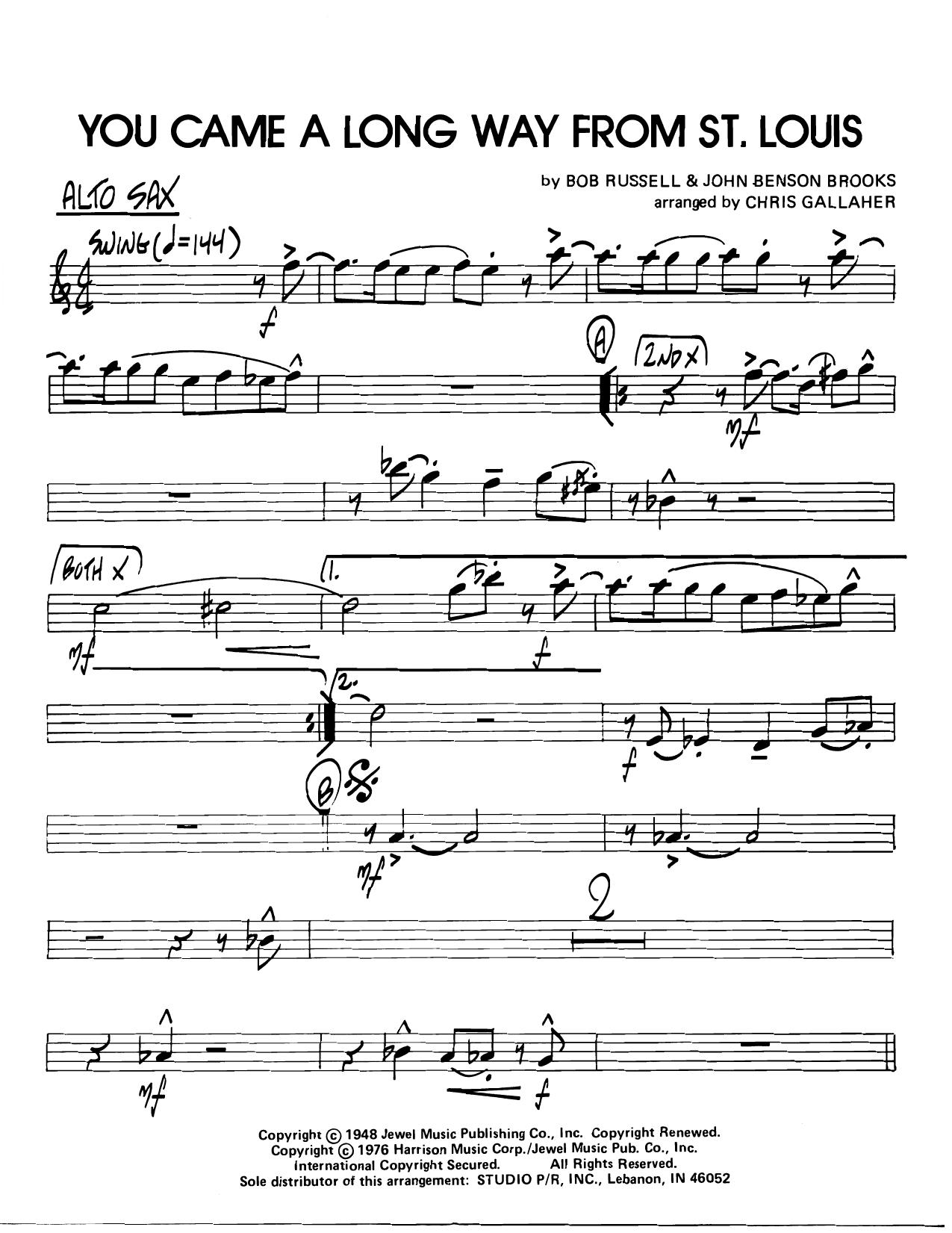
You Came A Long Way From St Louis (C.Gallaher)
Composed by Fred Brooks
Arranged by C.Gallaher
- Ensemble: Big Band
- Style: Jazz Standard
- Pages: 20
- Instruments (10): Alto Sax, Tenor Sax, Baritone Sax, 1st Trumpet, 2nd Trumpet, Trombone, Piano, Guitar, Bass, Drums
- Difficulty: easy
- Content: Individual Parts
- Format: PDF Download (Instant)
- Price: $24.99
Originating from the golden era of post-war popular song and jazz standard adaptation, "You Came A Long Way From St. Louis" was composed by John Benson (Fred) Brooks with lyrics by Bob Russell, rising to prominence through iconic 1948 recordings such as Ray McKinley's. It quickly established itself as a staple of sophisticated vocal and instrumental interpretations, embraced across subsequent decades by legendary performers ranging from Peggy Lee and Rosemary Clooney to Anita O'Day. The composition captures a witty, narrative-driven essence, poking fun at small-town roots meeting big-city ambitions, wrapped inside a sophisticated harmonic framework that naturally invites clever jazz treatment. Conceived with a suave, medium-tempo swing feel in 4/4 time, C. Gallaher’s chart radiates an infectious, laid-back groove balanced by crisp punchiness. The arrangement walks a fine line between blues-inflected warmth and sophisticated urban cool, evoking the smoky atmosphere of a mid-century metropolitan lounge. Key centers shift gracefully to highlight colorful instrumental textures, maintaining an upbeat, engaging energy throughout. The mood is cheeky yet sophisticated, driven by interlocking horn lines and a buoyant rhythm section foundation that keeps the swing momentum continuously moving forward. C. Gallaher approaches the material with a keen ear for big band color, utilizing modern-leaning extended tertian harmonies while respecting the idiomatic vernacular of classic swing writing. The scoring features tightly voiced saxophone solis, rich brass counter-melodies, and clever dynamic contrasts that give the chart an expansive sonic palette. Rather than relying on static block writing, Gallaher weaves independent lines through the ensemble, creating conversational interplay between the woodwinds and brass sections that culminates in a tightly disciplined yet roaring shout chorus. The melodic narrative is shared adeptly across the ensemble, opening with engaging thematic statements carried by the saxophones before brass responses inject rhythmic punctuation. Featured solo space allows improvisers to stretch out over changes that closely mirror the vocal vehicle's sophisticated harmonic path. Technical demands remain moderate-to-advanced, requiring clean articulation, secure section blend, and an innate sense of stylistic swing subdivision. Performers will find immense satisfaction in the intelligent voice-leading and the clever structural pacing that builds naturally toward the ensemble climaxes. Tailored specifically for advanced high school, collegiate, or professional community big bands, this 20-page publication rewards meticulous sectional work. Ensembles equipped with standard 10-instrument instrumentation will find it an exceptionally rewarding showcase piece. It offers an ideal balance of historical tribute and contemporary arranging craft, making it an inspired choice for festival performance or concert programming. Directors should establish a comfortable, confident medium swing tempo that prioritizes relaxed precision over rushing. Avoid dragging the quarter-note pulse; the groove relies heavily on accurate triplet subdivisions and lazy backbeats from the rhythm section. * **Technical Challenges:** The primary technical hurdle involves executing unison and harmonized lines with unified articulation. Pay close attention to short-long articulation patterns, ensuring that accented notes speak clearly without forcing the tone. * **Stylistic Nuances:** Saxophones should employ light, dry articulation on background figures, while brass players must balance warmth with crisp bite. Standard jazz phrasing applies: emphasize upbeats and lean into minor-third resolutions naturally. * **Mutes & Special Effects:** While open horns provide the core body of sound, subtle use of cup or straight mutes in the brass can be introduced during transitional passages to enhance dynamic variety if desired. * **Rehearsal Strategy:** Isolate the rhythm section first to lock in the foundational comping and bassline swing feel. Next, rehearse the saxophone and trumpet sections independently before merging to balance the counter-melodies against the primary thematic statements. Q: What instruments and parts are included in this arrangement? A: This chart is scored for a 10-instrument big band ensemble configuration, specifically featuring Alto Saxophone, Tenor Saxophone, Baritone Saxophone, Trumpet 1, Trumpet 2, and accompanying rhythm and horn sections across a 20-page manuscript. Q: What is the difficulty level of this C. Gallaher arrangement? A: It is designed for advanced high school, collegiate, and professional community big bands, requiring strong section blend, solid stylistic swing interpretation, and comfortable improvisational capabilities. Q: What is the historical style and background of the piece? A: It is based on the 1948 jazz standard composed by John Benson Brooks with lyrics by Bob Russell, famously recorded by Ray McKinley and numerous vocal icons, arranged here in a classic medium-swing style. Q: What makes this specific arrangement by C. Gallaher unique? A: Gallaher infuses the classic tune with sophisticated extended harmonies, conversational counter-melodies between sections, and a meticulously crafted shout chorus that updates the mid-century sound for modern big bands. Q: What is the performance duration and tempo feel of the piece? A: The arrangement is performed at a comfortable, medium-tempo swing feel in 4/4 time, offering an ideal duration for festival set lists or formal concert programming.
Questions and answers
- What is included in the You Came A Long Way From St Louis (C.Gallaher) PDF?
- The verified current file contains individual parts across 20 pages.
- How many instruments or parts are listed for You Came A Long Way From St Louis (C.Gallaher)?
- The verified instrumentation list contains 10 entries for this Big Band arrangement.
- Who is credited for You Came A Long Way From St Louis (C.Gallaher)?
- Composer: Fred Brooks. Arranger: C.Gallaher.
- What difficulty is listed for You Came A Long Way From St Louis (C.Gallaher)?
- The verified difficulty level is easy.
- What style is listed for You Came A Long Way From St Louis (C.Gallaher)?
- The catalog lists the style as Jazz Standard.
- Can I preview You Came A Long Way From St Louis (C.Gallaher) before buying?
- Yes. The product page provides a preview generated from the current PDF file.
- How is You Came A Long Way From St Louis (C.Gallaher) delivered?
- After successful payment, the digital PDF is made available for download. The displayed price is $24.99.
Musicians Also Search For
You Came A Long Way From St Louis C.Gallaher PDF • You Came A Long Way From St Louis C.Gallaher sheet music • You Came A Long Way From St Louis arranged by C.Gallaher • C.Gallaher big band charts • C.Gallaher jazz arrangements PDF • You Came A Long Way From St Louis Fred Brooks sheet music • You Came A Long Way From St Louis Fred Brooks big band arrangements • Fred Brooks big band charts • You Came A Long Way From St Louis big band arrangements • You Came A Long Way From St Louis big band PDF download • You Came A Long Way From St Louis jazz sheet music • big band sheet music download • You Came A Long Way From St Louis individual parts download • You Came A Long Way From St Louis sheet music PDF • You Came A Long Way From St Louis Jazz Standard charts • Jazz Standard big band arrangements • buy You Came A Long Way From St Louis sheet music • download You Came A Long Way From St Louis PDF • You Came A Long Way From St Louis jazz charts • best C.Gallaher big band arrangements • Fred Brooks arranged by C.Gallaher • You Came A Long Way From St Louis printable sheet music • big band repertoire PDF