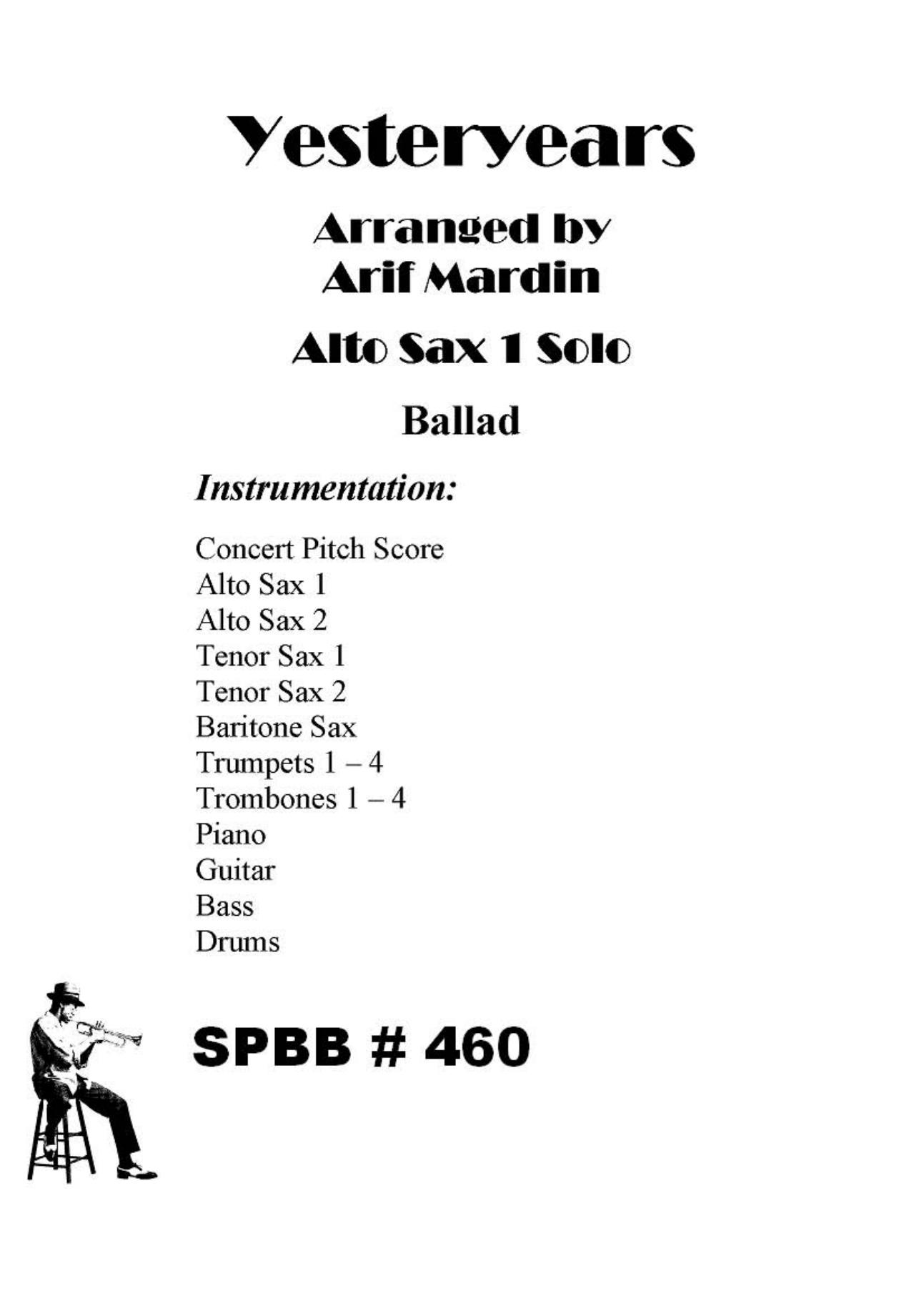
Yesteryears (A.Mardin)
Composed by Arif Mardin
Arranged by Arif Mardin
- Ensemble: Big Band
- Style: Jazz Standard
- Pages: 26
- Instruments (17): Alto Sax 1 (Solo), 2nd Alto Sax, Tenor Sax 1, Tenor Sax 2, Baritone Sax, Trumpet 1, Trumpet 2, Trumpet 3, Trumpet 4, Trombone 1, Trombone 2, Trombone 3, Trombone 4, Piano, Rh. Guitar, Bass, Drums
- Difficulty: medium
- Content: Individual Parts
- Format: PDF Download (Instant)
- Price: $24.99
Arif Mardin’s "Yesteryears" stands as a sophisticated cornerstone of modern big band writing, capturing the legendary arranger and producer’s unique bridge between sophisticated jazz harmony and accessible, emotionally resonant orchestration. Best known for his monumental production work at Atlantic Records, Mardin’s compositional voice in jazz reflects an encyclopedic knowledge of arranging traditions—melding the rich, dense chordal voicings of the Gil Evans school with the driving, rhythmic vitality of post-bop and contemporary soul-jazz. "Yesteryears" functions not merely as a head chart, but as a deeply textured tone poem that rewards repeated listening and meticulous rehearsal, offering an expansive view of mid-century modern jazz composition. The work unfolds with a sophisticated medium-up swing feel, anchored by an intricate harmonic landscape that balances lush, extended chord structures with driving rhythmic propulsion. The mood shifts fluidly between reflective, nostalgic lyricism and bursts of high-octane big band power. The arrangement opens with an atmospheric, rubato harmonic introduction in the brass before settling into a confident, assertive groove. The harmonic palette relies heavily on chromatic mediant shifts, modal mixture, and stacked upper-structure triads, creating an evocative atmosphere that feels both timeless and forward-thinking. The emotional arc moves from introspective vulnerability in the lower-register woodwinds to triumphant, brass-heavy climaxes that demand absolute dynamic control. Mardin’s distinctive arranging approach shines through his ingenious use of sectional counterpoint and non-traditional instrumental pairing. Instead of relying solely on standard block-chord tutti writing, Mardin frequently cross-voices the ensemble, blending muted trumpets with warm sax solis or assigning the lower-register counter-melodies to baritone saxophone and bass trombone. The woodwind writing is notably intricate, requiring fleet-fingered execution across both alto and tenor saxophones. A soaring, multi-chorus shout section serves as the centerpiece of the chart, building relentless tension through shifting metric accents and cascading dynamic swells before resolving into a warm, shimmering final chord. Advanced college ensembles, elite high school jazz bands, and professional repertory orchestras will find "Yesteryears" an exceptionally rewarding addition to their repertoire. The chart features designated solo space for tenor saxophone and trumpet, allowing featured improvisers to stretch out over sophisticated changes that nod to modal and bebop vocabularies. While the rhythm section must maintain a subtle, driving pocket without overplaying, the horn sections face technical demands primarily centered on intonation within altered dominant voicings and crisp articulation at dynamic extremes. Conscientious preparation of this chart yields a masterclass in dynamic contrast, ensemble blend, and sophisticated jazz storytelling. Navigating "Yesteryears" successfully requires meticulous attention to dynamic balance and precise rhythmic articulation, particularly within the sax soli and ensemble passages. Set at a driving medium-up tempo (approx. quarter note = 180), the swing feel must remain relaxed yet intensely focused, avoiding any tendency to rush the eighth-note subdivisions. The brass section should utilize cup mutes and harmon mutes where indicated, ensuring that muted passages project clearly without sacrificing warmth. Conductors should pay immediate attention to the complex altered harmonies in the sax section; slow down sectional rehearsals to isolate inner voices and tune major sevenths and flat-ninths against the bass line. The rhythm section functions as the engine of this chart—the drummer should employ tasteful, conversational comping that highlights the ensemble's rhythmic hits without cluttering the texture, while the bassist lays down a walking line that clearly outlines Mardin's sophisticated harmonic movement. Prioritize clean dynamic gradation, ensuring that the transition from the subdued ballad-like interludes to the roaring shout chorus feels organic and structurally unified. Q: What instruments and parts are included in this publication? A: This arrangement is scored for a standard 17-instrument big band, consisting of 2 alto saxophones, 2 tenor saxophones, 1 baritone saxophone, 4 trumpets, 4 trombones, guitar, piano, bass, and drums, along with a comprehensive conductor score spanning 28 pages. Q: What is the difficulty level of this arrangement? A: This piece is best suited for advanced high school, collegiate, and professional big bands due to its sophisticated harmonic language, extended ranges, and intricate sectional interdependence. Q: What is the musical style and historical context of "Yesteryears"? A: Composed and arranged by Arif Mardin, this piece is a sophisticated jazz standard that reflects the sophisticated, cross-genre arranging sensibilities of the legendary Atlantic Records producer during the height of modern big band writing. Q: What makes this specific arrangement by Arif Mardin unique? A: The arrangement stands out for its non-traditional cross-voicing, rich modal mixture, lush Gil Evans-esque harmonic textures, and a brilliantly structured shout chorus that showcases Mardin's mastery of dynamic contrast. Q: What is the performance duration and recommended tempo for this piece? A: The arrangement performs at a driving medium-up swing feel (around quarter note = 180) and typically runs between 5 and 6 minutes, depending on the length of the open solo sections.
Questions and answers
- What is included in the Yesteryears (A.Mardin) PDF?
- The verified current file contains a conductor score and individual parts across 26 pages.
- How many instruments or parts are listed for Yesteryears (A.Mardin)?
- The verified instrumentation list contains 17 entries for this Big Band arrangement.
- Who is credited for Yesteryears (A.Mardin)?
- Composer: Arif Mardin. Arranger: Arif Mardin.
- What difficulty is listed for Yesteryears (A.Mardin)?
- The verified difficulty level is medium.
- What style is listed for Yesteryears (A.Mardin)?
- The catalog lists the style as Jazz Standard.
- Can I preview Yesteryears (A.Mardin) before buying?
- Yes. The product page provides a preview generated from the current PDF file.
- How is Yesteryears (A.Mardin) delivered?
- After successful payment, the digital PDF is made available for download. The displayed price is $24.99.
Musicians Also Search For
Yesteryears Arif Mardin PDF • Yesteryears Arif Mardin sheet music • Yesteryears arranged by Arif Mardin • Arif Mardin big band charts • Arif Mardin jazz arrangements PDF • Yesteryears Arif Mardin big band arrangements • Yesteryears big band arrangements • Yesteryears big band PDF download • Yesteryears jazz sheet music • big band sheet music download • Yesteryears conductor score PDF • Yesteryears individual parts download • Yesteryears sheet music PDF • Yesteryears Jazz Standard charts • Jazz Standard big band arrangements • buy Yesteryears sheet music • download Yesteryears PDF • Yesteryears jazz charts • best Arif Mardin big band arrangements • Yesteryears printable sheet music • big band repertoire PDF