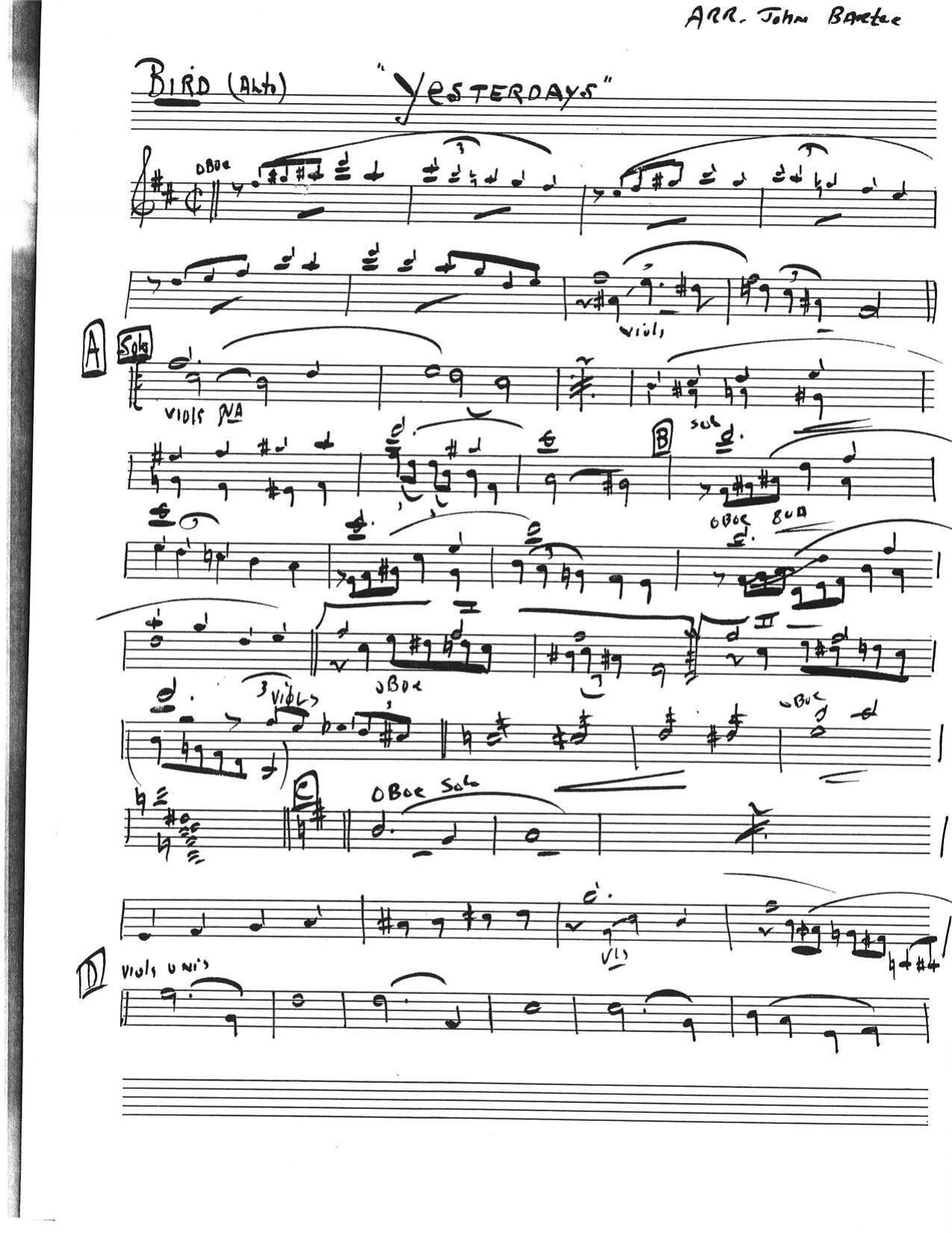
Yesterdays (C.Paker with Strings)
Composed by Jerome Kern
Arranged by Ch.Parker-String
- Ensemble: Big Band
- Pages: 30
- Instruments (10): Alto Saxophone, Oboe, Violin A, Violin B, Violin C, Viola, Cello, Harp, Piano, Double Bass
- Difficulty: medium
- Content: Individual Parts
- Format: PDF Download (Instant)
- Price: $24.99
Jerome Kern and Otto Harbach’s timeless 1933 composition "Yesterdays" achieved legendary status within the jazz canon largely due to its melancholic chromaticism, haunting minor-mode progression, and sweeping harmonic architecture. Originally introduced in the Broadway musical *Roberta*, the tune quickly transcended its theatrical origins to become a quintessential vehicle for jazz improvisation. Its stature was permanently cemented when modern jazz architects—most notably alto saxophonist Charlie Parker—reimagined its possibilities by wedding the language of bebop with lush, classical orchestration. This intersection of small-group jazz innovation and romantic string writing defined a watershed moment in mid-century American music, transforming standard song-form interpretation into high art. Evoking a contemplative yet emotionally urgent mood, this setting of "Yesterdays" unfolds with a deeply expressive, rubato-leaning ballad feel that gradually settles into an evocative, introspective medium-tempo pulse. Set in a minor key characterized by descending line-clichés and deceptive cadences, the music balances aching vulnerability with sophisticated harmonic tension. The emotional landscape shifts fluidly from dark, introspective melancholy during the thematic statements to flashes of brilliant, modern-jazz lyricism during the solo transitions, creating a profound narrative arc that captivates both listeners and performers alike. The unique instrumentation—scoring for a hybrid ensemble of 9 instruments including Alto Saxophone, Trumpet, Violin, Viola, and Cello—mirrors the iconic Charlie Parker with Strings aesthetic, blending traditional rhythm and horn sections with a classical string quartet or ensemble texture. The arranger utilizes the strings not merely as background pad material, but as active counter-melodic voices that engage in sophisticated polyphonic dialogue with the solo alto saxophone. Rich, extended chord voicings, lush harmonic suspensions, and delicate string counterlines frame the solo voice, while the trumpet and rhythm section provide subtle, modern harmonic support without ever cluttering the transparent, chamber-like orchestral space. The featured alto saxophone carries the primary melodic weight, requiring a mature player capable of channeling Parker’s fluid phrasing, pristine intonation, and deep blues sensibility. Technical challenges within the arrangement center on stylistic cohesion: string players must adapt their vibrato and articulation to blend seamlessly with the jazz articulation of the horns, while the rhythm section must maintain a supple, breathing time-feel beneath the rubato tendencies of the melody. Advanced high school, collegiate, and professional ensembles will find this 30-page masterwork immensely rewarding, as it offers a rare pedagogical and performance opportunity to explore the historical fusion of bebop and classical string orchestration with authenticity and depth. Navigating this arrangement successfully requires a delicate balance of classical precision and jazz flexibility, particularly given the unique 9-instrument instrumentation combining jazz horns and strings. The conductor should establish a flexible, expressive tempo concept, avoiding rigid metronomic playback in favor of a breathing, rubato-informed ballad feel where appropriate. The primary technical challenge lies in intonation and blend between the strings (Violin, Viola, Cello) and the jazz front-line (Alto Saxophone, Trumpet). String players should be encouraged to use a controlled, narrower vibrato that complements the horn section's tone rather than overpowering it. Articulation markings must be meticulously observed; string slurs should align conceptually with the bebop phrasing of the alto saxophone lead. Rehearsal should begin by separating the sections: rehearse the string choir independently to lock in the rich inner voicings and counter-melodies before introducing the solo alto saxophone and rhythm section. Ensure the rhythm section keeps the harmonic foundation transparent, using light cymbal work and tasteful chordal accompaniment to preserve the chamber-jazz transparency essential to the Parker-with-strings style. Q: What specific instruments and parts are included in this 30-page arrangement? A: The arrangement is scored for an intimate 9-instrument ensemble comprising Alto Saxophone (featured lead), Trumpet, Violin, Viola, Cello, and a standard rhythm section framework. Q: What is the difficulty level of this arrangement? A: This piece is best suited for advanced high school, collegiate, and professional ensembles due to its sophisticated harmonic language, stylistic demands, and the necessity for tight integration between jazz and classical players. Q: What is the historical context and style of this chart? A: Drawing heavily from the iconic Charlie Parker with Strings recordings, this arrangement styles Jerome Kern's 1933 standard as a sophisticated blend of bebop improvisation and lush, mid-century classical string writing. Q: What makes this specific arrangement unique? A: Its uniqueness stems from its authentic integration of a classical string section (violin, viola, cello) with jazz horns, creating a chamber-jazz texture featuring active counterlines rather than generic background pads. Q: What is the recommended performance duration and tempo feel? A: The arrangement typically runs around 4 to 5 minutes and is performed at an introspective, expressive ballad-to-medium tempo feel that emphasizes rubato phrasing and deep emotional nuance.
Questions and answers
- What is included in the Yesterdays (C.Paker with Strings) PDF?
- The verified current file contains a conductor score and individual parts across 30 pages.
- How many instruments or parts are listed for Yesterdays (C.Paker with Strings)?
- The verified instrumentation list contains 10 entries for this Big Band arrangement.
- Who is credited for Yesterdays (C.Paker with Strings)?
- Composer: Jerome Kern. Arranger: Ch.Parker-String.
- What difficulty is listed for Yesterdays (C.Paker with Strings)?
- The verified difficulty level is medium.
- Can I preview Yesterdays (C.Paker with Strings) before buying?
- Yes. The product page provides a preview generated from the current PDF file.
- How is Yesterdays (C.Paker with Strings) delivered?
- After successful payment, the digital PDF is made available for download. The displayed price is $24.99.
Musicians Also Search For
Yesterdays Ch.Parker-String PDF • Yesterdays Ch.Parker-String sheet music • Yesterdays arranged by Ch.Parker-String • Ch.Parker-String big band charts • Ch.Parker-String jazz arrangements PDF • Yesterdays Jerome Kern sheet music • Yesterdays Jerome Kern big band arrangements • Jerome Kern big band charts • Yesterdays big band arrangements • Yesterdays big band PDF download • Yesterdays jazz sheet music • big band sheet music download • Yesterdays conductor score PDF • Yesterdays individual parts download • Yesterdays sheet music PDF • buy Yesterdays sheet music • download Yesterdays PDF • Yesterdays jazz charts • best Ch.Parker-String big band arrangements • Jerome Kern arranged by Ch.Parker-String • Yesterdays printable sheet music • big band repertoire PDF