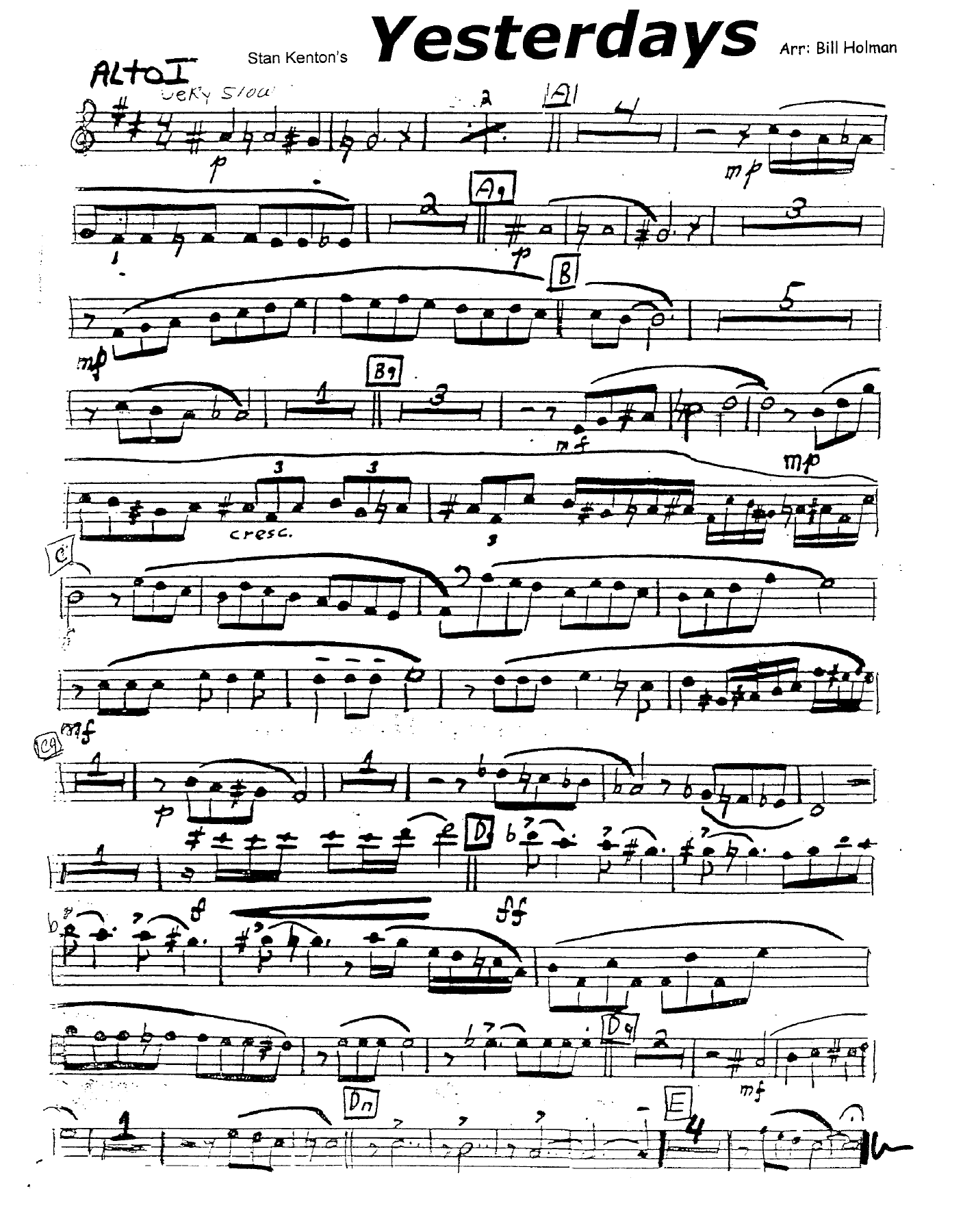
Yesterdays (B.Holman) sheet music preview

Yesterdays (B.Holman)

Composed by Jerome Kern

Arranged by Bill Holman

  • Ensemble: Big Band
  • Style: Jazz Standard
  • Pages: 30
  • Instruments (17): Alto Saxophone I, Alto Saxophone II, Tenor Saxophone I, Tenor Saxophone II, Baritone Saxophone, Trumpet I, Trumpet II, Trumpet III, Trumpet IV, Trombone I, Trombone II, Trombone III, Trombone IV, Drums, Bass, Guitar, Piano
  • Difficulty: medium
  • Content: Individual Parts
  • Format: PDF Download (Instant)
  • Price: $24.99

Jerome Kern's "Yesterdays," composed in 1933 for the Broadway musical *Roberta* with lyrics by Otto Harbach, quickly transcended its theatrical origins to become a cornerstone of the Great American Songbook and an enduring jazz standard. While initially overshadowed by *Roberta*'s more popular tune, "Smoke Gets in Your Eyes," "Yesterdays" gained widespread recognition through its adoption by jazz luminaries. Artists from Billie Holiday and Oscar Peterson to Miles Davis and Art Tatum have offered definitive interpretations, solidifying its status as one of the most frequently recorded and performed standards in jazz history. The piece is characterized by its melancholic, wistful minor ballad feel, most commonly performed in the key of D minor. Its harmonic structure is notably sophisticated, featuring a 32-bar ABAC form with a chromatically rich A section that employs descending voice leading, creating a dramatic and reflective mood. This particular arrangement by the legendary Bill Holman transforms the reflective original into a masterful big band vehicle, notably recorded by the Stan Kenton Orchestra on their seminal *Contemporary Concepts* album. Holman, renowned for his ability to reimagine well-known melodies into compelling new works, approaches "Yesterdays" not merely as an orchestration, but as a complete re-composition built upon the original's harmonic framework. His signature style, characterized by intricate counterpoint, extended harmonies, and a sophisticated use of dissonance, is evident throughout. Rather than a simple head-soli-shout chorus structure, Holman weaves complex sectional writing, often employing canonic imitation and unexpected melodic development that keeps the listener engaged. The arrangement maintains the original's ballad tempo and emotional depth but expands its expressive palette through rich voicings and dynamic contrasts. A standout feature of this arrangement is its role as a tenor saxophone showcase, famously recorded with Bill Perkins as the soloist. The melody is primarily carried by the featured tenor saxophone, allowing ample space for a lyrical and expressive improvised solo that navigates Holman's harmonically adventurous landscape. The ensemble writing supports the soloist with lush, often understated textures, building to moments of powerful, yet never overbearing, soli passages and subtle shout choruses that underscore the tune's inherent drama. Technical challenges include precise ensemble blend and balance, particularly in the intricate woodwind and brass voicings, and maintaining a consistent, flowing ballad feel across the band. The arrangement is immensely rewarding to perform, offering musicians the opportunity to engage with a sophisticated and emotionally resonant piece of big band literature. This arrangement is ideally suited for advanced high school, collegiate, community, and professional jazz ensembles capable of executing complex harmonic and rhythmic figures with musical maturity and sensitivity. This Bill Holman arrangement of "Yesterdays" demands a cohesive ensemble sound and a deep understanding of ballad interpretation. The tempo should be a slow, expressive ballad, typically around 60-72 beats per minute, emphasizing a flowing, legato feel rather than a strict metronomic pulse. Conductors should guide the ensemble to focus on breath support and sustained tones, particularly in the brass and saxophone sections, to achieve Holman's characteristic rich voicings. Key technical challenges include navigating the dense harmonic clusters and maintaining precise intonation, especially in the saxophone soli sections where voicings can be quite close. Balance is paramount; ensure that inner voices speak clearly without overpowering the lead lines or the featured tenor saxophone. Rehearsal should prioritize listening across sections and developing a unified ensemble concept of phrasing and dynamics. Pay close attention to dynamic swells and decays, as Holman uses these to great effect in building and releasing tension. No special techniques like plunger mutes or falls are explicitly required, but expressive vibrato and sensitive articulation will enhance the performance. Q: What instruments are included in this arrangement? A: This arrangement is scored for a standard 17-piece big band: Alto Saxophone 1 & 2, Tenor Saxophone 1 & 2, Baritone Saxophone, Trumpet 1-4, Trombone 1-4, Piano, Bass, and Drums. Q: What is the difficulty level of this arrangement? A: This arrangement is rated as advanced (Grade 5). It requires a mature ensemble with strong technical proficiency, excellent intonation, and a sophisticated understanding of jazz ballad interpretation and complex harmonies. Q: What is the musical style and historical context of this arrangement? A: This is a big band jazz arrangement of "Yesterdays," a jazz standard composed by Jerome Kern in 1933. Bill Holman's arrangement, famously recorded by the Stan Kenton Orchestra, is a classic example of West Coast Cool Jazz arranging, known for its intricate counterpoint and rich harmonic language. Q: What makes this Bill Holman arrangement unique? A: Holman's treatment is distinctive for its re-compositional approach, transforming the original standard into a complex big band work featuring intricate voicings, extended harmonies, and a prominent, lyrical tenor saxophone solo feature. It avoids typical big band clichés, focusing instead on sophisticated ensemble writing and emotional depth. Q: What is the typical performance duration or tempo for this piece? A: As a jazz ballad, this arrangement is typically performed at a slow tempo, around 60-72 beats per minute. The overall performance duration will vary depending on the length of the improvised tenor saxophone solo, but generally ranges from 5-7 minutes.

Questions and answers

What is included in the Yesterdays (B.Holman) PDF?
The verified current file contains individual parts across 30 pages.
How many instruments or parts are listed for Yesterdays (B.Holman)?
The verified instrumentation list contains 17 entries for this Big Band arrangement.
Who is credited for Yesterdays (B.Holman)?
Composer: Jerome Kern. Arranger: Bill Holman.
What difficulty is listed for Yesterdays (B.Holman)?
The verified difficulty level is medium.
What style is listed for Yesterdays (B.Holman)?
The catalog lists the style as Jazz Standard.
Can I preview Yesterdays (B.Holman) before buying?
Yes. The product page provides a preview generated from the current PDF file.
How is Yesterdays (B.Holman) delivered?
After successful payment, the digital PDF is made available for download. The displayed price is $24.99.

Musicians Also Search For

Yesterdays Bill Holman PDFYesterdays Bill Holman sheet musicYesterdays arranged by Bill HolmanBill Holman big band chartsBill Holman jazz arrangements PDFYesterdays Jerome Kern sheet musicYesterdays Jerome Kern big band arrangementsJerome Kern big band chartsYesterdays big band arrangementsYesterdays big band PDF downloadYesterdays jazz sheet musicbig band sheet music downloadYesterdays individual parts downloadYesterdays sheet music PDFYesterdays Jazz Standard chartsJazz Standard big band arrangementsbuy Yesterdays sheet musicdownload Yesterdays PDFYesterdays jazz chartsbest Bill Holman big band arrangementsJerome Kern arranged by Bill HolmanYesterdays printable sheet musicbig band repertoire PDF

All arrangements by Bill Holman All Jerome Kern sheet music