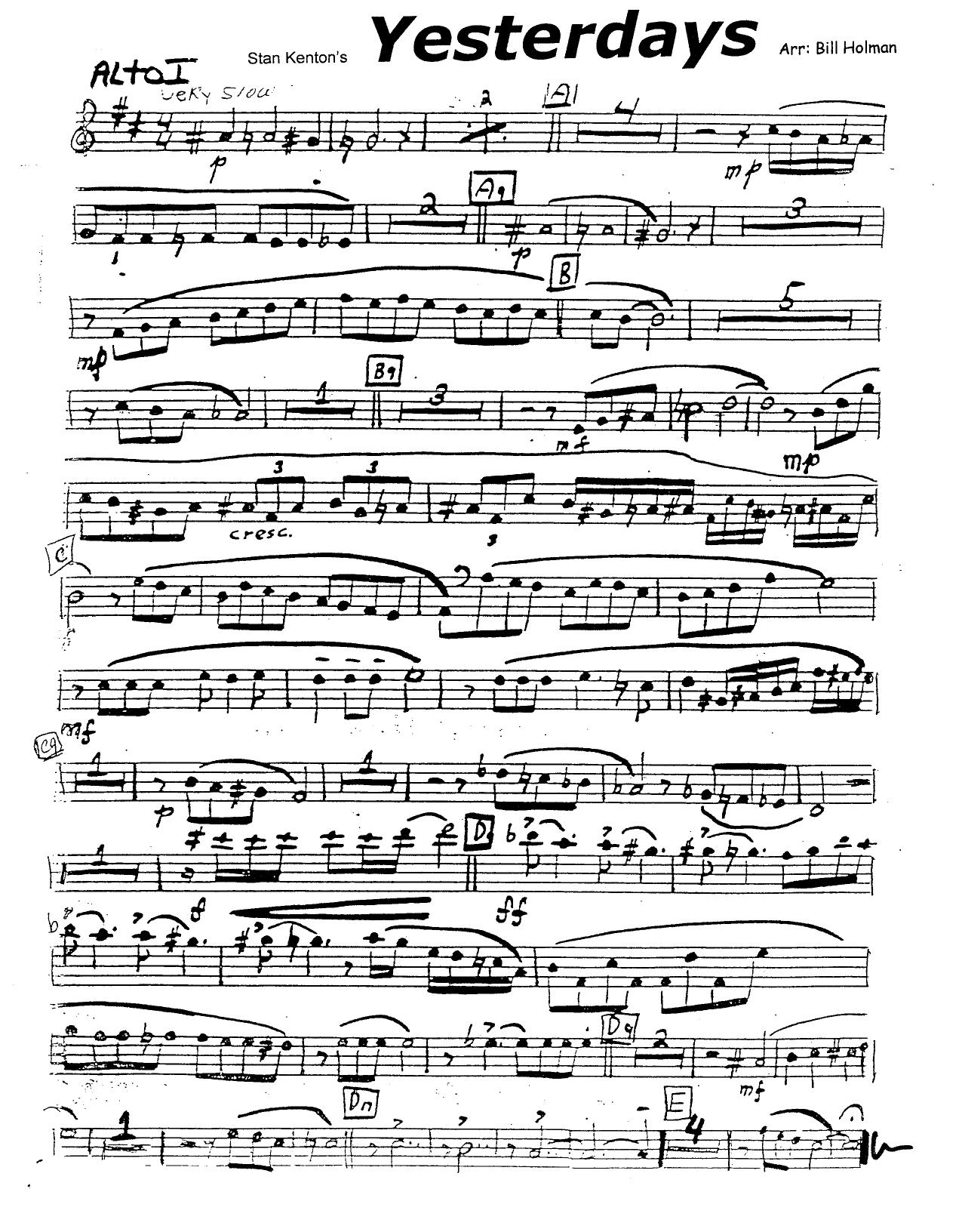
Yesterdays (B.Holman)
Composed by Jerome Kern
Arranged by Bill Holman
- Ensemble: Big Band
- Pages: 30
- Instruments (17): Alto Saxophone I, Alto Saxophone II, Tenor Saxophone I, Tenor Saxophone II, Baritone Saxophone, Trumpet I, Trumpet II, Trumpet III, Trumpet IV, Trombone I, Trombone II, Trombone III, Trombone IV, Drums, Bass, Guitar, Piano
- Difficulty: medium
- Content: Individual Parts
- Format: PDF Download (Instant)
- Price: $24.99
Jerome Kern and Otto Harbach penned the timeless standard "Yesterdays" for the 1933 Broadway musical *Roberta*, cementing its status as one of the most enduring vehicles for jazz improvisation. Over the decades, the melancholy, minor-mode melody has been reinterpreted by countless jazz luminaries, most notably Art Tatum, Stan Getz, and John Coltrane. Bill Holman—one of the most innovative and structurally adventurous arrangers to emerge from the West Coast jazz scene and the Stan Kenton orchestra—takes this familiar, introspective theme and transforms it into a masterclass in modern big band architecture. Rather than relying on a straightforward ballad treatment, Holman injects the chart with sophisticated harmonic motion, labyrinthine counterpoint, and shifting rhythmic textures that elevate the material into a profound artistic statement. Holman approaches the standard with a driving, restless medium-tempo swing feel that recontextualizes the song's inherent nostalgia into something urgent and searching. The arrangement opens with a haunting, tension-filled introduction that utilizes interlocking woodwind voicings and angular harmonic drops, instantly establishing a moody and sophisticated atmosphere. As the form unfolds, the mood oscillates between lush, densely voiced chordal passages that showcase Holman's signature West Coast transparency, and explosive, linear interludes where the brass and saxophones engage in fierce conversational counterpoint. The emotional arc moves from dark introspection to soaring, dynamic releases of tension, driven by clever reharmonizations that constantly reframe Kern's original melody. The arrangement heavily features the saxophone section, which carries much of the intricate thematic exposition through tightly woven solis that demand absolute rhythmic precision and a unified concept of tone. Solos are designated for key chairs, providing an ideal platform for advanced improvisers to stretch out over Holman's sophisticated harmonic roadmap. Technically, the chart challenges the ensemble through its complex syncopations, wide dynamic ranges, and fast-moving inner lines that require complete command of the horn. The reward for mastering these elements is a deeply satisfying journey through some of the finest writing in modern jazz arranging, highlighted by a brilliant developmental section that avoids predictable shout chorus clichés in favor of organic, forward-moving symphonic jazz development. Advanced collegiate, professional, and elite community big bands are best suited for this demanding 17-instrument arrangement. The intricate writing requires mature players who are comfortable with modern harmonic language, flawless intonation within section solis, and the stylistic flexibility to navigate Holman's unique blend of swing tradition and progressive West Coast modernism. Directors seeking a centerpiece for a festival program or a serious concert set will find this chart an unforgettable vehicle that commands audience attention and stretches an ensemble's collective musicianship. Navigating Bill Holman’s sophisticated chart requires meticulous attention to articulation balance and dynamic shading across all three horn sections. The primary technical challenge lies in the execution of fast, interwoven counterlines; players must maintain a light, agile articulation even during dense, forte passages to ensure the inner voices remain transparent. Establish a steady, driving medium-swing feel early in rehearsals, utilizing a lightweight ride cymbal pattern to anchor the tempo without heavy-handedness. Pay close attention to the abrupt dynamic shifts and unisons between the brass and saxophones, as precision in these transition points defines the Holman sound. Rehearsal should begin section by section, isolating the complex rhythmic unisons before attempting full ensemble runs. Conductors should emphasize horizontal linear momentum over vertical chord-bashing, ensuring the melancholic beauty of the original melody pierces through the intricate, modernist reharmonizations. Q: What instruments and parts are included in this arrangement? A: The chart is scored for a standard 17-instrument big band instrumentation, featuring Alto Saxophone 1, Alto Saxophone 2, Tenor Saxophone 1, Tenor Saxophone 2, and Baritone Saxophone, alongside standard trumpet, trombone, and rhythm section parts. Q: What is the difficulty level of this Bill Holman arrangement? A: This arrangement is designated as advanced, making it best suited for college, professional, and elite high school or community jazz orchestras with strong sight-readers and mature soloists. Q: What is the stylistic background and historical context of this piece? A: Based on Jerome Kern's 1933 standard, this arrangement filters the classic composition through Bill Holman's legendary West Coast modern jazz aesthetic, blending traditional swing elements with progressive, harmonically rich textures. Q: What makes this specific arrangement unique compared to other big band versions of "Yesterdays"? A: Holman replaces predictable ballad or swing clichés with labyrinthine counterpoint, innovative reharmonizations, and linear development that treats the standard like a sophisticated modern jazz composition. Q: What is the performance duration and recommended tempo for this chart? A: The arrangement is set to a driving medium-swing tempo and typically spans between 4 to 6 minutes depending on the length of the open improvised solos.
Questions and answers
- What is included in the Yesterdays (B.Holman) PDF?
- The verified current file contains individual parts across 30 pages.
- How many instruments or parts are listed for Yesterdays (B.Holman)?
- The verified instrumentation list contains 17 entries for this Big Band arrangement.
- Who is credited for Yesterdays (B.Holman)?
- Composer: Jerome Kern. Arranger: Bill Holman.
- What difficulty is listed for Yesterdays (B.Holman)?
- The verified difficulty level is medium.
- Can I preview Yesterdays (B.Holman) before buying?
- Yes. The product page provides a preview generated from the current PDF file.
- How is Yesterdays (B.Holman) delivered?
- After successful payment, the digital PDF is made available for download. The displayed price is $24.99.
Musicians Also Search For
Yesterdays Bill Holman PDF • Yesterdays Bill Holman sheet music • Yesterdays arranged by Bill Holman • Bill Holman big band charts • Bill Holman jazz arrangements PDF • Yesterdays Jerome Kern sheet music • Yesterdays Jerome Kern big band arrangements • Jerome Kern big band charts • Yesterdays big band arrangements • Yesterdays big band PDF download • Yesterdays jazz sheet music • big band sheet music download • Yesterdays individual parts download • Yesterdays sheet music PDF • buy Yesterdays sheet music • download Yesterdays PDF • Yesterdays jazz charts • best Bill Holman big band arrangements • Jerome Kern arranged by Bill Holman • Yesterdays printable sheet music • big band repertoire PDF