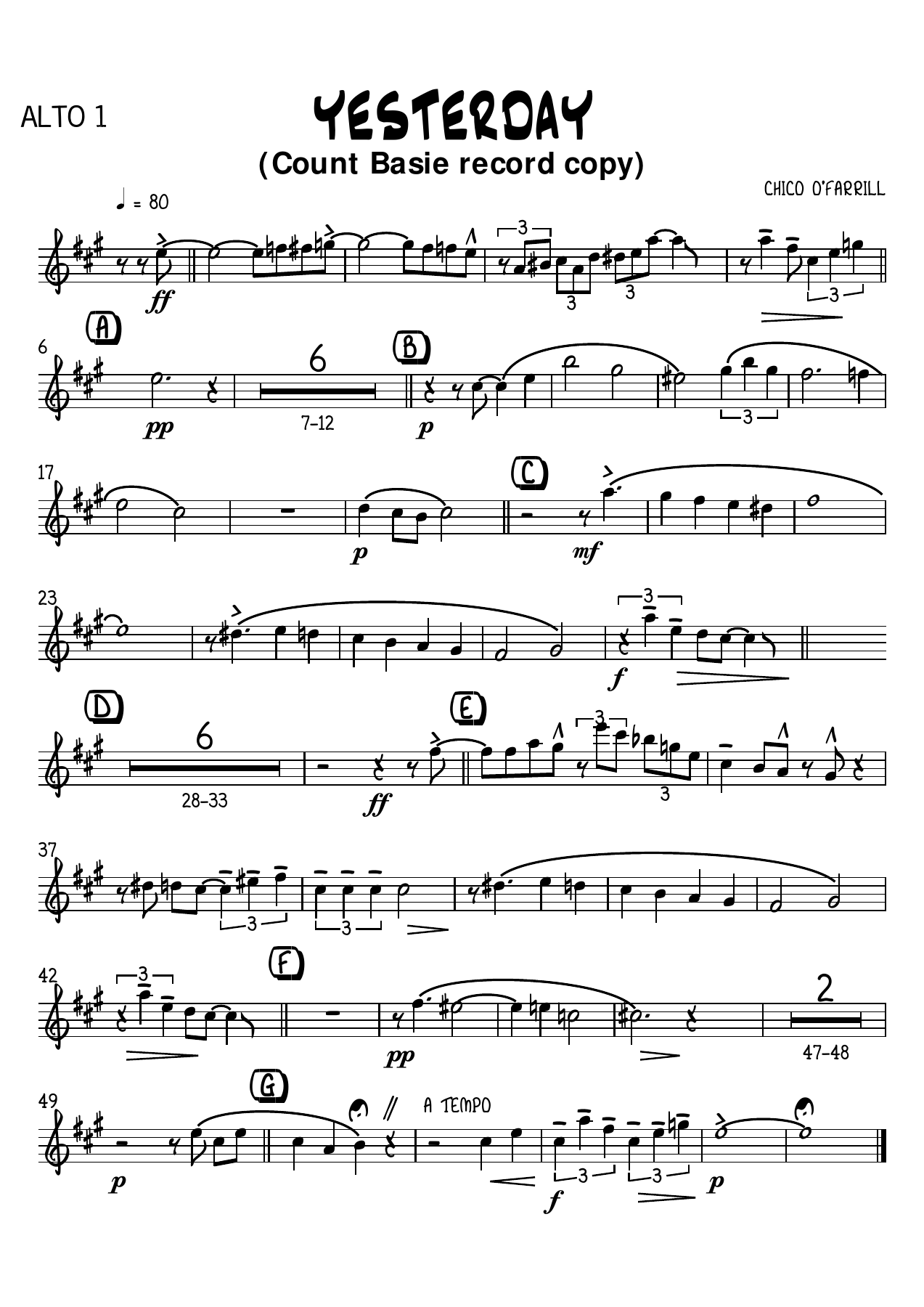
Yesterday (C.O'Farill) C.Basie Voc
Composed by Lennon-McCartney
Arranged by Beatles
- Ensemble: Big Band
- Style: Jazz Standard
- Pages: 28
- Instruments (19): Alto 1, Alto 2, Clarinet in Bb, Tenor 1, Tenor 2, Bari. Sax., Trumpet 1, Trumpet 2, Trumpet 3, Trumpet 4, Trombone 1, Trombone 2, Trombone 3, Bass Trombone, Piano, Guitar, Bass, Drum Set, Male Vocal
- Difficulty: medium
- Content: Individual Parts
- Format: PDF Download (Instant)
- Price: $24.99
The timeless ballad "Yesterday," originally composed by Lennon-McCartney in 1965 and immortalized by The Beatles, stands as one of the most covered songs in music history. While its origins lie in pop-rock, its profound melodic beauty and poignant harmonic structure have long made it a fertile ground for jazz interpretation, cementing its status as a beloved jazz standard. This particular arrangement, attributed to the innovative mind of The Beatles, reimagines the classic with a distinctive big band sensibility, evoking the sophisticated yet accessible style often associated with legendary bandleaders like Count Basie, particularly in its vocal feature. The original's melancholic reflection on lost love finds a new voice here, translated into the rich, expressive palette of a full jazz orchestra. This arrangement presents "Yesterday" as a medium-slow swing ballad, set in the key of F major, transitioning to G major for the vocal chorus. The mood is one of tender nostalgia, imbued with a classic big band warmth that balances the original's intimacy with a grander, more expansive sound. The arrangement opens with a beautifully voiced saxophone section chorale, establishing the harmonic foundation and setting a contemplative tone before the vocalist enters. The rhythmic feel is a relaxed, understated swing, emphasizing legato lines and a gentle pulse, allowing the melody to truly breathe. The ensemble's dynamic control is paramount, moving from hushed textures to moments of rich, full-bodied expression, particularly during the brass soli sections. The arranger's approach is characterized by elegant voicings and a masterful use of the full big band canvas. While the arrangement is attributed to "Beatles," it strongly channels the sophisticated, yet swinging, aesthetic of Gil Evans or even the later Basie bands, particularly in its sparse, impactful brass punctuations and the lush, often unexpected harmonic extensions. The melody is predominantly carried by the featured vocalist, who navigates the familiar tune with ample space for personal interpretation, supported by a meticulously crafted ensemble accompaniment. There are no extended improvised solos in the traditional sense; instead, the arrangement focuses on the collective ensemble's interpretation of the melody and harmony, with brief, lyrical fills from the saxophone and brass sections adding color and counterpoint. A notable feature is the carefully constructed shout chorus following the vocal, where the full band reinterprets the main theme with increased intensity and harmonic richness, culminating in a powerful, yet controlled, climax before a gentle return to the ballad's reflective mood. This big band arrangement is ideally suited for college, community, or professional ensembles seeking a classic, sophisticated chart that highlights ensemble blend, dynamic control, and musical sensitivity. The technical demands are moderate, focusing more on precise articulation, blend, and rhythmic subtlety rather than extreme ranges or rapid-fire passages. The rewarding aspect lies in the opportunity to perform a beloved standard with a fresh, elegant big band treatment, offering both musicians and audiences a deeply moving and memorable experience. Conductors should emphasize a consistent, relaxed medium-slow swing feel throughout, ensuring the rhythm section lays down a solid, yet unobtrusive, foundation. The key technical challenge lies in achieving seamless blend and balance, particularly within the saxophone section chorales and the brass soli passages. Encourage legato phrasing and precise dynamic control, especially when supporting the vocalist, to allow the melody to shine without being overshadowed. Articulation should be light and nuanced, avoiding overly aggressive attacks. There are no special techniques like plunger mutes or falls required; the focus is on pure tone and expressive phrasing. Rehearsal time should be dedicated to perfecting the ensemble's dynamic swells and decays, as well as ensuring the harmonic richness of the voicings is fully realized, particularly in the climactic shout chorus. Q: What instruments are included in this arrangement? A: This big band arrangement is scored for 17 instruments: Alto Saxophone 1, Alto Saxophone 2, Tenor Saxophone 1, Tenor Saxophone 2, Baritone Saxophone, Trumpet 1, Trumpet 2, Trumpet 3, Trumpet 4, Trombone 1, Trombone 2, Trombone 3, Bass Trombone, Piano, Bass, Drums, and a featured Vocalist part. Q: What is the difficulty level of "Yesterday (C.O'Farill) C.Basie Voc"? A: This arrangement is rated as medium difficulty, suitable for advanced high school, college, community, or professional jazz ensembles. It emphasizes musicality, blend, and dynamic control over extreme technical demands. Q: What is the musical style and historical context of this arrangement? A: This is a big band jazz standard arrangement of The Beatles' "Yesterday" (1965). It reimagines the classic pop ballad with a medium-slow swing feel, incorporating a sophisticated big band sound reminiscent of Count Basie's vocal features and Gil Evans' lush orchestrations. Q: What makes this arrangement unique compared to other versions of "Yesterday"? A: This arrangement stands out for its elegant big band voicings, its focus on ensemble interpretation rather than extended solos, and its sophisticated medium-slow swing treatment of the iconic melody, particularly featuring a dedicated vocal part within a classic Basie-esque framework. Q: What is the approximate performance duration and tempo for this piece? A: The approximate performance duration is 4-5 minutes, depending on the vocalist's interpretation. The tempo is a consistent medium-slow swing, typically around 80-90 beats per minute, allowing for a reflective and expressive feel.
Questions and answers
- What is included in the Yesterday (C.O'Farill) C.Basie Voc PDF?
- The verified current file contains a conductor score and individual parts across 28 pages.
- How many instruments or parts are listed for Yesterday (C.O'Farill) C.Basie Voc?
- The verified instrumentation list contains 19 entries for this Big Band arrangement.
- Who is credited for Yesterday (C.O'Farill) C.Basie Voc?
- Composer: Lennon-McCartney. Arranger: Beatles.
- What difficulty is listed for Yesterday (C.O'Farill) C.Basie Voc?
- The verified difficulty level is medium.
- What style is listed for Yesterday (C.O'Farill) C.Basie Voc?
- The catalog lists the style as Jazz Standard.
- Can I preview Yesterday (C.O'Farill) C.Basie Voc before buying?
- Yes. The product page provides a preview generated from the current PDF file.
- How is Yesterday (C.O'Farill) C.Basie Voc delivered?
- After successful payment, the digital PDF is made available for download. The displayed price is $24.99.
Musicians Also Search For
Yesterday Beatles PDF • Yesterday Beatles sheet music • Yesterday arranged by Beatles • Beatles big band charts • Beatles jazz arrangements PDF • Yesterday Lennon-McCartney sheet music • Yesterday Lennon-McCartney big band arrangements • Lennon-McCartney big band charts • Yesterday big band arrangements • Yesterday big band PDF download • Yesterday jazz sheet music • big band sheet music download • Yesterday conductor score PDF • Yesterday individual parts download • Yesterday sheet music PDF • Yesterday Jazz Standard charts • Jazz Standard big band arrangements • buy Yesterday sheet music • download Yesterday PDF • Yesterday jazz charts • best Beatles big band arrangements • Lennon-McCartney arranged by Beatles • Yesterday printable sheet music • big band repertoire PDF