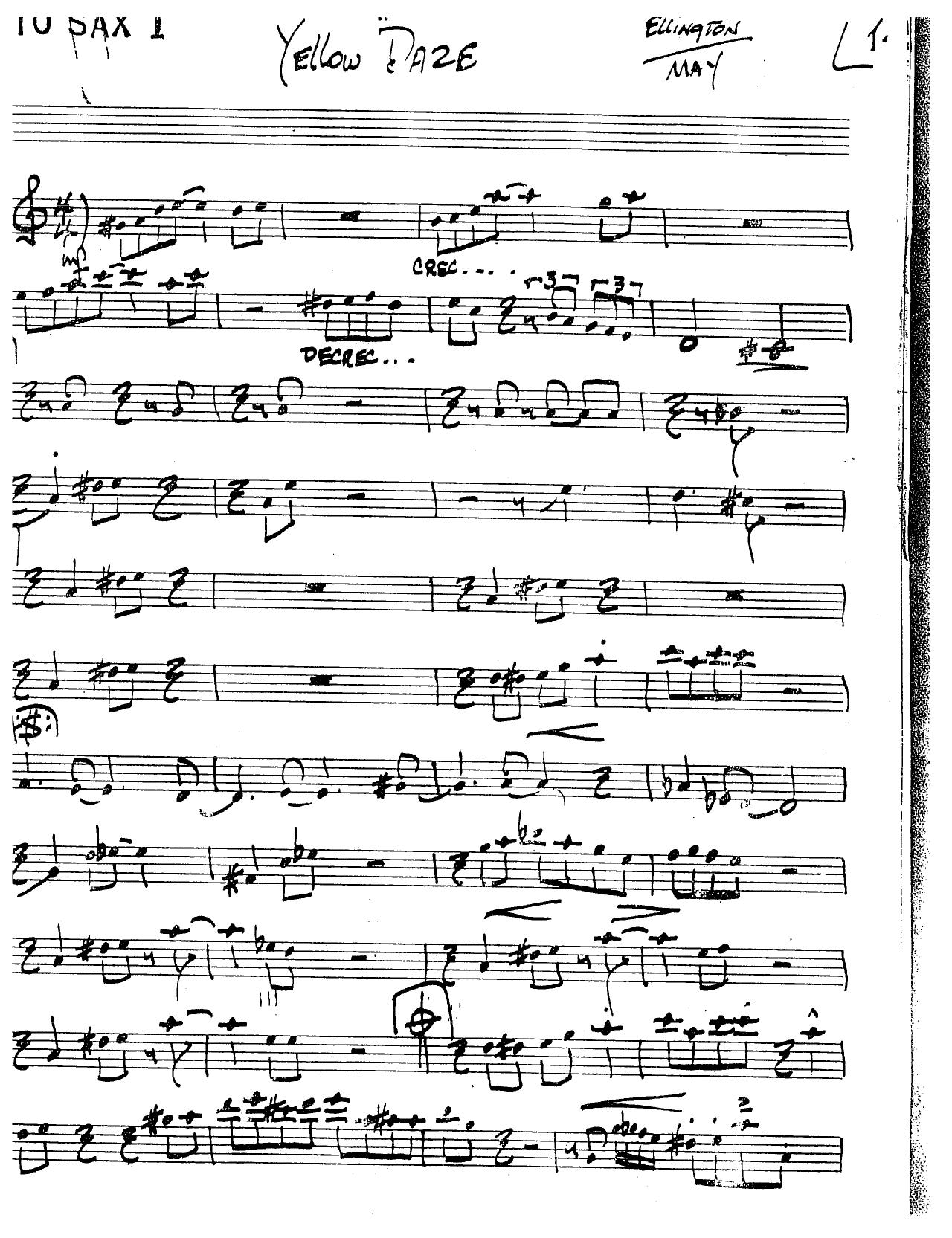
Yellow Days (D.Ellington) sheet music preview

Yellow Days (D.Ellington)

Composed by Duke Ellington

Arranged by Duke Ellington & B.Strayhorn.D.Berger

  • Ensemble: Big Band
  • Pages: 34
  • Instruments (17): Alto Saxophone 1 (doubles Clarinet), Alto Saxophone 2, Tenor Saxophone 1, Tenor Saxophone 2, Baritone Saxophone, Trumpet 1, Trumpet 2, Trumpet 3, Trumpet 4, Trombone 1, Trombone 2, Trombone 3, Trombone 4, Guitar, Piano, Bass, Drums
  • Difficulty: medium
  • Content: Individual Parts
  • Format: PDF Download (Instant)
  • Price: $24.99

Duke Ellington’s compositional genius reached its zenith during the mid-twentieth century, a period when his orchestra functioned as a living laboratory for tone color and harmonic innovation. Working in tandem with his alter ego and principal collaborator, Billy Strayhorn, Ellington crafted a sophisticated sonic vocabulary that bridged traditional big band swing with modernist impressionism. "Yellow Days" emerges from this rich compositional lineage, capturing the sultry, reflective atmosphere that characterized the Ellington Orchestra's mature repertoire. While drawing deeply on the blues-inflected language of Harlem and the sophisticated voicings of the Strayhorn era, this masterwork stands out for its evocative, cinematic pacing and subtle emotional depth. Musically, the arrangement unfolds at a relaxed, sultry medium-slow tempo, propelled by an underlying lazy swing feel that demands absolute precision from the rhythm section. The tonal center shifts through rich, unexpected harmonic plateaus, evoking the hazy, golden light of late afternoon through lush, extended chord structures—major sevenths, minor ninths, and signature Ellingtonian cluster voicings. The mood is simultaneously melancholic and deeply reassuring, driven by a warm, enveloping ensemble texture. Rather than relying on high-energy pyrotechnics, the emotional weight of the piece is carried by its velvety harmonic suspension, creating a sense of timeless introspection and understated elegance. The collaborative editorial hand of David Berger brings a meticulous musicological authenticity to this publication, meticulously transcribing and adapting the score from the original manuscript materials to honor the unique voicing strategies of the Ellington-Strayhorn partnership. The arrangement utilizes a balanced 10-instrument big band instrumentation, maximizing the expressive potential of a leaner ensemble by exploiting cross-section scoring. The saxophones—comprising alto, tenor, and baritone—frequently employ tight, reedy harmonies that blend seamlessly with the brass. Muted trumpets and warm trombones trade sighs and counter-melodies, creating a call-and-response dynamic that mimics human vocal inflection. Solos are integrated organically into the structural fabric, allowing featured players to stretch out over sophisticated chord changes without disrupting the overarching mood. Executing this chart successfully requires a mature ensemble capable of nuance, dynamic control, and deep stylistic awareness. Advanced high school, collegiate, and professional jazz orchestras will find it an exceptionally rewarding addition to their repertoire, particularly for programmers seeking to showcase ensemble blend over sheer volume. The technical challenges lie primarily in intonation, balance, and maintaining a steady, unhurried groove at a slow tempo. When approached with a refined sense of swing and an appreciation for Ellington's palette of textures, "Yellow Days" becomes a profound vehicle for musical storytelling, offering audiences an intimate glimpse into the sophisticated heart of classic big band jazz. Achieving an authentic rendition of "Yellow Days" requires prioritizing stylistic cohesion, balance, and patience over technical flash. The conductor should anchor the ensemble with a relaxed, pulsing swing eighth-note feel in 4/4 time, ensuring the rhythm section never rushes the underlying groove. The drummer should favor a sparse, conversational ride cymbal pattern with light hi-hat chokes on beats two and four, while the bassist walks a smooth, connected line that emphasizes the root-third motion of the complex harmonic shifts. Horns must pay meticulous attention to blend and intonation, particularly during the dense chord clusters in the saxes and muted brass. Encourage players to use subtle vibrato on sustained notes to mimic the vocal qualities characteristic of the classic Ellington reed and brass sections. Dynamic contrast is paramount; allow the ensemble's natural warmth to project during quiet background figures, keeping the background figures well-subordinated whenever a soloist takes center stage. Rehearsals should focus initially on section intonation and articulation uniformity, ensuring that all falls, doits, and slurs are executed with unanimous intent and stylistic unity. Q: What instruments and parts are included in this 10-instrument arrangement? A: The scoring is tailored for a 10-piece ensemble, featuring parts for Alto Saxophone, Tenor Saxophone, Baritone Saxophone, Trumpet, Trombone, and a full rhythm section (piano, bass, drums, and auxiliary or guitar parts as appropriate to the transcription). Q: What is the difficulty level of this arrangement? A: This chart is graded as advanced, making it best suited for college jazz ensembles, advanced high school bands, and professional community big bands that possess strong foundational intonation and stylistic maturity. Q: What musical style and historical context does "Yellow Days" represent? A: It represents the sophisticated, impressionistic jazz style of the mid-20th-century Duke Ellington Orchestra, arranged with input from Billy Strayhorn and transcribed by David Berger to capture the classic swing-era aesthetic. Q: What makes this specific arrangement unique? A: Unlike high-energy shout-chorus charts, this arrangement emphasizes rich harmonic color, sparse textures, and moody, vocal-like interplay between the horns, showcasing the subtle genius of the Ellington-Strayhorn writing style. Q: What is the recommended performance tempo and duration? A: The piece is designed to be performed at a relaxed, sultry medium-slow swing tempo, resulting in a performance duration of approximately 4 to 5 minutes depending on the length of the improvised solos.

Questions and answers

What is included in the Yellow Days (D.Ellington) PDF?
The verified current file contains individual parts across 34 pages.
How many instruments or parts are listed for Yellow Days (D.Ellington)?
The verified instrumentation list contains 17 entries for this Big Band arrangement.
Who is credited for Yellow Days (D.Ellington)?
Composer: Duke Ellington. Arranger: Duke Ellington & B.Strayhorn.D.Berger.
What difficulty is listed for Yellow Days (D.Ellington)?
The verified difficulty level is medium.
Can I preview Yellow Days (D.Ellington) before buying?
Yes. The product page provides a preview generated from the current PDF file.
How is Yellow Days (D.Ellington) delivered?
After successful payment, the digital PDF is made available for download. The displayed price is $24.99.

Musicians Also Search For

Yellow Days Duke Ellington & B.Strayhorn.D.Berger PDFYellow Days Duke Ellington & B.Strayhorn.D.Berger sheet musicYellow Days arranged by Duke Ellington & B.Strayhorn.D.BergerDuke Ellington & B.Strayhorn.D.Berger big band chartsDuke Ellington & B.Strayhorn.D.Berger jazz arrangements PDFYellow Days Duke Ellington sheet musicYellow Days Duke Ellington big band arrangementsDuke Ellington big band chartsYellow Days big band arrangementsYellow Days big band PDF downloadYellow Days jazz sheet musicbig band sheet music downloadYellow Days individual parts downloadYellow Days sheet music PDFbuy Yellow Days sheet musicdownload Yellow Days PDFYellow Days jazz chartsbest Duke Ellington & B.Strayhorn.D.Berger big band arrangementsDuke Ellington arranged by Duke Ellington & B.Strayhorn.D.BergerYellow Days printable sheet musicbig band repertoire PDF

All arrangements by Duke Ellington & B.Strayhorn.D.Berger All Duke Ellington sheet music