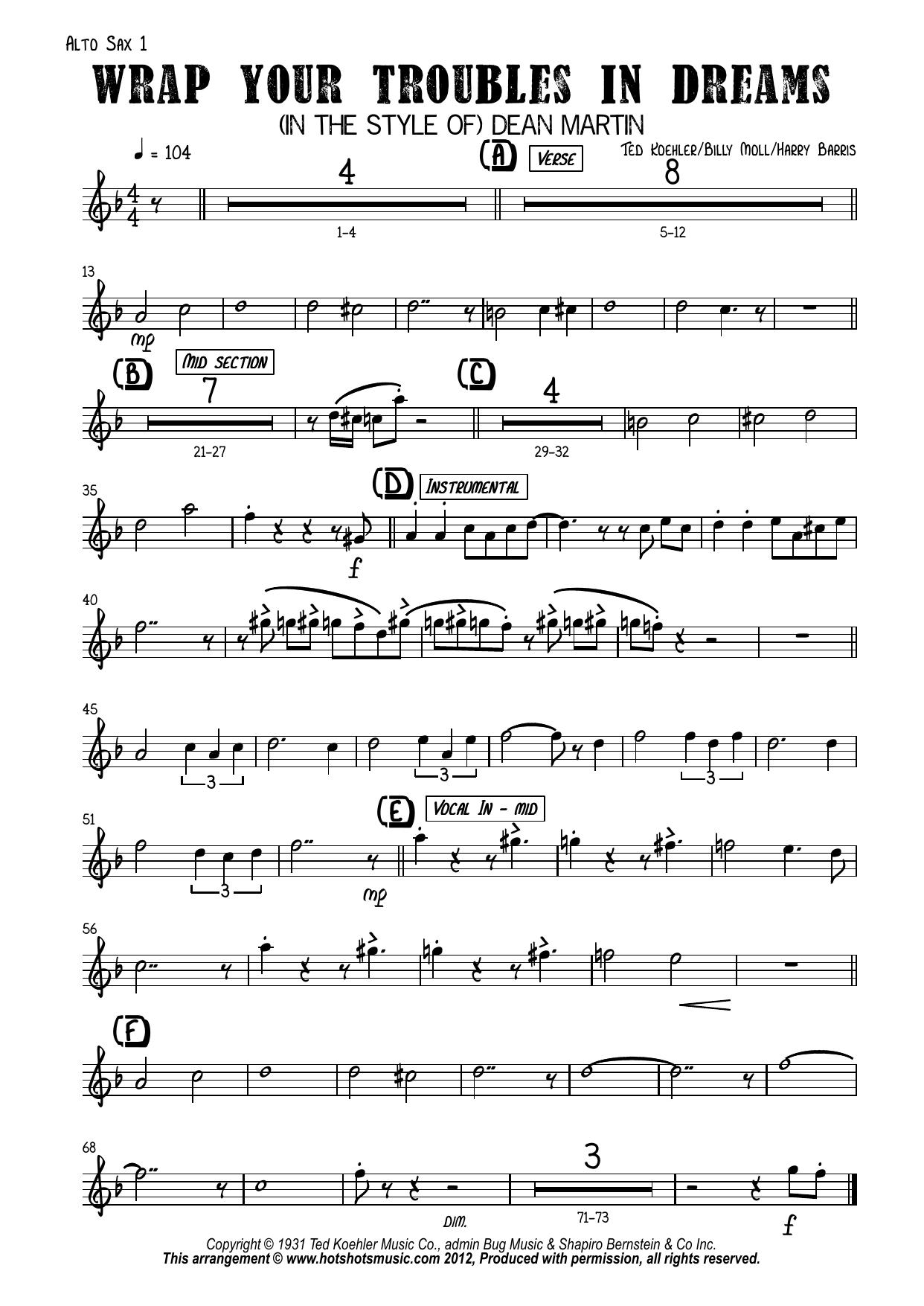
Wrap Your Troubles In Dreams (P.Tappern)
Composed by Harry Barris
Arranged by P.Tappern
- Ensemble: Big Band
- Style: Jazz Standard
- Pages: 33
- Instruments (17): Alto Sax 1, Alto Sax 2, Tenor Sax 1, Tenor Sax 2, Baritone Sax, Trumpet 1, Trumpet 2, Trumpet 3, Trumpet 4, Trombone 1, Trombone 2, Trombone 3, Bass Trombone, Guitar, Keyboard, Bass, Drums
- Difficulty: medium
- Content: Individual Parts
- Format: PDF Download (Instant)
- Price: $24.99
Harry Barris, Ted Koehler, and Billy Moll penned "Wrap Your Troubles in Dreams (And Dream Your Troubles Away)" in 1931, right at the height of the early swing era and the Great Depression, capturing a poignant cultural duality where uplifting, therapeutic optimism met smoky, late-night salon jazz. Immortalized by legendary interpreters like Bing Crosby, Louis Armstrong, and later classic big bands, the tune remains a masterclass in turning minor-key melancholy into major-mode resilience. Its durable, thirty-two-bar AABA form provides an ideal canvas for jazz arrangers seeking to balance rich harmonic nostalgia with driving rhythmic momentum, anchoring its legacy as an enduring Great American Songbook standard. P.Tappern’s sophisticated big band interpretation frames the timeless melody in a luminous medium-swing groove that bridges classic 1930s sentimentality with contemporary chordal color. Opening with a lush, harmonically rich brass introduction, the arrangement quickly establishes a relaxed yet forward-driving pocket in 4/4 time. The mood shifts effortlessly between introspective, harmon-muted brass textures and surging, full-ensemble shout choruses that utilize extended tertian harmonies, sharp dynamic contrasts, and subtle chromatic slide movements. Tappern masterfully navigates the inherent tension of the tune, using lush saxophone solis to evoke a classic ballroom atmosphere while keeping the rhythm section locked into an infectious, buoyant bounce. Melodic duties are shared thoughtfully across the ensemble, migrating from warm tenor saxophone statements to soaring trumpet lead lines, ensuring every section plays an active role in the narrative arc. Solo opportunities are thoughtfully integrated, providing ample space for an expressive horn player to stretch out over standard changes before the chart builds toward a powerful, harmonically sophisticated climax. Technical challenges primarily lie in maintaining a pristine, unhurried swing subdivision at moderate tempos, demanding exceptional blend, intonation, and dynamic control from the brass and reed sections alike. Performers will find the chart deeply rewarding due to its intelligent voice-leading and the satisfying payoff of its dynamic peaks and valleys. Advanced high school ensembles with strong section leaders, collegiate jazz orchestras, and professional community big bands will find this 37-bar-form adaptation an ideal program centerpiece. Its blend of accessible melodic hooks and sophisticated harmonic depth makes it a brilliant showcase for groups looking to demonstrate maturity in phrasing, ensemble listening, and stylistic versatility without relying on breakneck tempos. Conductors should approach P.Tappern’s chart with a strong emphasis on a relaxed, behind-the-beat medium-swing feel (approx. Quarter Note = 112–120 BPM). The primary technical challenge rests in the precise execution of light, buoyant eighth-note subdivisions; avoid heavy, accented downbeats in the rhythm section to preserve the effortless, floating quality of the 1930s aesthetic. The saxophones must prioritize a unified, warm blend during their soli sections, matching vibrato widths closely—especially in the delicate lower-register baritone and tenor lines. Brass players should utilize cup or harmon mutes where indicated to achieve the authentic textural warmth required in the opening and background figures, ensuring that muted passages never pinch the tone or drag the tempo. Rehearsals should initially isolate the dynamic transitions leading into the shout chorus, ensuring the ensemble drops to a whisper before executing the crescendo without forcing the sound. Work closely with the rhythm section (piano, guitar, bass, drums) to ensure the walking bassline remains linear and supportive, driving the changes beneath the horns rather than competing with them. Q: What instrumentation and parts are included in this arrangement? A: This standard 17-instrument big band chart includes full scoring for Alto Saxophone 1 & 2, Tenor Saxophone 1 & 2, Baritone Saxophone, 4 Trumpets, 4 Trombones, Piano, Guitar, Bass, and Drums, spanning a comprehensive 33-page master score and part set. Q: What is the overall difficulty level of this arrangement? A: This piece is graded as medium-advanced, making it exceptionally well-suited for proficient high school jazz bands, collegiate ensembles, and professional community big bands that possess solid sectional balance and reading skills. Q: What is the historical style and background of the underlying composition? A: Originally written in 1931 by Harry Barris, Ted Koehler, and Billy Moll, the tune is a quintessential Great American Songbook standard from the early swing era, famously recorded by icons like Bing Crosby and Louis Armstrong as an uplifting antidote to Depression-era blues. Q: What makes P.Tappern’s arrangement unique compared to other versions? A: Tappern bridges vintage 1930s sentimental charm with modern harmonic color, utilizing clever chord substitutions, rich saxophone solis, and dynamic textural contrasts between muted brass and open ensemble shouts. Q: What is the recommended performance tempo and approximate duration? A: The arrangement is designed for a medium-swing feel at roughly 112 to 120 beats per minute, resulting in an engaging performance duration of approximately 3.5 to 4 minutes depending on solo extensions.
Questions and answers
- What is included in the Wrap Your Troubles In Dreams (P.Tappern) PDF?
- The verified current file contains individual parts across 33 pages.
- How many instruments or parts are listed for Wrap Your Troubles In Dreams (P.Tappern)?
- The verified instrumentation list contains 17 entries for this Big Band arrangement.
- Who is credited for Wrap Your Troubles In Dreams (P.Tappern)?
- Composer: Harry Barris. Arranger: P.Tappern.
- What difficulty is listed for Wrap Your Troubles In Dreams (P.Tappern)?
- The verified difficulty level is medium.
- What style is listed for Wrap Your Troubles In Dreams (P.Tappern)?
- The catalog lists the style as Jazz Standard.
- Can I preview Wrap Your Troubles In Dreams (P.Tappern) before buying?
- Yes. The product page provides a preview generated from the current PDF file.
- How is Wrap Your Troubles In Dreams (P.Tappern) delivered?
- After successful payment, the digital PDF is made available for download. The displayed price is $24.99.
Musicians Also Search For
Wrap Your Troubles In Dreams P.Tappern PDF • Wrap Your Troubles In Dreams P.Tappern sheet music • Wrap Your Troubles In Dreams arranged by P.Tappern • P.Tappern big band charts • P.Tappern jazz arrangements PDF • Wrap Your Troubles In Dreams Harry Barris sheet music • Wrap Your Troubles In Dreams Harry Barris big band arrangements • Harry Barris big band charts • Wrap Your Troubles In Dreams big band arrangements • Wrap Your Troubles In Dreams big band PDF download • Wrap Your Troubles In Dreams jazz sheet music • big band sheet music download • Wrap Your Troubles In Dreams individual parts download • Wrap Your Troubles In Dreams sheet music PDF • Wrap Your Troubles In Dreams Jazz Standard charts • Jazz Standard big band arrangements • buy Wrap Your Troubles In Dreams sheet music • download Wrap Your Troubles In Dreams PDF • Wrap Your Troubles In Dreams jazz charts • best P.Tappern big band arrangements • Harry Barris arranged by P.Tappern • Wrap Your Troubles In Dreams printable sheet music • big band repertoire PDF