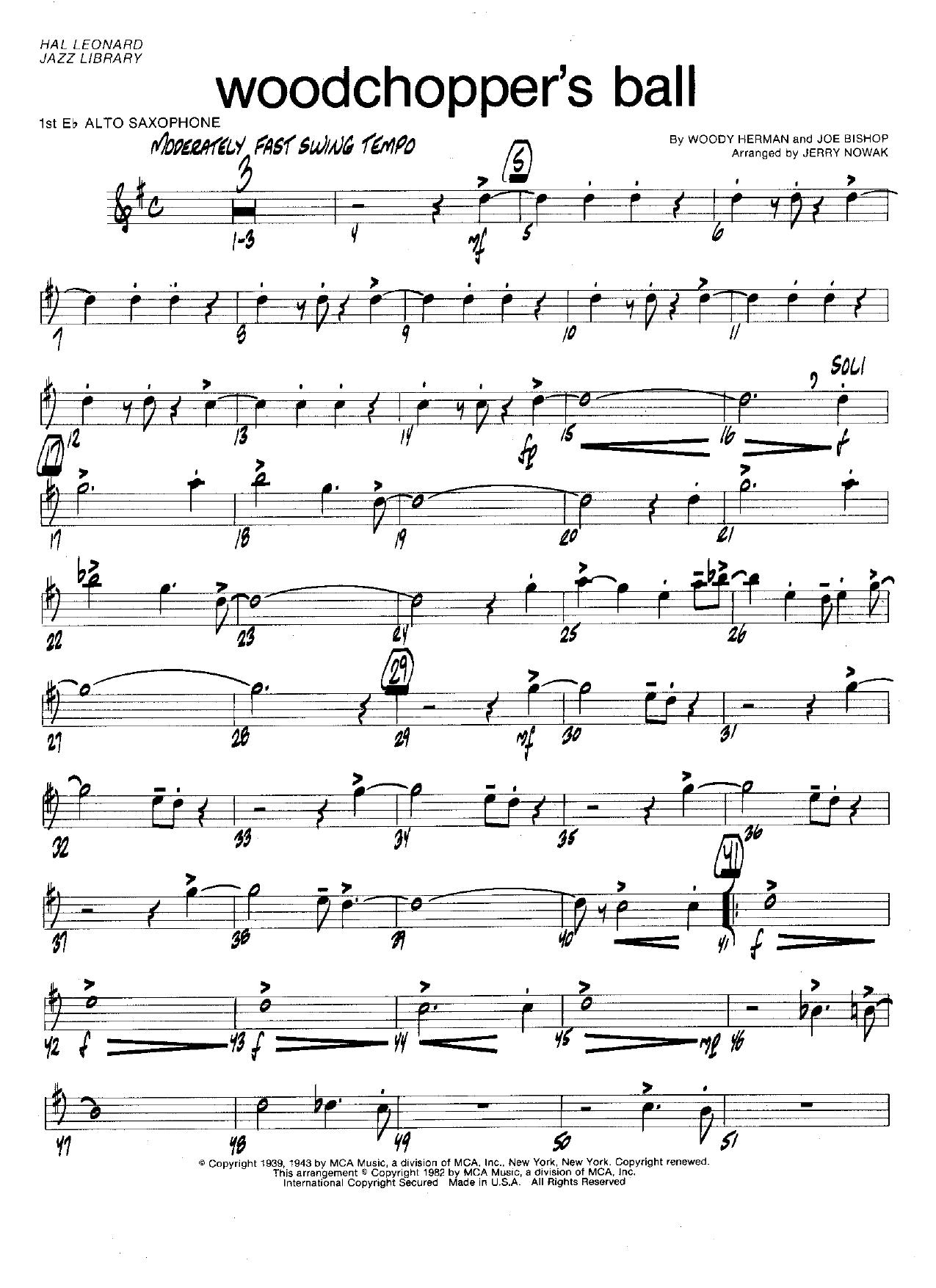
Woodchopper's Ball (J.Nowak) sheet music preview

Woodchopper's Ball (J.Nowak)

Composed by Joe Bishop

Arranged by Jerry Nowak

  • Ensemble: Big Band
  • Pages: 40
  • Instruments (16): 1st Eb Alto Saxophone, 2nd Eb Alto Saxophone, 1st Bb Tenor Saxophone, 2nd Bb Tenor Saxophone, Eb Baritone Saxophone, 1st Bb Trumpet, 2nd Bb Trumpet, 3rd Bb Trumpet, 1st Trombone, 2nd Trombone, 3rd Trombone, Piano, Guitar, Bass, Drums, Conductor
  • Difficulty: medium
  • Content: Individual Parts
  • Format: PDF Download (Instant)
  • Price: $24.99

First recorded in 1939 by Woody Herman and His Orchestra, "Woodchopper's Ball" stands as one of the definitive swing era anthems and a premier showcase for the driving, blues-infused energy of Herman’s early band, often called "The Band That Plays the Blues." Co-composed by Woody Herman and pianist Joe Bishop, the tune rocketed to massive popularity, becoming Herman's signature theme song and a timeless staple of big band literature. Rooted in a twelve-bar blues framework with an infectious riff-driven head, the composition encapsulates the high-octane spirit of late-1930s Kansas City swing blended with the polished punch of the emerging big band tradition. It remains an essential cornerstone for understanding the transition from the early swing era into the more aggressive, rhythm-driven big bands of the 1940s. Brimming with high-voltage exuberance, Jerry Nowak’s dynamic setting captures the raw, foot-stomping vitality of the original Herman recording while tailoring it for modern ensemble playability. Operating at a bright, driving swing tempo (typically around quarters equal to 160–172 BPM), the chart opens with the instantly recognizable, unison brass and sax riffs that immediately set a celebratory, high-energy mood. The harmonic language remains faithful to the swinging blues tradition, utilizing punchy dominant sevenths, crisp blues-scale inflections, and rich block-chord voicings in the brass that evoke the classic, roaring shout choruses of the 1930s and 40s. The emotional trajectory moves from a playful, swaggering opening straight into an unbridled, roof-raising climax that never fails to electrify an audience. Nowak expertly structures the arrangement to distribute melodic interest across the entire ensemble, ensuring that every section gets a chance to drive the rhythm. The saxophones handle crisp, linear bebop-informed counterlines, while the brass section delivers biting, articulate background figures that push the groove forward. Solos are strategically placed to highlight section leaders or standout improvisers, built over standard blues changes that make them accessible yet thrilling to execute. The technical demands center on precision swing articulation, clean section blend, and maintaining a relentless, unhurried time-feel across extended up-tempo passages. The standout feature is the towering shout chorus, where Nowak layers brass stabs against a walking sax background, building structural tension that resolves in a triumphant final cadence. Advanced high school, collegiate, and community jazz ensembles will find this chart to be an ideal vehicle for developing tight ensemble cohesion, stamina, and authentic swing style. Because the rhythmic figures are exposed and require absolute synchronization between the rhythm section and the horns, it serves as an exceptional educational tool for teaching students how to lock in a medium-up swing groove without rushing. At the same time, its crowd-pleasing pedigree and historical weight make it a powerhouse selection for festival programs, spring concerts, and legacy-themed jazz showcases. Executing Jerry Nowak’s arrangement of "Woodchopper's Ball" successfully requires a disciplined approach to swing phrasing and rhythmic endurance. The primary technical challenge lies in maintaining a relaxed, driving feel at a bright tempo without letting the quarter-note rush or bog down. Conductors should ensure the rhythm section—particularly the drummer—establishes a light, floating ride cymbal pattern with a crisp hi-hat on beats two and four, avoiding heavy foot-stomping on every beat. Horn players must focus on uniform articulation: shorter, detached eighth notes on the downbeats and a natural, vocalized upward slurs into off-beat accents. Stylistic devices such as traditional jazz falls, doits, and short terminal accents should be executed with unanimity across the brass sections to mimic the roaring effect of the 1939 Herman recording. Rehearsal time should be initially split between slow-tempo sectional work to iron out complex ensemble unisons and full-band runs focused exclusively on dynamic contrast, ensuring the background riffs never overpower the primary melodic voice. Q: What instruments and parts are included in this arrangement? A: This 40-page big band chart is scored for a standard 17-instrument ensemble: 5 saxophones (Alto Sax 1, Alto Sax 2, Tenor Sax 1, Tenor Sax 2, Baritone Sax), 3 trumpets, 3 trombones, and a full 4-piece rhythm section consisting of piano, bass, drums, and guitar. Q: What is the difficulty level of this chart? A: This arrangement is graded as medium-advanced (approximately Grade 3.5 to 4), making it well-suited for proficient high school bands, collegiate ensembles, and community jazz orchestras seeking a rewarding challenge in swing style. Q: What is the historical style and context of this piece? A: Originally composed by Joe Bishop and Woody Herman in 1939, this piece is a cornerstone of the swing era and blues-based big band tradition, famous for defining the high-energy sound of Woody Herman's early orchestra. Q: What makes Jerry Nowak's arrangement unique? A: Nowak expertly balances authentic, vintage 1930s riff-band textures with clean, modern scoring practices, providing clear section interplay, robust ensemble shout choruses, and accessible blues solo changes that keep players engaged. Q: What is the performance duration and recommended tempo? A: The arrangement runs approximately 3 to 4 minutes and is designed to be performed at a bright, energetic medium-up swing tempo, typically around 160 to 172 beats per minute.

Questions and answers

What is included in the Woodchopper's Ball (J.Nowak) PDF?
The verified current file contains a conductor score and individual parts across 40 pages.
How many instruments or parts are listed for Woodchopper's Ball (J.Nowak)?
The verified instrumentation list contains 16 entries for this Big Band arrangement.
Who is credited for Woodchopper's Ball (J.Nowak)?
Composer: Joe Bishop. Arranger: Jerry Nowak.
What difficulty is listed for Woodchopper's Ball (J.Nowak)?
The verified difficulty level is medium.
Can I preview Woodchopper's Ball (J.Nowak) before buying?
Yes. The product page provides a preview generated from the current PDF file.
How is Woodchopper's Ball (J.Nowak) delivered?
After successful payment, the digital PDF is made available for download. The displayed price is $24.99.

Musicians Also Search For

Woodchopper's Ball Jerry Nowak PDFWoodchopper's Ball Jerry Nowak sheet musicWoodchopper's Ball arranged by Jerry NowakJerry Nowak big band chartsJerry Nowak jazz arrangements PDFWoodchopper's Ball Joe Bishop sheet musicWoodchopper's Ball Joe Bishop big band arrangementsJoe Bishop big band chartsWoodchopper's Ball big band arrangementsWoodchopper's Ball big band PDF downloadWoodchopper's Ball jazz sheet musicbig band sheet music downloadWoodchopper's Ball conductor score PDFWoodchopper's Ball individual parts downloadWoodchopper's Ball sheet music PDFbuy Woodchopper's Ball sheet musicdownload Woodchopper's Ball PDFWoodchopper's Ball jazz chartsbest Jerry Nowak big band arrangementsJoe Bishop arranged by Jerry NowakWoodchopper's Ball printable sheet musicbig band repertoire PDF

All arrangements by Jerry Nowak All Joe Bishop sheet music