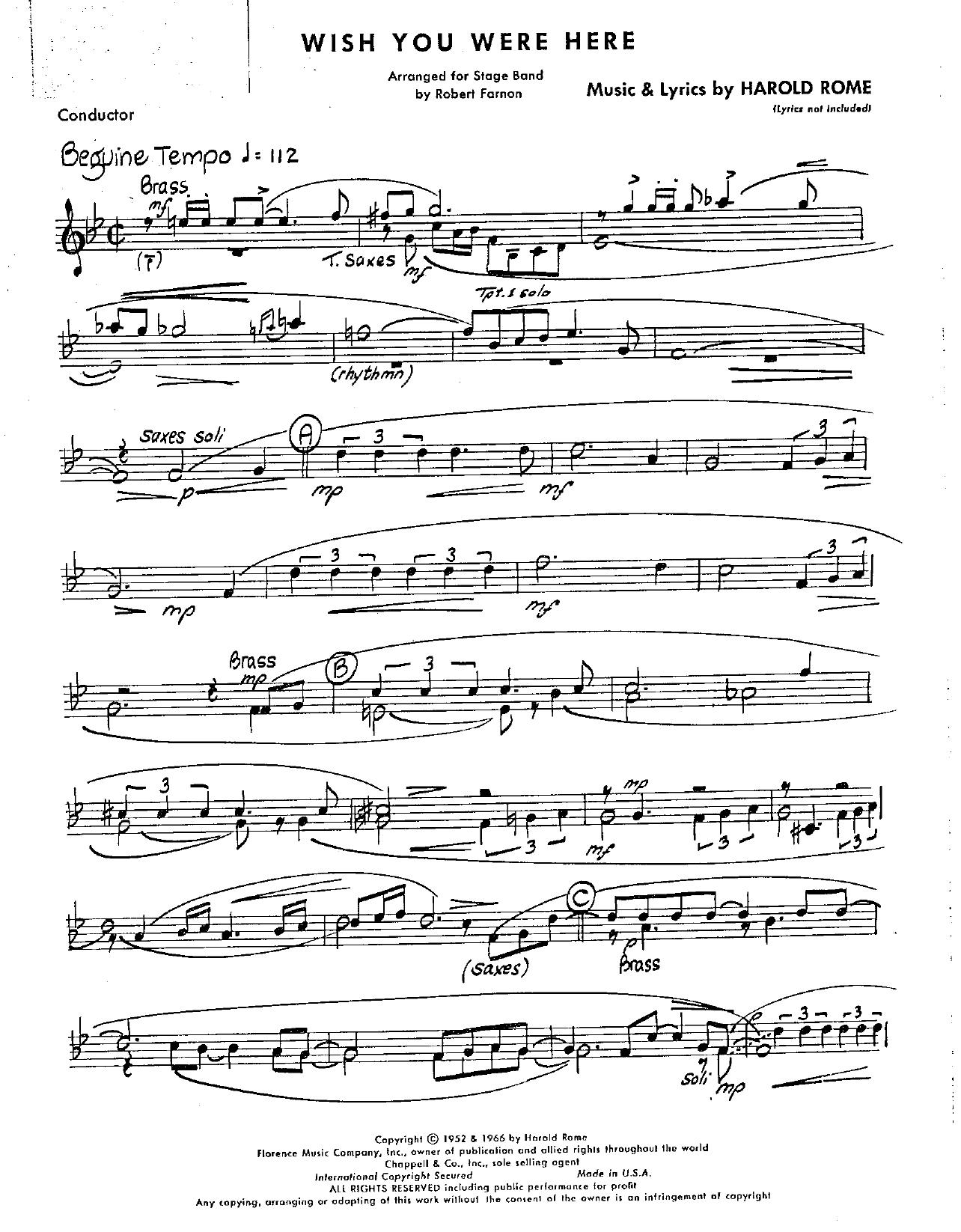
Wish You Were Here (R.Farnon)
Composed by Harold Rome
Arranged by R.Farnon
- Ensemble: Big Band
- Style: Jazz Standard
- Pages: 27
- Instruments (18): Conductor, 1st Eb Alto Saxophone, 2nd Eb Alto Saxophone, 1st Bb Tenor Saxophone, 2nd Bb Tenor Saxophone, Eb Baritone Saxophone, 1st Bb Trumpet, 2nd Bb Trumpet, 3rd Bb Trumpet, 4th Bb Trumpet, 1st Trombone, 2nd Trombone, 3rd Trombone, 4th Trombone, Piano, Guitar, Bass, Drums
- Difficulty: medium
- Content: Individual Parts
- Format: PDF Download (Instant)
- Price: $24.99
Originally penned by Broadway composer Harold Rome for the 1952 musical *Wish You Were Here*, the title song swiftly transcended its theatrical origins to enter the standard jazz and Great American Songbook repertoire. While the stage production captured a nostalgic summer camp atmosphere, the song's underlying lyrical melancholy and rich harmonic framework naturally attracted the attention of mid-century jazz interpreters and master arrangers. It represents a golden era of sophisticated popular song adaptation, bridging the gap between Broadway structural integrity and the expansive, lush orchestration typical of sophisticated jazz writing. Robert Farnon, celebrated for his peerless craftsmanship and velvety string-infused or harmonically dense brass writing, brings a breathtaking cinematic quality to this big band interpretation. Built around a flowing, expressive medium tempo, the arrangement balances a warm, reflective mood with pulsing rhythmic undercurrents. Farnon’s signature approach avoids routine predictability; instead, he utilizes lush, extended voicings, subtle chromatic inner-voice movements, and shifting tone-color combinations across the saxophone and brass sections. The emotional arc moves from introspective vulnerability to sweeping, cinematic grandeur, evoking a sense of bittersweet nostalgia and soaring optimism. The arrangement opens with an atmospheric introduction that establishes the harmonic landscape before the woodwinds and muted brass gently introduce the primary thematic material. Sectional solis showcase Farnon’s brilliant ear for counterpoint, where secondary melodic lines weave seamlessly beneath the main tune. While the ensemble writing is rich and demanding—requiring immaculate balance and intonation—it rewards the listener and performer alike with breathtaking harmonic shifts and dynamic swells. Featured solo space allows a mature soloist to stretch out over sophisticated chord changes that subtly reinterpret Rome’s original progression, culminating in a tasteful, restrained ensemble culmination rather than a bombastic shout chorus. Advanced high school ensembles with strong section players, collegiate jazz orchestras, and professional big bands will find this chart an exceptional vehicle for developing ensemble blend, dynamic control, and stylistic maturity. Because Farnon relies heavily on nuanced phrasing and subtle dynamic gradation rather than sheer volume or breakneck speed, it serves as an ideal masterclass in ensemble sensitivity. Directors seeking to elevate their band's command of lush ballad-to-medium-swing idioms will discover that this 27-page comprehensive score and 17-instrument instrumentation provides a deeply rewarding, sophisticated addition to any concert program. Mastering this arrangement requires acute attention to balance, intonation, and stylistic cohesion. Conductors should establish a fluid, breathing medium tempo that never feels rushed, allowing Farnon’s intricate inner-voice movements to speak clearly. The primary technical challenge lies in the sophisticated extended harmonies; saxophone and brass sections must spend dedicated rehearsal time tuning complex chord clusters, particularly during the lush tutti passages where minor seconds and major sevenths color the texture. Dynamics are the lifeblood of this chart—avoid a static mezzo-forte. Encourage the brass to use warm, velvet mutes where indicated, and ensure that cup and straight mutes blend cohesively without pinching the sound. Phrasing should be lyrical and connected, emulating a vocal delivery of Harold Rome's melody even during swung passages. In rehearsal, isolate the woodwind and brass soli sections independently to ensure absolute rhythmic unison before integrating them into the full ensemble fabric. Q: What instruments and parts are included in this arrangement? A: The arrangement is scored for a standard 17-instrument big band instrumentation, featuring Alto Saxophone 1, Alto Saxophone 2, Tenor Saxophone 1, Tenor Saxophone 2, Baritone Saxophone, plus full brass and rhythm sections, totaling 27 pages including the comprehensive conductor score. Q: What is the difficulty level of this chart? A: This arrangement is best suited for advanced high school, collegiate, and professional big bands due to its sophisticated extended harmonies, subtle dynamic demands, and the requirement for precise sectional blend and intonation. Q: What is the historical background of the music? A: The composition originates from Harold Rome's 1952 Broadway musical of the same name, later adapted into a jazz standard that captures the sophisticated arranging style of the mid-20th century. Q: What makes Robert Farnon’s arrangement unique? A: Farnon treats the standard with cinematic lushness, utilizing intricate inner-voice counterpoint, shifting tone-color combinations, and sophisticated harmonic reharmonizations that elevate it far beyond a standard stock arrangement. Q: What is the performance tempo and duration of the piece? A: The arrangement is set at an expressive, flowing medium tempo that typically yields a performance duration of approximately 4 to 5 minutes, depending on the length of the featured improvised solo space.
Questions and answers
- What is included in the Wish You Were Here (R.Farnon) PDF?
- The verified current file contains a conductor score and individual parts across 27 pages.
- How many instruments or parts are listed for Wish You Were Here (R.Farnon)?
- The verified instrumentation list contains 18 entries for this Big Band arrangement.
- Who is credited for Wish You Were Here (R.Farnon)?
- Composer: Harold Rome. Arranger: R.Farnon.
- What difficulty is listed for Wish You Were Here (R.Farnon)?
- The verified difficulty level is medium.
- What style is listed for Wish You Were Here (R.Farnon)?
- The catalog lists the style as Jazz Standard.
- Can I preview Wish You Were Here (R.Farnon) before buying?
- Yes. The product page provides a preview generated from the current PDF file.
- How is Wish You Were Here (R.Farnon) delivered?
- After successful payment, the digital PDF is made available for download. The displayed price is $24.99.
Musicians Also Search For
Wish You Were Here R.Farnon PDF • Wish You Were Here R.Farnon sheet music • Wish You Were Here arranged by R.Farnon • R.Farnon big band charts • R.Farnon jazz arrangements PDF • Wish You Were Here Harold Rome sheet music • Wish You Were Here Harold Rome big band arrangements • Harold Rome big band charts • Wish You Were Here big band arrangements • Wish You Were Here big band PDF download • Wish You Were Here jazz sheet music • big band sheet music download • Wish You Were Here conductor score PDF • Wish You Were Here individual parts download • Wish You Were Here sheet music PDF • Wish You Were Here Jazz Standard charts • Jazz Standard big band arrangements • buy Wish You Were Here sheet music • download Wish You Were Here PDF • Wish You Were Here jazz charts • best R.Farnon big band arrangements • Harold Rome arranged by R.Farnon • Wish You Were Here printable sheet music • big band repertoire PDF