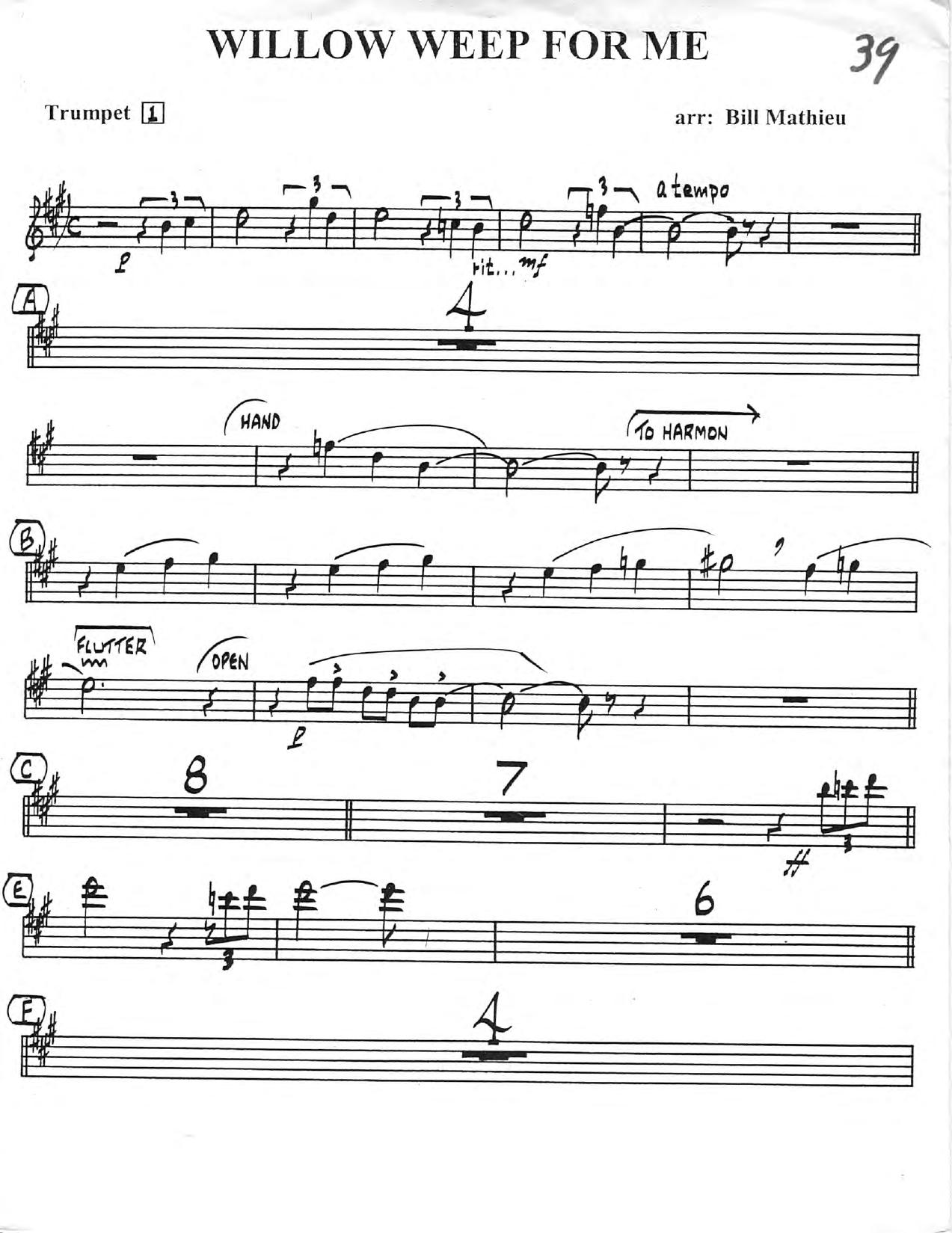
Willow Weep For Me (B.Mathieu)
Composed by Ann Ronell
Arranged by B.Mathieu
- Ensemble: Big Band
- Style: Jazz Standard
- Pages: 34
- Instruments (17): Trumpet 1, Trumpet 2, Trumpet 3, Trumpet 4, Trumpet 5, Trombone 1, Trombone 2, Trombone 3, Trombone 4, Bass Trombone 5, Alto Sax 1, Alto Sax 2, Tenor Sax 1, Tenor Sax 2, Baritone Sax, Bass, Drums
- Difficulty: medium
- Content: Individual Parts
- Format: PDF Download (Instant)
- Price: $24.99
Ann Ronell’s immortal 1932 classic "Willow Weep for Me" occupies a revered space in the American Songbook, transitioning from a melancholy vocal vehicle into an essential instrumental jazz standard embraced by icons like Billie Holiday, Art Tatum, and the Dexter Gordon quartet. Originally published during the depth of the Great Depression, the composition's haunting minor-mode tonality and inherent chromatic tension have long provided a fertile canvas for jazz arrangers seeking to explore deep emotional resonance and sophisticated harmonic coloring. In this compelling big band setting, arranger B.Mathieu reimagines Ronell’s masterpiece as a smoldering, evocative medium-slow swing ballad that balances dense, modern harmonic structures with the classic warmth of traditional big band writing. The arrangement opens with a atmospheric, rubato-tinged intro that establishes a brooding mood before settling into a steady, unhurried groove anchored by a subtle walking bassline and crisp hi-hat pulse. The overall emotional landscape shifts fluidly from introspective melancholy to powerful, brass-heavy desperation, driven by rich extended chords, shifting tonal centers, and lush saxophone voicings that evoke the midnight-noir aesthetic of the 1950s jazz club scene. Mathieu’s distinctive approach shines through the clever distribution of thematic material across the ensemble, avoiding predictable tutti blocks in favor of transparent, interactive textures. The woodwinds and muted brass trade fragments of the melody before uniting in a soaring, harmonically rich soli section that demands exquisite blend, intonation, and dynamic control. Rather than relying on a standard, high-octane shout chorus, the arrangement builds toward a climactic, dynamic peak characterized by soaring trumpet lines over cascading saxophone counterpoint, eventually subsiding gracefully into a tender, whispered coda that leaves a lasting impression on the listener. Advanced high school, collegiate, and professional jazz orchestras will find this chart to be a deeply rewarding centerpiece for festival programs or concert sets. While the technical demands on individual players are moderate in terms of raw velocity, the true challenge lies in the realm of musical maturity: maintaining precise ensemble cohesion at a slow tempo, balancing rich chord voicings, and capturing the authentic blues-infused melancholy baked into every measure. Featured solo space allows a featured instrumentalist—ideally on tenor saxophone or trombone—to stretch out over sophisticated changes that naturally elevate the performance's dramatic arc. Success with this arrangement hinges entirely on ensemble patience, control, and a deep, relaxed swing feel. Conductors should establish a steady, unhurried tempo around 84 beats per minute, ensuring the rhythm section maintains a forward-moving momentum without rushing the eighth-note subdivisions. The primary technical challenge lies in the execution of the dense, extended chord voicings in the brass and saxophones; players must actively listen across sections to balance minor ninths and altered dominants cleanly. Brass players should utilize cup mutes or harmon mutes where indicated to achieve the requisite smoky, intimate tone color in the opening choruses. Pay close attention to dynamic markings, particularly the gradual crescendos leading into the climax, ensuring the band does not overblow the upper registers prematurely. Rehearsals should initially focus on sectional tuning of the chord clusters, followed by careful integration of the rhythm section to lock in the subtle, laying-back-on-the-beat phrasing essential to this style. Q: What instrumentation and parts are included in this arrangement? A: The chart is scored for a standard 17-instrument big band, consisting of 5 trumpets, 4 trombones, 5 saxophones (typically AATBB), and a full rhythm section of piano, guitar, bass, and drums, spanning a comprehensive 34-page conductor and instrumental score set. Q: What is the overall difficulty level of this big band chart? A: This arrangement is graded as advanced-intermediate to advanced, making it best suited for college ensembles, advanced high school jazz bands, and professional community big bands that possess strong sectional control and maturity. Q: What is the historical and stylistic background of this piece? A: Based on Ann Ronell's 1932 standard, this chart reimagines the classic composition within a traditional yet harmonically updated medium-slow swing ballad style, honoring the rich lineage of vocal and instrumental jazz interpretations. Q: What makes B.Mathieu's arrangement unique? A: The arrangement stands out through its transparent, interactive textures, sophisticated harmonic reharmonizations, and a dramatic structural arc that culminates in a rich, multi-layered emotional climax rather than a standard high-volume shout chorus. Q: What is the performance duration and tempo recommendation? A: The performance duration is approximately 5 to 6 minutes, designed to be performed at a relaxed, smoldering medium-slow swing tempo around 84 BPM.
Questions and answers
- What is included in the Willow Weep For Me (B.Mathieu) PDF?
- The verified current file contains individual parts across 34 pages.
- How many instruments or parts are listed for Willow Weep For Me (B.Mathieu)?
- The verified instrumentation list contains 17 entries for this Big Band arrangement.
- Who is credited for Willow Weep For Me (B.Mathieu)?
- Composer: Ann Ronell. Arranger: B.Mathieu.
- What difficulty is listed for Willow Weep For Me (B.Mathieu)?
- The verified difficulty level is medium.
- What style is listed for Willow Weep For Me (B.Mathieu)?
- The catalog lists the style as Jazz Standard.
- Can I preview Willow Weep For Me (B.Mathieu) before buying?
- Yes. The product page provides a preview generated from the current PDF file.
- How is Willow Weep For Me (B.Mathieu) delivered?
- After successful payment, the digital PDF is made available for download. The displayed price is $24.99.
Musicians Also Search For
Willow Weep For Me B.Mathieu PDF • Willow Weep For Me B.Mathieu sheet music • Willow Weep For Me arranged by B.Mathieu • B.Mathieu big band charts • B.Mathieu jazz arrangements PDF • Willow Weep For Me Ann Ronell sheet music • Willow Weep For Me Ann Ronell big band arrangements • Ann Ronell big band charts • Willow Weep For Me big band arrangements • Willow Weep For Me big band PDF download • Willow Weep For Me jazz sheet music • big band sheet music download • Willow Weep For Me individual parts download • Willow Weep For Me sheet music PDF • Willow Weep For Me Jazz Standard charts • Jazz Standard big band arrangements • buy Willow Weep For Me sheet music • download Willow Weep For Me PDF • Willow Weep For Me jazz charts • best B.Mathieu big band arrangements • Ann Ronell arranged by B.Mathieu • Willow Weep For Me printable sheet music • big band repertoire PDF