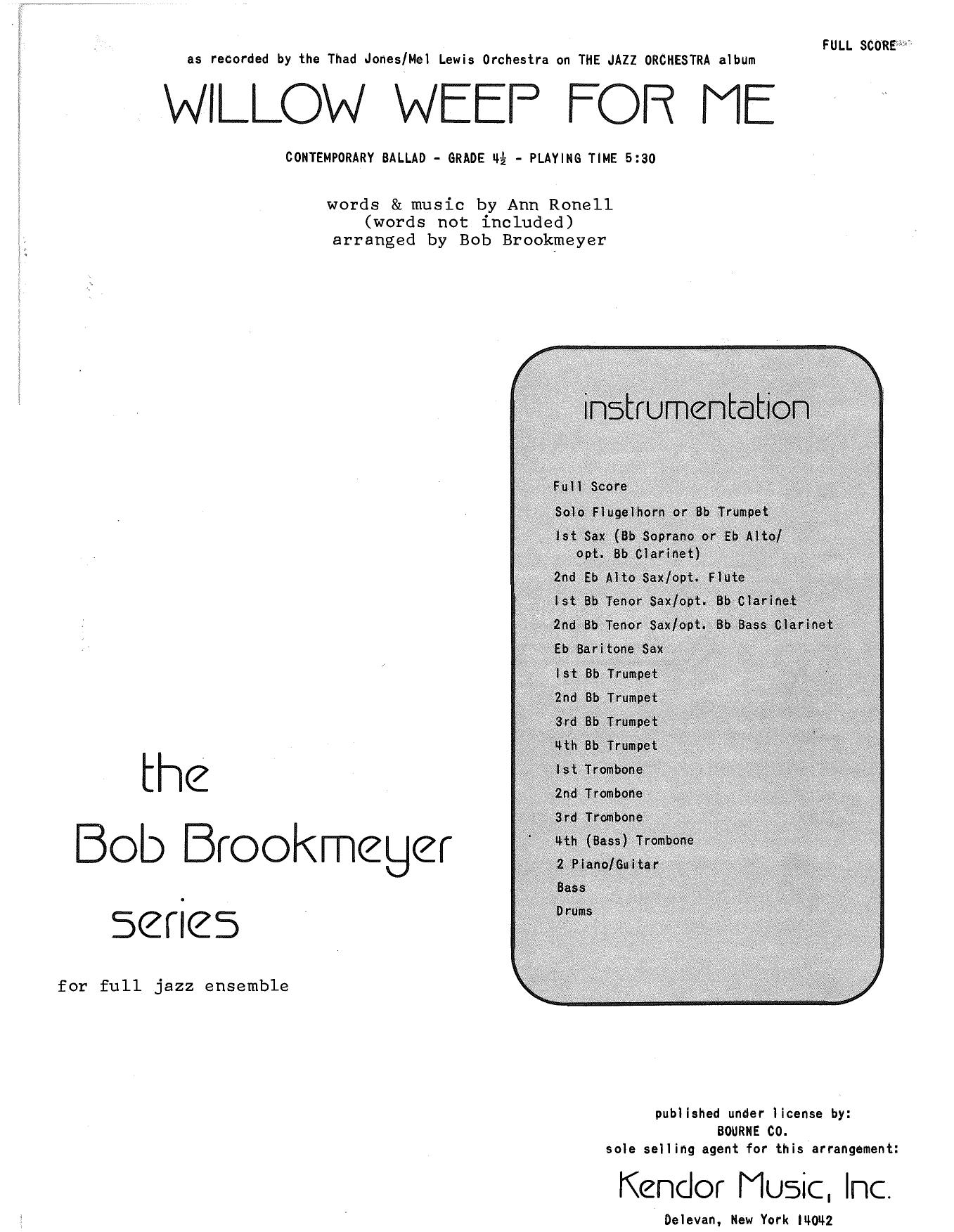
Willow Weep For Me (B.Brookmeyer)
Composed by Ann Ronell
Arranged by Bob Brookmeyer
- Ensemble: Big Band
- Pages: 26
- Instruments (17): Solo Flugelhorn or Bb Trumpet, 1st Sax (Bb Soprano, Eb Alto, or Bb Clarinet), 2nd Eb Alto Sax (opt. Flute), 1st Bb Tenor Sax (opt. Bb Clarinet), 2nd Bb Tenor Sax (opt. Bb Bass Clarinet), Eb Baritone Sax, 1st Bb Trumpet, 2nd Bb Trumpet, 3rd Bb Trumpet, 4th Bb Trumpet, 1st Trombone, 2nd Trombone, 3rd Trombone, 4th Trombone (Bass), Piano-Guitar, Bass, Drums
- Difficulty: medium
- Content: Individual Parts
- Format: PDF Download (Instant)
- Price: $24.99
Ann Ronell’s immortal 1932 torch song “Willow Weep for Me” occupies a revered place in the Great American Songbook, having transitioned from a popular vocal vehicle into an essential instrumental jazz standard. While countless artists have interpreted its haunting, minor-mode melody, Bob Brookmeyer’s legendary big band arrangement elevates the tune into a masterclass of modern jazz composition. Originally crafted for elite professional ensembles, this chart showcases Brookmeyer’s genius for transforming familiar material into a rich harmonic landscape characterized by lush, dense voicings, sophisticated counterpoint, and an introspective, blues-drenched atmosphere. Opening with a moody, reflective tempo feel that balances a relaxed swing pulse with rubato-esque expressive freedoms, the arrangement explores a rich palette of extended and altered dominant harmonies. Brookmeyer eschews predictable big band clichés, opting instead for impressionistic chord clusters and innovative section writing that blurs the lines between traditional brass and reed boundaries. The mood shifts masterfully from haunting vulnerability to smoldering intensity, evoking a late-night, noir-esque cinematic energy. The writing demands an ensemble with exceptional listening skills, as the internal voice-leading within the saxophones and brass requires precise intonation and a unified concept of balance to let the complex harmonies bloom fully. The instrumental architecture highlights prominent solo voices, prominently featuring a soaring flugelhorn and trumpet that carry the emotional core of the piece, alongside expressive contributions from the soprano saxophone and clarinet within the reed doubling matrix. Brookmeyer’s scoring utilizes specialized textures—such as high-register brass pads set against low, rolling reed figures—to create a deep spatial depth across the 23-instrument setup. Rather than relying on a conventional, high-octane shout chorus for cheap excitement, the climax of the arrangement builds through organic textural density and mounting dynamic tension, making the eventual release both powerful and profoundly satisfying for both performers and listeners. Advanced college ensembles, elite community jazz orchestras, and professional big bands will find this 26-page chart an extraordinary vehicle for artistic growth. The technical challenges lie less in sheer velocity and much more in stylistic maturity, breath control, blend, and the ability to interpret advanced modernist voicings with warmth and conviction. Complete with the definitive conductor score, this arrangement offers a rare window into the compositional mind of one of jazz’s most fiercely original arrangers, rewarding deep rehearsal with a sophisticated, emotionally gripping performance experience. Conductors approaching this Bob Brookmeyer masterwork must prioritize sectional balance and stylistic cohesion above all else. The tempo should remain fluid yet anchored, avoiding a rigid metronomic feel; let the underlying swing pulse breathe organically behind the soloists. Key technical challenges center around the intricate counterpoint and dense, modern harmonies, which require meticulous tuning of minor seconds and extended intervals. Players should approach their parts with a warm, dark tone—utilizing vibrato sparingly and purposefully—to match the nocturnal mood of the piece. Ensure that the featured flugelhorn and trumpet soloists have ample room to project without forcing, as the background voicings, while lush, are carefully voiced to sit beneath the lead voices. Rehearsals should begin by isolating individual choir sections (reeds, trumpets, trombones) to lock in the internal intonation of Brookmeyer's complex chord clusters before combining them into full ensemble passes. Pay close attention to dynamic markings; the emotional impact of this chart relies entirely on seamless transitions from whispered subtones to commanding, resonant crescendos. Q: What instruments and parts are included in this big band arrangement? A: This arrangement is scored for a 23-instrument ensemble, featuring dual soloist parts for Flugelhorn and Trumpet, Soprano Saxophone 1, Alto Saxophone 1, Clarinet, standard big band brass and rhythm sections, and a comprehensive conductor score spanning 26 pages. Q: What is the difficulty level of this Bob Brookmeyer chart? A: This piece is tailored for advanced college, conservatory, and professional big bands due to its sophisticated harmonic language, intricate voice-leading, and high demands on intonation and stylistic maturity. Q: What is the historical and stylistic context of this arrangement? A: It reinterprets Ann Ronell’s classic 1932 jazz standard through Bob Brookmeyer’s modern, impressionistic arranging style, bridging traditional swing aesthetics with advanced post-bop harmonic concepts. Q: What makes this specific arrangement unique compared to standard big band charts? A: Brookmeyer avoids predictable big band clichés by utilizing dense, innovative chord clusters, rich reed-and-brass blending, and an organic architectural buildup rather than a traditional high-octane shout chorus. Q: What is the performance tempo and duration feel of the piece? A: The arrangement is set at a relaxed, moody medium-slow tempo with a flexible swing feel, emphasizing expressive depth and atmospheric tension over fast technical display.
Questions and answers
- What is included in the Willow Weep For Me (B.Brookmeyer) PDF?
- The verified current file contains a conductor score and individual parts across 26 pages.
- How many instruments or parts are listed for Willow Weep For Me (B.Brookmeyer)?
- The verified instrumentation list contains 17 entries for this Big Band arrangement.
- Who is credited for Willow Weep For Me (B.Brookmeyer)?
- Composer: Ann Ronell. Arranger: Bob Brookmeyer.
- What difficulty is listed for Willow Weep For Me (B.Brookmeyer)?
- The verified difficulty level is medium.
- Can I preview Willow Weep For Me (B.Brookmeyer) before buying?
- Yes. The product page provides a preview generated from the current PDF file.
- How is Willow Weep For Me (B.Brookmeyer) delivered?
- After successful payment, the digital PDF is made available for download. The displayed price is $24.99.
Musicians Also Search For
Willow Weep For Me Bob Brookmeyer PDF • Willow Weep For Me Bob Brookmeyer sheet music • Willow Weep For Me arranged by Bob Brookmeyer • Bob Brookmeyer big band charts • Bob Brookmeyer jazz arrangements PDF • Willow Weep For Me Ann Ronell sheet music • Willow Weep For Me Ann Ronell big band arrangements • Ann Ronell big band charts • Willow Weep For Me big band arrangements • Willow Weep For Me big band PDF download • Willow Weep For Me jazz sheet music • big band sheet music download • Willow Weep For Me conductor score PDF • Willow Weep For Me individual parts download • Willow Weep For Me sheet music PDF • buy Willow Weep For Me sheet music • download Willow Weep For Me PDF • Willow Weep For Me jazz charts • best Bob Brookmeyer big band arrangements • Ann Ronell arranged by Bob Brookmeyer • Willow Weep For Me printable sheet music • big band repertoire PDF