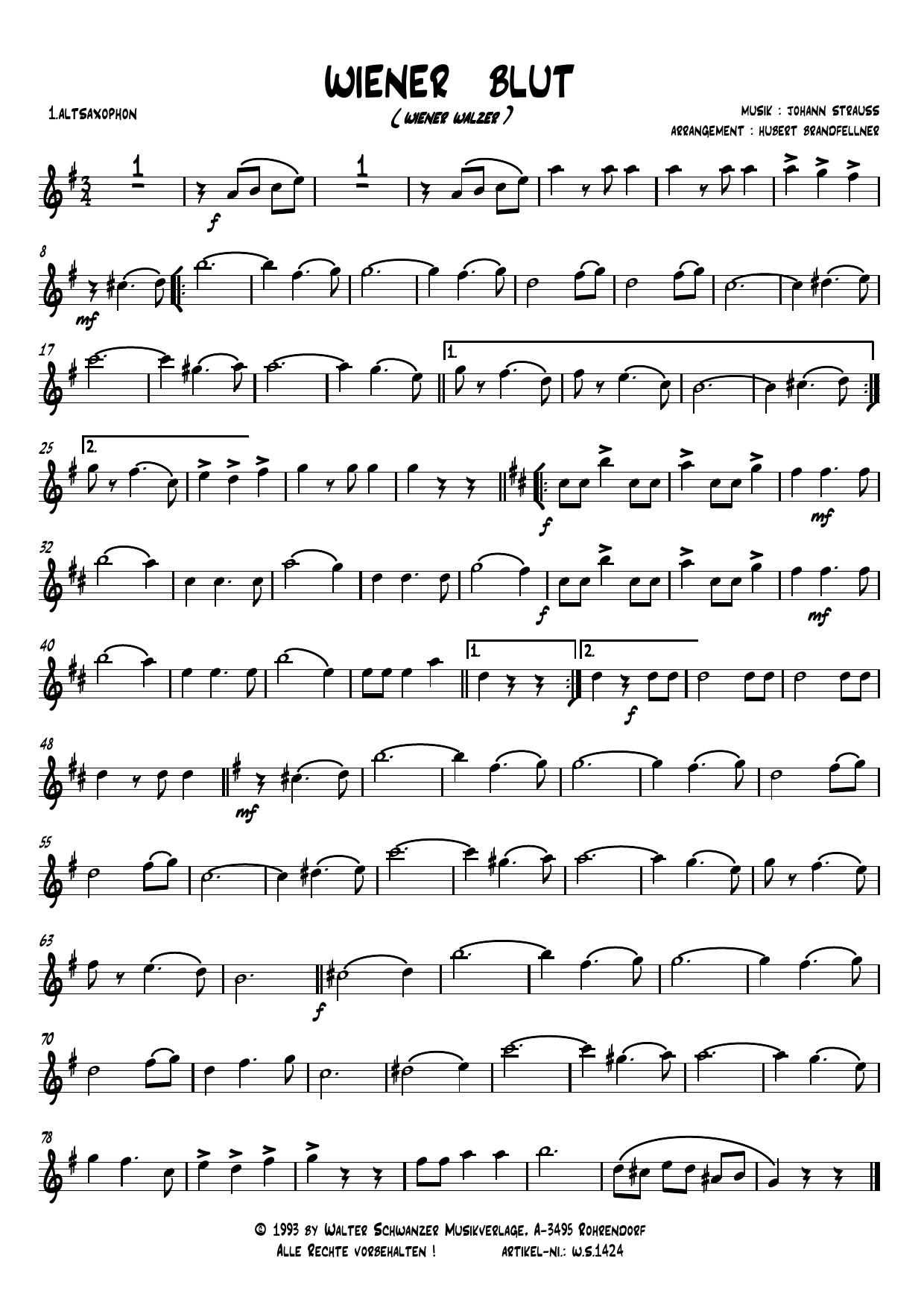
Wiener Blut (H.Brandfellner)
Composed by Johann Strauss II
Arranged by H.Brandfellner
- Ensemble: Big Band
- Style: Jazz Standard
- Pages: 17
- Instruments (16): 1. Alto Saxophone, 2. Alto Saxophone, 1. Tenor Saxophone, 2. Tenor Saxophone, Baritone Saxophone, 1. Trumpet, 2. Trumpet, 3. Trumpet, 4. Trumpet, 1. Trombone, 2. Trombone, 3. Trombone, Piano / Organ, Guitar, Bass, Drums
- Difficulty: easy
- Content: Individual Parts
- Format: PDF Download (Instant)
- Price: $24.99
Johann Strauss II’s immortal 1873 operetta waltz "Wiener Blut" undergoes a striking transatlantic metamorphosis in this ambitious big band interpretation. Originally conceived as a quintessential expression of Viennese high society and Habsburg-era ballroom culture, the thematic material is brilliantly re-harmonized through a sophisticated post-bop and swing lens. While Strauss’s melodies retain their irresistible, danceable charm, H.Brandfellner reimagines the traditional 3/4 European meter into dynamic alternating feels, masterfully bridging the gap between 19th-century salon music and mid-century modern jazz orchestration. This clever juxtaposition honors the infectious melodic genius of the Waltz King while satisfying the sophisticated harmonic palette expected by contemporary jazz audiences. Driving the arrangement is an effervescent rhythmic framework that alternates between sparkling, authentic Viennese lilt and swinging, hard-driving 4/4 big band grooves. The key centers shift fluidly to accommodate extended jazz extensions—ninths, elevenths, and altered dominants—giving the classic motifs a rich, contemporary coloration. The mood shifts effortlessly from playful, flirtatious banter in the woodwinds to thunderous, high-octane ensemble passages. Brandfellner exploits the full dynamic spectrum of the jazz orchestra, utilizing lush, Ellingtonian chord clusters in the saxophones contrasted against crisp, punchy brass stabs that evoke the bustling energy of modern metropolitan nightlife. Brandfellner’s arrangement shines brightest in its architectural pacing, distributing melodic responsibility democratically across the entire ensemble. Richly textured soli sections feature tightly intertwined writing for the saxophone section, while the brass corps steps forward with roaring counter-melodies that elevate the tension toward a massive, harmonically adventurous shout chorus. Featured solo space allows improvisers to stretch out over changes that respect the sophisticated voice-leading of the underlying Strauss motifs. Technical demands center around nimble fingerwork in the woodwinds during rapid-fire scalar runs and precise articulation matching between sections, making every rehearsal an invigorating masterclass in stylistic versatility. Advanced high school ensembles with strong section players, collegiate jazz orchestras, and professional freelance big bands will find this chart an exceptional vehicle for concert programming. Because it requires a keen ear for shifting feels and a high degree of dynamic sensitivity, it serves as a brilliant showcase piece that immediately captivates listeners. The clever fusion of familiar classical architecture with modern big band swagger guarantees an unforgettable concert moment, rewarding both the performers on stage and the connoisseurs in the audience. Conductors should approach "Wiener Blut" with a dual focus on classical grace and aggressive jazz articulation. The primary technical challenge lies in the seamless transition between traditional triplet-based swing feels and straight-eighth European waltz grooves; rhythm section players must anchor these shifts with absolute authority. The drummer should utilize light, crisp ride-cymbal phrasing during the rubato and lighter thematic head statements, reserving heavy backbeats for the roaring full-ensemble sections. Brass players should master a wide palette of articulations, utilizing controlled doits and warm, non-aggressive falls to mimic vocal inflections without sacrificing intonation. Rehearsal time is best spent isolating the intricate saxophone soli, ensuring that internal balance and blend are established before layering in the brass counterlines. Pay careful attention to dynamic markings; the contrast between whispering muted passages and blazing unmuted shout choruses defines the emotional trajectory of the entire performance. Q: What specific instruments and parts are included in this arrangement? A: The chart is scored for a standard 16-instrument big band instrumentation, featuring Alto Saxophone 1, Alto Saxophone 2, Tenor Saxophone 1, Tenor Saxophone 2, and Baritone Saxophone, alongside standard brass and rhythm sections. Q: What is the overall difficulty level of this chart? A: This arrangement is tailored for advanced high school, collegiate, and professional big bands due to its complex modulations, demanding saxophone technique, and required stylistic versatility. Q: How does this arrangement honor the historical context of the original composition? A: It takes Johann Strauss II’s 1873 Viennese waltz themes and brilliantly re-contextualizes them within a modern jazz framework, preserving the iconic European melodies while introducing sophisticated swing and post-bop harmony. Q: What makes H.Brandfellner’s treatment unique compared to standard big band charts? A: Brandfellner uniquely fuses classical waltz aesthetics with dynamic jazz grooves, incorporating intricate cross-rhythms, lush Ellingtonian chord voicings, and unexpected harmonic twists into the classic Strauss motifs. Q: What is the recommended performance tempo and duration for this piece? A: The arrangement features flexible tempo pacing that moves between an expressive, rubato-influenced rub/waltz feel and a brisk medium-swing tempo, resulting in an ideal concert performance length of approximately 4 to 5 minutes.
Questions and answers
- What is included in the Wiener Blut (H.Brandfellner) PDF?
- The verified current file contains individual parts across 17 pages.
- How many instruments or parts are listed for Wiener Blut (H.Brandfellner)?
- The verified instrumentation list contains 16 entries for this Big Band arrangement.
- Who is credited for Wiener Blut (H.Brandfellner)?
- Composer: Johann Strauss II. Arranger: H.Brandfellner.
- What difficulty is listed for Wiener Blut (H.Brandfellner)?
- The verified difficulty level is easy.
- What style is listed for Wiener Blut (H.Brandfellner)?
- The catalog lists the style as Jazz Standard.
- Can I preview Wiener Blut (H.Brandfellner) before buying?
- Yes. The product page provides a preview generated from the current PDF file.
- How is Wiener Blut (H.Brandfellner) delivered?
- After successful payment, the digital PDF is made available for download. The displayed price is $24.99.
Musicians Also Search For
Wiener Blut H.Brandfellner PDF • Wiener Blut H.Brandfellner sheet music • Wiener Blut arranged by H.Brandfellner • H.Brandfellner big band charts • H.Brandfellner jazz arrangements PDF • Wiener Blut Johann Strauss II sheet music • Wiener Blut Johann Strauss II big band arrangements • Johann Strauss II big band charts • Wiener Blut big band arrangements • Wiener Blut big band PDF download • Wiener Blut jazz sheet music • big band sheet music download • Wiener Blut individual parts download • Wiener Blut sheet music PDF • Wiener Blut Jazz Standard charts • Jazz Standard big band arrangements • buy Wiener Blut sheet music • download Wiener Blut PDF • Wiener Blut jazz charts • best H.Brandfellner big band arrangements • Johann Strauss II arranged by H.Brandfellner • Wiener Blut printable sheet music • big band repertoire PDF