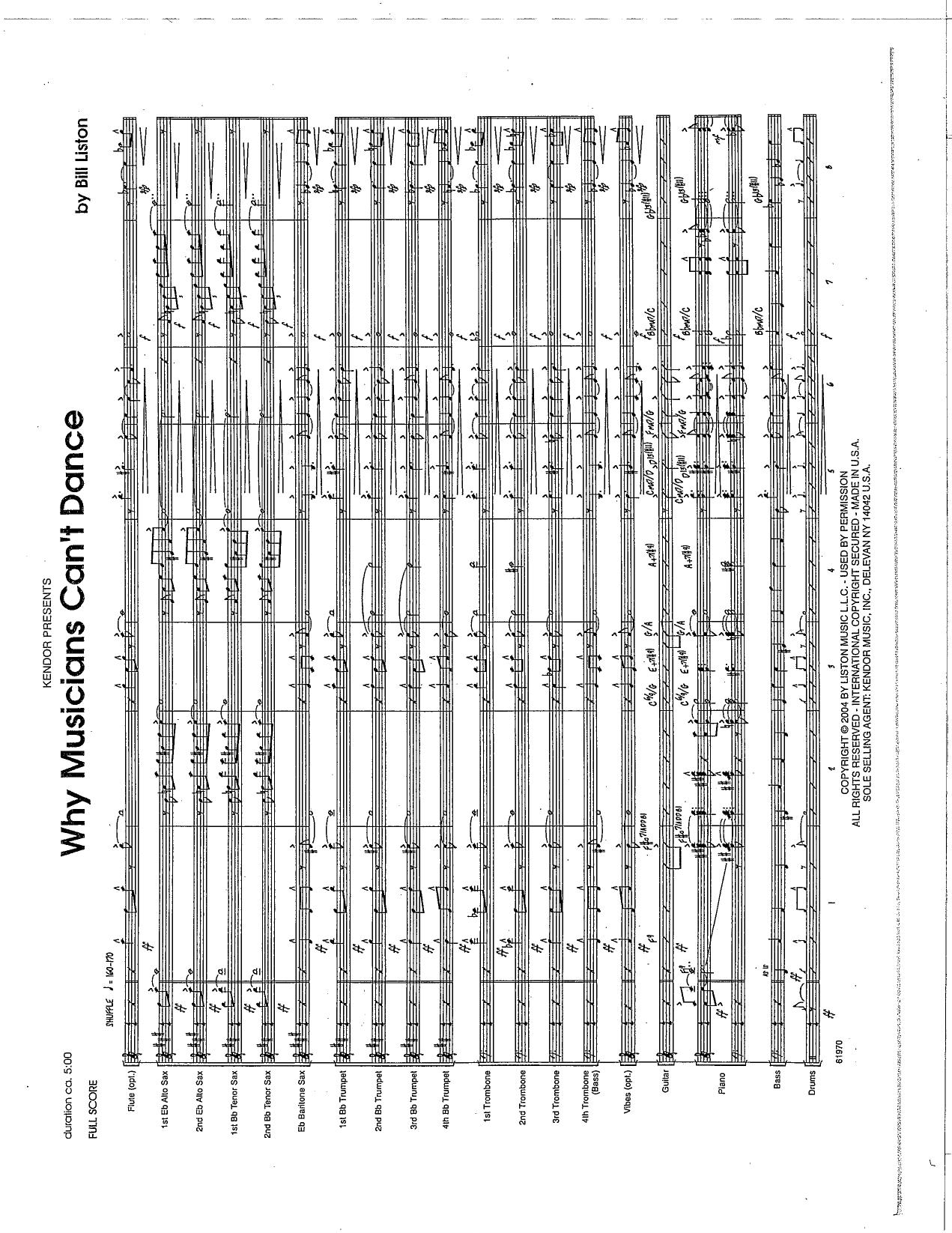
Why Musicians Can't Dance (B.Liston) sheet music preview

Why Musicians Can't Dance (B.Liston)

Composed by Bill Liston

Arranged by Bill Liston

  • Ensemble: Big Band
  • Pages: 93
  • Instruments (19): 1st Eb Alto Sax, 2nd Eb Alto Sax, 1st Bb Tenor Sax, 2nd Bb Tenor Sax, Eb Baritone Sax, 1st Bb Trumpet, 2nd Bb Trumpet, 3rd Bb Trumpet, 4th Bb Trumpet, 1st Trombone, 2nd Trombone, 3rd Trombone, 4th Trombone (Bass), Piano, Guitar, Bass, Drums, Vibes (opt.), Flute (opt.)
  • Difficulty: advanced
  • Content: Individual Parts
  • Format: PDF Download (Instant)
  • Price: $24.99

Bill Liston’s original composition "Why Musicians Can't Dance" stands as a brilliant entry into modern big band literature, capturing the sophisticated wit, intricate harmonic language, and infectious rhythmic vitality characteristic of contemporary contemporary jazz composition. Written by veteran arranger, orchestrator, and woodwind specialist Bill Liston—whose extensive credits span major motion picture soundtracks and collaborations with jazz royalty—this chart bridges the gap between classic swinging big band traditions and modern harmonic complexity. It reflects an era of progressive writing where clever metric phrasing and tongue-in-cheek conceptual themes challenge both performers and audiences to rethink the physical relationship between jazz music and movement. Musically, the chart drives forward with an energetic, straight-ahead-meets-contemporary medium-up swing feel set in a bright, harmonically rich key center. The mood is playfully cynical yet intensely driving, propelled by an assertive rhythm section groove that balances sophisticated chord extensions with an undeniable toe-tapping pulse. Liston utilizes lush, extended voicings for the saxophones alongside punchy, brass-heavy counterlines that evoke the spirit of classic Sammy Nestico or Bob Mintzer charts, but with a distinctively modern, cinematic flair. The melody bounces unpredictably between sections, often landing on syncopated downbeats that highlight the composition's wry, rhythmic joke about rhythm-challenged instrumentalists. Liston’s arranging approach shines brightest in the tightly woven sax soli and the explosive, high-energy shout chorus that builds systematically from a subdued, conversational dynamic. The woodwinds—anchored by a flute double and dual alto and tenor saxophones—glide through agile, bebop-infused lines, while the brass section utilizes crisp articulation, controlled falls, and dynamic shading to punctuate the ensemble hits. Solo opportunities are carved out for featured horns, allowing improvisers to stretch out over harmonically sophisticated changes that reward both traditional vocabulary and modern chromaticism. The interplay between the rhythm section and the horn tiers demands precise articulation, making every transition from whisper-quiet background figures to roaring ensemble peaks feel organic and thrilling. Advanced high school, collegiate, and professional jazz ensembles will find "Why Musicians Can't Dance" an exceptionally rewarding addition to their repertoire. The chart serves as an ideal festival showpiece or concert closer, testing an ensemble's internal clock, stylistic versatility, and dynamic control. Because the 93-page conductor score and 19-instrument parts lay out intricate lines across the entire big band texture, the chart requires mature section playing and a rhythm section capable of driving a sophisticated, modern swing vehicle with unwavering authority. Achieving success with "Why Musicians Can't Dance" requires meticulous attention to articulation and dynamic contrast, particularly during the tricky syncopated figures that populate the head. The conductor should ensure the tempo remains steady and forward-moving, guarding against any tendency to drag during the more harmonically dense transitional passages. Saxophones must blend tightly during the soli sections, keeping vibrato controlled and modern to match the contemporary aesthetic of the writing. Brass players should approach mutes and stylistic markings (such as short accents and controlled doits) with precision rather than excessive force, ensuring that the humor and punch of Liston's writing come through cleanly. Rehearsals should initially focus on sectional isolation of the rhythm changes and complex counterlines before bringing the full 19-piece ensemble together to balance the massive dynamic peaks of the shout chorus against the lighter, conversational comping behind the soloists. Q: What instruments and parts are included in this arrangement? A: The 93-page package includes a full conductor score and individual parts for a standard 19-instrument big band lineup, featuring Flute, Alto Saxophone 1, Alto Saxophone 2, Tenor Saxophone 1, Tenor Saxophone 2, and full brass and rhythm sections. Q: What is the difficulty level of this arrangement? A: This arrangement is graded as advanced, making it best suited for college, top-tier high school, community, and professional big bands that possess strong section reading skills and rhythmic independence. Q: What is the musical style and historical context of the piece? A: Composed by Bill Liston, the piece is a contemporary big band jazz composition that blends traditional swing drive with modern, cinematic harmonic voicings and a clever, witty programmatic concept. Q: What makes this Bill Liston arrangement unique? A: It features Liston's signature sophisticated woodwind doubling, intricate harmonic extensions, and a playful narrative structure that contrasts tight, bebop-inflected solis with massive, high-energy ensemble shout choruses. Q: What is the performance duration and tempo feel of the piece? A: The piece is written in a bright, driving medium-up swing feel with an energetic pulse designed to showcase an ensemble's precision, typically running around 4 to 5 minutes in performance length.

Questions and answers

What is included in the Why Musicians Can't Dance (B.Liston) PDF?
The verified current file contains a conductor score and individual parts across 93 pages.
How many instruments or parts are listed for Why Musicians Can't Dance (B.Liston)?
The verified instrumentation list contains 19 entries for this Big Band arrangement.
Who is credited for Why Musicians Can't Dance (B.Liston)?
Composer: Bill Liston. Arranger: Bill Liston.
What difficulty is listed for Why Musicians Can't Dance (B.Liston)?
The verified difficulty level is advanced.
Can I preview Why Musicians Can't Dance (B.Liston) before buying?
Yes. The product page provides a preview generated from the current PDF file.
How is Why Musicians Can't Dance (B.Liston) delivered?
After successful payment, the digital PDF is made available for download. The displayed price is $24.99.

Musicians Also Search For

Why Musicians Can't Dance Bill Liston PDFWhy Musicians Can't Dance Bill Liston sheet musicWhy Musicians Can't Dance arranged by Bill ListonBill Liston big band chartsBill Liston jazz arrangements PDFWhy Musicians Can't Dance Bill Liston big band arrangementsWhy Musicians Can't Dance big band arrangementsWhy Musicians Can't Dance big band PDF downloadWhy Musicians Can't Dance jazz sheet musicbig band sheet music downloadWhy Musicians Can't Dance conductor score PDFWhy Musicians Can't Dance individual parts downloadWhy Musicians Can't Dance sheet music PDFbuy Why Musicians Can't Dance sheet musicdownload Why Musicians Can't Dance PDFWhy Musicians Can't Dance jazz chartsbest Bill Liston big band arrangementsWhy Musicians Can't Dance printable sheet musicbig band repertoire PDF

All arrangements by Bill Liston All Bill Liston sheet music