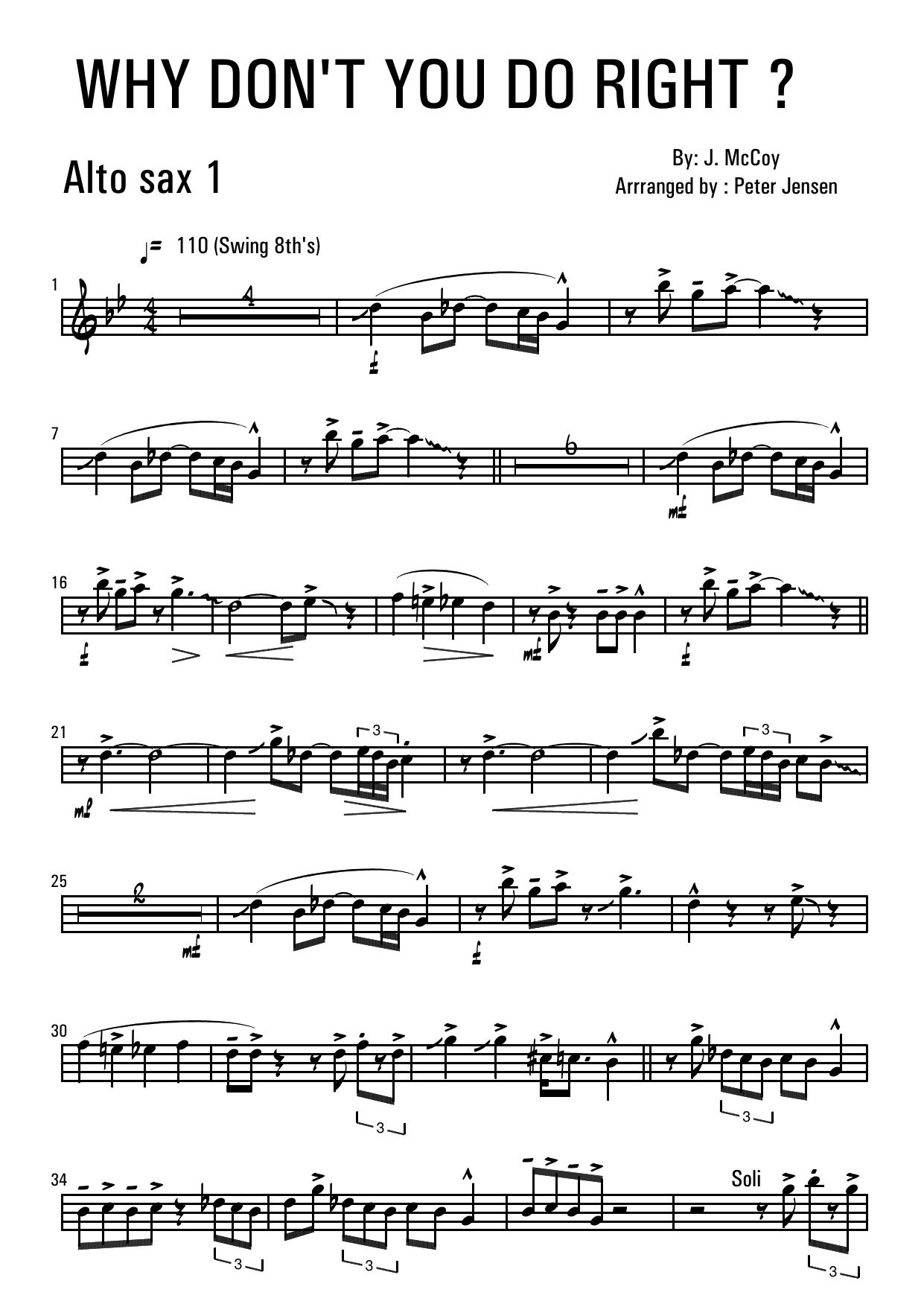
Why Don't You Do Right (instrumental) sheet music preview

Why Don't You Do Right (instrumental)

Composed by Kansas Joe McCoy

Arranged by instrumental

  • Ensemble: Big Band
  • Style: Jazz Standard
  • Pages: 39
  • Instruments (16): Alto sax 1, Alto sax 2, Tenor sax 1, Tenor sax 2, Baritone sax, Trumpet 1, Trumpet 2, Trumpet 3, Trumpet 4, Trombone 1, Trombone 2, Trombone 3, Trombone 4, Piano, Bass, Drums
  • Difficulty: medium
  • Content: Individual Parts
  • Format: PDF Download (Instant)
  • Price: $24.99

Kansas Joe McCoy originally penned "Why Don't You Do Right?" in 1936, though the tune achieved immortal status when sultry blues singer Lil Green recorded it in 1941, followed swiftly by Peggy Lee’s definitive 1942 blockbuster recording with the Benny Goodman Orchestra. Emanating from the intersection of classic blues and swing-era jazz, this iconic standard captures the smoky, seductive atmosphere of a late-night speakeasy or club. Its minor-key blues progression and cynical, sharp-witted lyricism have made it a timeless vehicle for jazz ensembles looking to inject dramatic tension and heavy groove into their repertoire. Steeped in a sultry, mid-tempo minor swing feel (around 116 BPM), this big band instrumental setting drips with urban sophistication and understated swagger. The chart opens with a moody, vamp-driven introduction that immediately establishes a tense, nocturnal ambiance before unfolding into rich, cascading horn voicings. The overall mood shifts seamlessly between cool, slithering ensemble backgrounds and blistering, high-energy counterpoint. Dense, extended chord voicings in the brass evoke classic 1940s Kansas City and Goodman-era arranging styles, utilizing muted trumpets and warm sax solis to create a thick, cinematic texture that feels both vintage and strikingly fresh. Rather than relying on a vocal soloist, this instrumental adaptation brilliantly distributes the iconic melody and subsequent variations across the entire ensemble. The reed section carries the primary thematic weight early on, utilizing tight, interlocking harmonies reminiscent of Johnny Mercer or Benny Carter charts. Featured solo space is provided over standard minor blues changes, allowing a standout tenor saxophone or trumpet player to stretch out. Technical challenges center primarily on stylistic execution—specifically, maintaining a relaxed yet driving eighth-note subdivision, precise section articulation on syncopated figures, and subtle dynamic control during the dynamic swelling of the shout chorus. The reward lies in the chart's incredible pacing, which builds a slow burn of dramatic tension before resolving into a satisfying, full-ensemble climax. Advanced high school, collegiate, and professional jazz orchestras will find this arrangement an ideal centerpiece for concert programs or festival sets. Because it relies less on sheer velocity and more on deep stylistic integrity, rhythmic precision, and ensemble interplay, it serves as an exceptional pedagogical tool for developing a authentic swing groove. Directors will appreciate how naturally the chart balances feature moments for soloists with robust, texturally diverse writing for all sixteen standard big band voices. Achieving an authentic performance of "Why Don't You Do Right?" requires strict adherence to a relaxed, behind-the-beat medium swing feel. The primary technical hurdle rests in the rhythm section: the bass player must lay down a relentless, pulsing walking quarter-note line that anchors the minor harmony, while the drummer keeps a crisp, understated ride cymbal pattern with a gentle hi-hat choke on beats two and four. For the horn sections, precision in articulation is paramount. Ensure that all eighth-note lines are swung naturally without sounding overly dotted or stiff. Brass players should make effective use of cup and bucket mutes where indicated to achieve that authentic 1940s breathy texture, executing subtle falls and bends with restraint rather than caricature. Rehearsals should initially isolate the dynamic swells in the transition passages; the band must balance the descending saxophone lines against sustained, moody brass pads without overblowing. Pay close attention to the dynamic contrast leading into the climax, ensuring the ensemble maintains a transparent texture even at peak volume. Q: What instruments and parts are included in this big band arrangement? A: This chart is scored for a standard 16-piece big band instrumentation, comprising 2 alto saxophones, 2 tenor saxophones, 1 baritone saxophone, 4 trumpets, 4 trombones, guitar, piano, bass, and drums, along with a comprehensive conductor score. Q: What is the difficulty level of this arrangement? A: This arrangement is rated as medium-advanced (Grade 4), making it well-suited for proficient high school, collegiate, and professional community big bands that have a strong grasp of minor swing styles. Q: What is the historical style and background of this piece? A: Originally written by Kansas Joe McCoy and made legendary by Lil Green and Peggy Lee, this piece is a classic 1940s minor blues standard that bridges the gap between classic blues and swing-era jazz. Q: What makes this specific instrumental arrangement unique? A: Unlike versions that rely on a vocal soloist, this arrangement cleverly reimagines the iconic vocal lines as rich ensemble solis and dynamic counter-melodies, offering featured solo space while keeping the full big band actively engaged throughout. Q: What is the performance duration and recommended tempo? A: The arrangement runs approximately 3.5 to 4 minutes in length and is best performed at a sultry, driving medium swing tempo of around 116 beats per minute.

Questions and answers

What is included in the Why Don't You Do Right (instrumental) PDF?
The verified current file contains a conductor score and individual parts across 39 pages.
How many instruments or parts are listed for Why Don't You Do Right (instrumental)?
The verified instrumentation list contains 16 entries for this Big Band arrangement.
Who is credited for Why Don't You Do Right (instrumental)?
Composer: Kansas Joe McCoy. Arranger: instrumental.
What difficulty is listed for Why Don't You Do Right (instrumental)?
The verified difficulty level is medium.
What style is listed for Why Don't You Do Right (instrumental)?
The catalog lists the style as Jazz Standard.
Can I preview Why Don't You Do Right (instrumental) before buying?
Yes. The product page provides a preview generated from the current PDF file.
How is Why Don't You Do Right (instrumental) delivered?
After successful payment, the digital PDF is made available for download. The displayed price is $24.99.

Musicians Also Search For

Why Don't You Do Right instrumental PDFWhy Don't You Do Right instrumental sheet musicWhy Don't You Do Right arranged by instrumentalinstrumental big band chartsinstrumental jazz arrangements PDFWhy Don't You Do Right Kansas Joe McCoy sheet musicWhy Don't You Do Right Kansas Joe McCoy big band arrangementsKansas Joe McCoy big band chartsWhy Don't You Do Right big band arrangementsWhy Don't You Do Right big band PDF downloadWhy Don't You Do Right jazz sheet musicbig band sheet music downloadWhy Don't You Do Right conductor score PDFWhy Don't You Do Right individual parts downloadWhy Don't You Do Right sheet music PDFWhy Don't You Do Right Jazz Standard chartsJazz Standard big band arrangementsbuy Why Don't You Do Right sheet musicdownload Why Don't You Do Right PDFWhy Don't You Do Right jazz chartsbest instrumental big band arrangementsKansas Joe McCoy arranged by instrumentalWhy Don't You Do Right printable sheet musicbig band repertoire PDF

All arrangements by instrumental All Kansas Joe McCoy sheet music