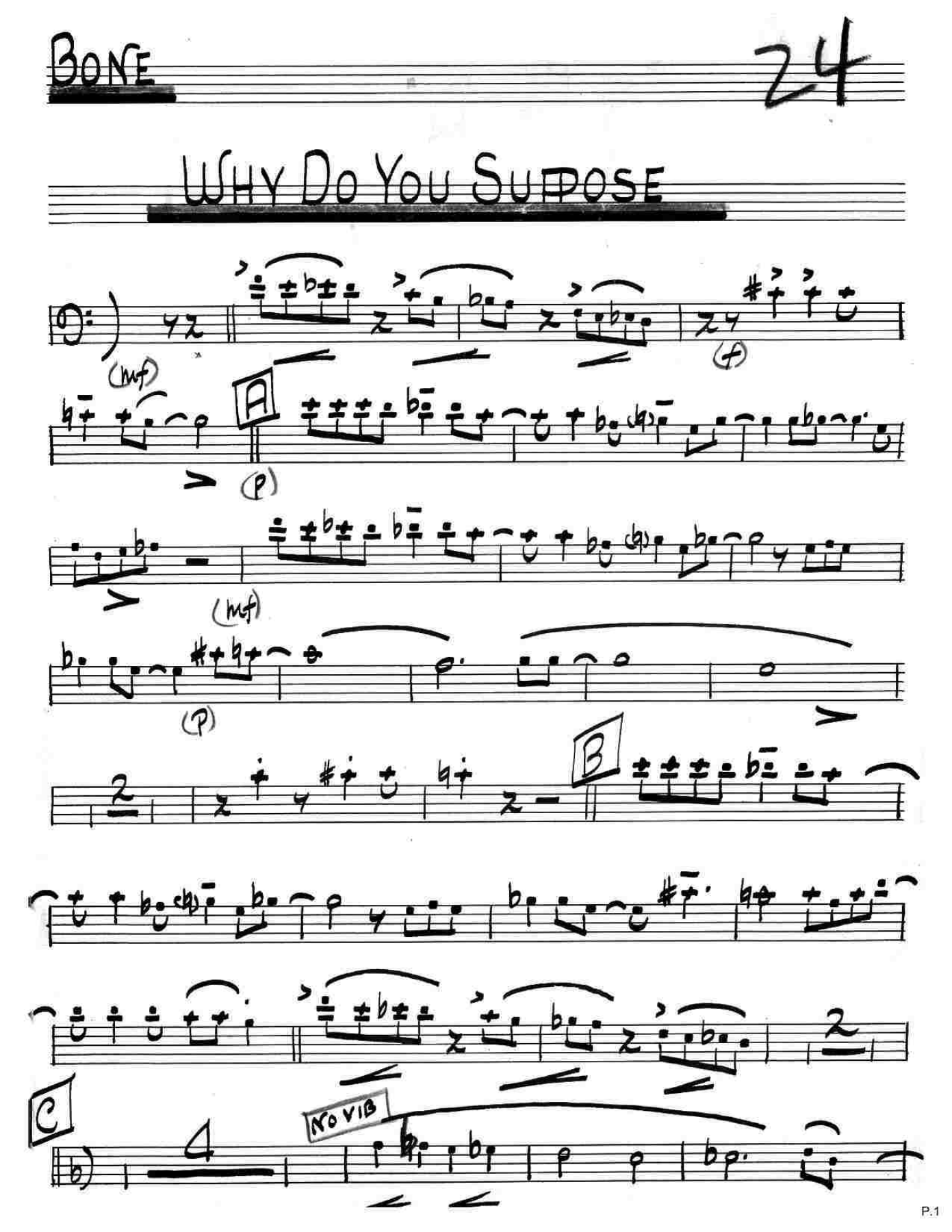
Why Do You Suppose (M.Paich) sheet music preview

Why Do You Suppose (M.Paich)

Composed by Marty Paich

Arranged by M. Paich - Dave Pell Octet - Ts,Bs,Trp,Trb+Rhythm

  • Ensemble: Small Ensemble
  • Style: Jazz Standard
  • Pages: 23
  • Instruments (8): Trombone, Trumpet, Baritone Saxophone, Tenor Saxophone, Piano, Guitar, Drums, Bass
  • Difficulty: easy
  • Content: Individual Parts
  • Format: PDF Download (Instant)
  • Price: $12.99

"Why Do You Suppose" emerges from the vibrant post-bop era, a sophisticated jazz standard whose origins are deeply intertwined with the West Coast jazz scene of the 1950s. While not as widely known as some of its contemporaries, its enduring appeal lies in its elegant harmonic structure and lyrical melodic lines. Composed by the legendary Marty Paich, a master of intricate yet accessible arrangements, this piece embodies the cool, cerebral aesthetic that defined much of the era. Paich's compositional style often featured sophisticated voicings and a refined sense of swing, making his contributions significant to the evolution of small group jazz. The piece itself is a testament to the era's focus on melodic invention and harmonic richness, offering a blend of introspection and understated swing that has captivated musicians and audiences for decades. This particular arrangement, crafted by Marty Paich for the Dave Pell Octet, presents "Why Do You Suppose" as a medium swing exploration in a bright, inviting key, typically C or F major, allowing for a comfortable yet engaging performance. The mood is one of sophisticated charm and subtle energy, evoking the cool, laid-back atmosphere characteristic of West Coast jazz. Paich's genius lies in his ability to create a full, rich sound from a relatively small ensemble, utilizing the unique timbres of the tenor saxophone, baritone saxophone, trumpet, and trombone, alongside a classic rhythm section. The arrangement maintains a consistent, flowing energy, driven by a buoyant swing feel in 4/4 time, inviting both introspection and rhythmic engagement from the performers and listeners alike. Paich's distinctive arranging approach is immediately evident in the intricate voicings and counterpoint that define this octet setting. Expect tightly knit soli sections where the horns weave complex harmonic textures, showcasing Paich’s signature blend of clarity and sophistication. The melody is typically introduced by a lead horn, often the trumpet or tenor saxophone, before being passed through various sections of the ensemble, creating dynamic interplay. While specific written solos are not always present, ample space is provided for improvised solos over the rich harmonic progression, allowing individual musicians to shine. The technical challenges lie in achieving precise articulation, maintaining a cohesive blend within the soli passages, and navigating the sometimes-dense harmonic changes during improvisation. The rewarding aspect is the sheer beauty of the ensemble sound and the opportunity to perform a truly classic example of West Coast arranging. This arrangement is ideally suited for college-level jazz ensembles, advanced community bands, or professional small groups seeking a challenging yet deeply rewarding piece. The demands on individual players, particularly in terms of blend, intonation, and harmonic understanding, make it an excellent vehicle for developing sophisticated ensemble playing. High school bands with exceptionally strong sections and a dedicated focus on stylistic authenticity could also tackle this, particularly under experienced direction. Its compact scoring makes it perfect for groups looking for a full sound without the resources of a full big band, offering a perfect blend of historical significance, musical depth, and performance satisfaction. Conductors should emphasize a relaxed, yet precise medium swing feel, ensuring the rhythm section provides a buoyant foundation without rushing. Articulation is key; encourage light, detached phrasing in the horn soli sections to maintain clarity and avoid a heavy sound. The intricate voicings require meticulous attention to intonation, particularly between the saxophones and brass. Rehearsal time should be dedicated to balancing the horn lines in the soli passages, ensuring each voice is heard but blends seamlessly into the overall texture. There are no special techniques like mutes or falls explicitly notated, allowing the focus to remain on clean execution and stylistic interpretation. Soloists should be encouraged to embrace the cool jazz aesthetic, favoring melodic invention and harmonic sophistication over overt technical fireworks. Pay close attention to dynamics, using subtle shifts to highlight melodic contours and harmonic changes. Q: What instruments and parts are included in this arrangement? A: This arrangement is scored for a small ensemble, specifically a jazz octet, featuring Tenor Saxophone, Baritone Saxophone, Trumpet, Trombone, Piano, Bass, and Drums. Q: What is the difficulty level of "Why Do You Suppose (M.Paich)" for a performing ensemble? A: This arrangement is considered advanced intermediate to advanced, suitable for college-level jazz ensembles, advanced community bands, or professional small groups due to its intricate voicings, harmonic sophistication, and demands on blend and intonation. Q: What is the musical style and historical context of this arrangement? A: This arrangement embodies the sophisticated West Coast jazz style of the 1950s, characterized by its cool, cerebral aesthetic, intricate harmonies, and elegant melodic lines, composed and arranged by the influential Marty Paich. Q: What makes this specific arrangement by M. Paich for the Dave Pell Octet unique? A: Its uniqueness lies in Paich's masterful ability to create a full, rich sound from a small octet, utilizing sophisticated voicings, intricate counterpoint, and a refined sense of medium swing, showcasing his signature arranging style. Q: What is the typical performance duration or tempo for this piece? A: "Why Do You Suppose" is typically performed at a medium swing tempo, allowing for a comfortable and expressive performance that usually lasts between 4 to 6 minutes, depending on the length of improvised solos.

Questions and answers

What is included in the Why Do You Suppose (M.Paich) PDF?
The verified current file contains individual parts across 23 pages.
How many instruments or parts are listed for Why Do You Suppose (M.Paich)?
The verified instrumentation list contains 8 entries for this Small Ensemble arrangement.
Who is credited for Why Do You Suppose (M.Paich)?
Composer: Marty Paich. Arranger: M. Paich - Dave Pell Octet - Ts,Bs,Trp,Trb+Rhythm.
What difficulty is listed for Why Do You Suppose (M.Paich)?
The verified difficulty level is easy.
What style is listed for Why Do You Suppose (M.Paich)?
The catalog lists the style as Jazz Standard.
Can I preview Why Do You Suppose (M.Paich) before buying?
Yes. The product page provides a preview generated from the current PDF file.
How is Why Do You Suppose (M.Paich) delivered?
After successful payment, the digital PDF is made available for download. The displayed price is $12.99.

Musicians Also Search For

Why Do You Suppose M. Paich - Dave Pell Octet - Ts,Bs,Trp,Trb+Rhythm PDFWhy Do You Suppose M. Paich - Dave Pell Octet - Ts,Bs,Trp,Trb+Rhythm sheet musicWhy Do You Suppose arranged by M. Paich - Dave Pell Octet - Ts,Bs,Trp,Trb+RhythmM. Paich - Dave Pell Octet - Ts,Bs,Trp,Trb+Rhythm small ensemble chartsM. Paich - Dave Pell Octet - Ts,Bs,Trp,Trb+Rhythm jazz arrangements PDFWhy Do You Suppose Marty Paich sheet musicWhy Do You Suppose Marty Paich small ensemble arrangementsMarty Paich small ensemble chartsWhy Do You Suppose small ensemble arrangementsWhy Do You Suppose small ensemble PDF downloadWhy Do You Suppose jazz sheet musicsmall ensemble sheet music downloadWhy Do You Suppose individual parts downloadWhy Do You Suppose sheet music PDFWhy Do You Suppose Jazz Standard chartsJazz Standard small ensemble arrangementsbuy Why Do You Suppose sheet musicdownload Why Do You Suppose PDFWhy Do You Suppose jazz chartsbest M. Paich - Dave Pell Octet - Ts,Bs,Trp,Trb+Rhythm small ensemble arrangementsMarty Paich arranged by M. Paich - Dave Pell Octet - Ts,Bs,Trp,Trb+RhythmWhy Do You Suppose printable sheet musicsmall ensemble repertoire PDF

All arrangements by M. Paich - Dave Pell Octet - Ts,Bs,Trp,Trb+Rhythm All Marty Paich sheet music